
First Narrative Coherence Benchmark Objectively Scores 150 B2B Technology Company Stories
Source: PR Newswire
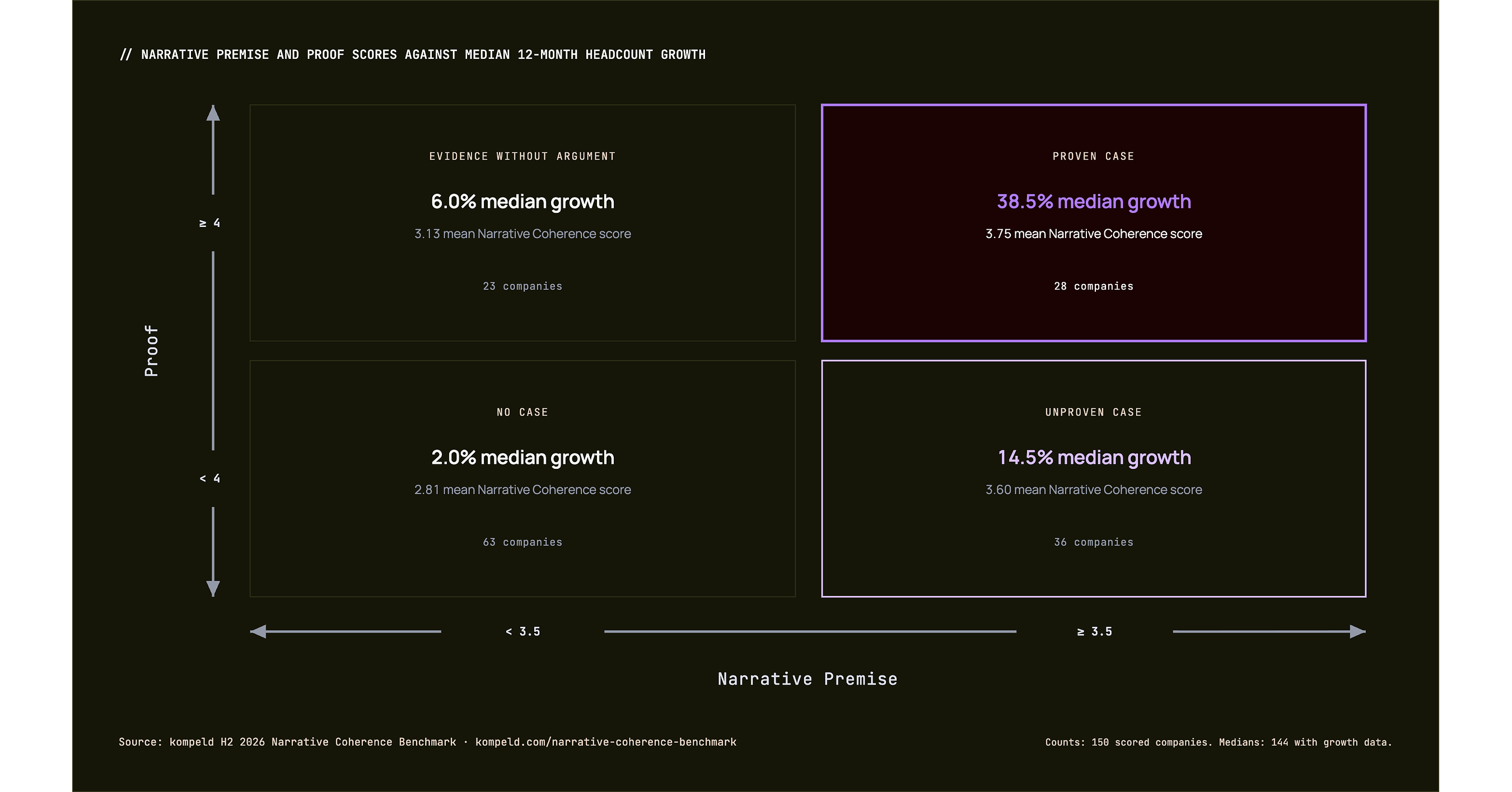
Kompeld's H2 2026 Narrative Coherence Benchmark found that B2B technology companies scoring 4.0 out of 5 on narrative coherence posted median 12-month headcount growth of 26%, versus -1% for companies scoring 2.5. Companies with both a strong buyer case and supporting proof grew 38.5% at the median, compared with 14.5% for strong but unproven cases and 6% for strong proof behind weak cases. The study of 150 companies also found that 57% made a weak case for why buyers should care, highlighting broad go-to-market positioning gaps.
Analysis
This is not a direct earnings catalyst for FORR or IT. The relevant implication is modestly supportive of their advisory franchises: procurement friction and AI-mediated vendor evaluation increase the value of research, messaging validation, and sales-enablement consulting, but any revenue benefit is diffuse and unlikely to move estimates over the next 1-3 quarters. Gartner’s larger enterprise contract base and recurring-revenue model make it the cleaner, albeit still low-beta, beneficiary versus FORR.
The claimed relationship between narrative quality and growth is not investable as presented because headcount growth is a lagging and noisy revenue proxy, while causality likely runs both ways: companies with product-market fit can afford stronger marketing and proof points. The useful second-order signal is that weaker B2B software vendors may see longer sales cycles and higher CAC as buying committees use AI tools to compare claims, pressuring rule-of-40 laggards before it affects category leaders.
Consensus may overstate AI’s benefit to generic B2B SaaS marketing. AI lowers content-production cost, but it also commoditizes feature descriptions and makes independently verifiable ROI, integration depth, security posture, and customer references more important. Over 6-18 months, this favors scaled platforms with measurable customer outcomes—CRM, cybersecurity, data infrastructure—over smaller application vendors relying on differentiated positioning without evidence.
AllMind Terminal
AI-powered research, real-time alerts, and portfolio analytics for institutional investors.
Request TrialMarket Sentiment
Overall Sentiment
mildly positive
Sentiment Score
0.28
Key Decisions for Investors
- No standalone trade in FORR or IT on this release; maintain event-driven alerts for subscription-booking commentary, consulting utilization, and renewal rates at the next earnings cycle rather than extrapolating from a vendor-sponsored benchmark.
- For a 6-12 month quality screen, favor long CRM or NOW versus a basket of high-sales-and-marketing, sub-rule-of-40 SaaS names: require evidence of net retention stabilization and improving CAC payback before entry. The thesis is falsified if smaller vendors show sustained sales-cycle compression without incremental discounting.
- Monitor IT for a potential tactical long only if post-earnings contract-value growth and operating-margin guidance inflect upward; a research/advisory demand recovery would be incremental upside, but the position should be avoided if retention deteriorates or enterprise IT-spending guidance weakens.
- Use upcoming SaaS earnings to identify short candidates where management emphasizes AI-generated marketing reach but provides no quantified pipeline conversion, win-rate, or customer ROI data; the likely 1-3 quarter risk is rising S&M spend with insufficient bookings conversion.
More News
- Japan’s corporate leaders sound alarm over weak yen — even dollar-earners are voicing concerns
- 'Hostile act': Trump threatens EU with tariffs over Canada associate-membership proposal
- Fed hikes again - an AI-Picked insurer is still cashing in
- Berkshire May Boost Japan Trading House Holdings, Itochu Says
- US official says upcoming spectrum auctions could generate more than $100 billion
- 'Science fiction': Transport companies — the backbone of economy — are sounding alarm on fuel prices