
Salt Security Extends Agentic Security Platform with Autonomous Defense
Source: PR Newswire
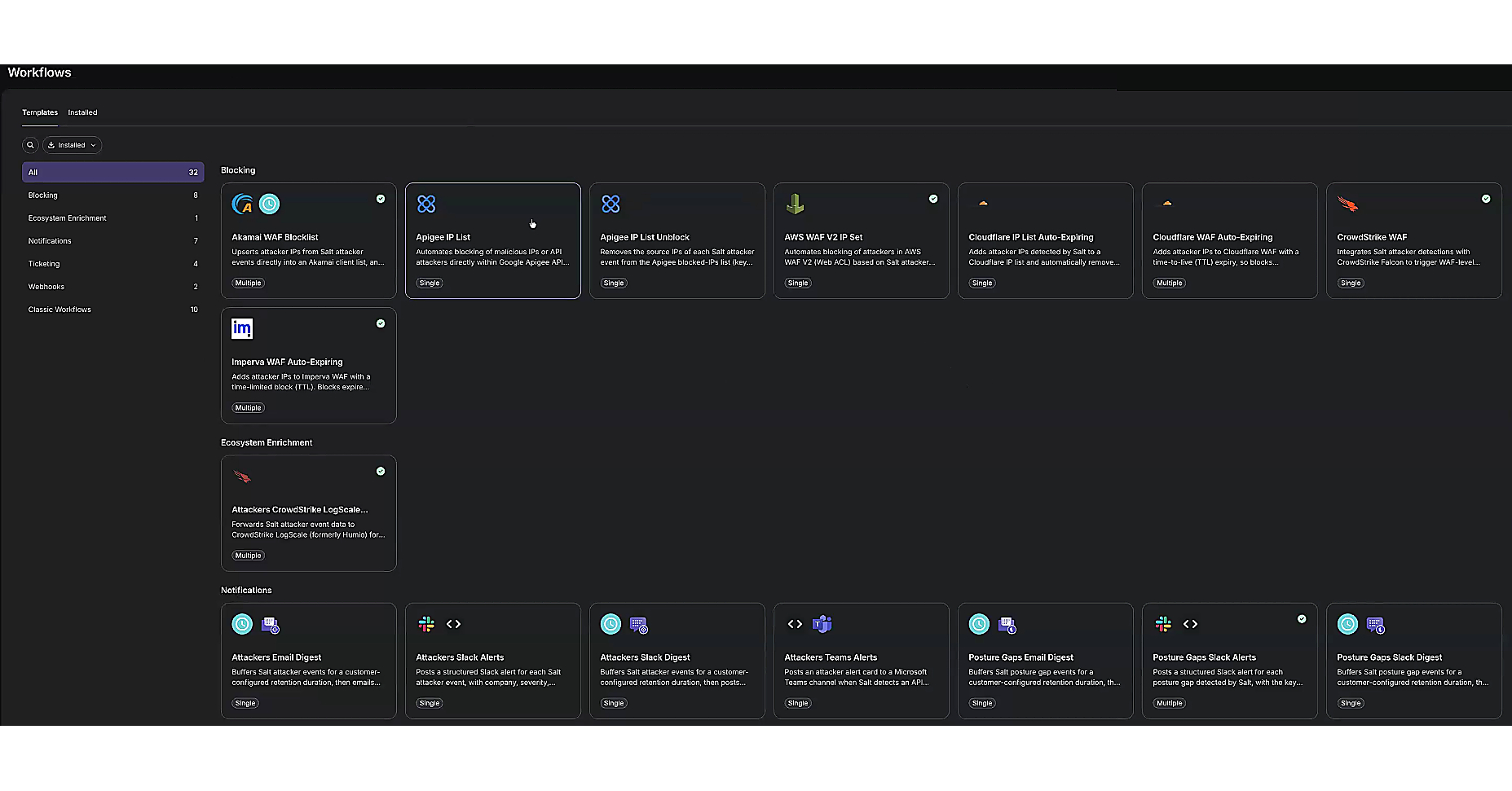
Salt Security announced Autonomous Defense, an expansion of Salt Workflows that can automate threat blocking, access revocation, and remediation across connected enterprise systems. Salt says the platform includes 200+ out-of-the-box connectors; customers can set which actions run automatically and which require approval. Salt Workflows is available to customers today.
Analysis
Analysis
This is a product-capability signal, not yet an earnings signal: Salt is private, and the announcement provides no customer adoption, pricing, retention, or measurable incident-outcome data. The market mechanism to watch is whether security buyers shift budget from alerting toward tools that can safely execute remediation. If that shift is real, vendors that own enforcement points—such as WAFs, API gateways, and identity controls—may retain leverage, while standalone detection products risk being judged on time-to-containment rather than alert volume. Palo Alto Networks, Cloudflare, and Akamai are relevant public-market names to monitor, but this announcement alone does not establish share gains or losses for them.
For the mapped names, this looks more complementary than immediately displacing: ServiceNow and Atlassian’s Jira remain possible workflow and audit destinations, while automated remediation could reduce manual ticket handling at the margin. There is no basis here to infer material impact to NOW or TEAM; CRM is not directly implicated. Near term, likely negligible financial impact. Over 1–3 months, look for customer references, paid adoption, and evidence that workflows execute across heterogeneous controls. Over 6–18 months, the structural question is whether enterprises trust automated security actions enough to reduce response labor without creating costly false positives.
The contrarian risk is that “autonomous” response sells well but enterprise change controls keep consequential actions approval-gated, limiting differentiation and monetization. Conversely, if measurable containment outcomes emerge, the market may underprice the value of owning the response loop. Thesis weakens if adoption remains limited to alerting/ticketing, or if customers report rollback, false-positive, or integration-friction issues.
AllMind Terminal
AI-powered research, real-time alerts, and portfolio analytics for institutional investors.
Request TrialMarket Sentiment
Overall Sentiment
mildly positive
Sentiment Score
0.25
Key Decisions for Investors
- No event-driven position in TEAM, CRM, or NOW on this announcement; the product is from a private vendor and no listed-company revenue linkage is established.
- Treat NOW and TEAM as watch items, not shorts: verify whether customer deployments reduce manual workflow activity or instead increase integration and audit usage; reassess only with quantified customer evidence or guidance commentary.
- Monitor public security-platform vendors including Palo Alto Networks, Cloudflare, and Akamai for proof that automated remediation drives paid adoption or displaces competing detection spend; do not infer a relative winner from this release alone.
- Revisit the thesis over the next 1–3 months if Salt or peers disclose customer counts, attach rates, retention, or independently credible time-to-containment outcomes. Falsify the bullish automation thesis if deployments remain approval-bound or customers cite false positives and rollback risk.
More News
- Microsoft’s strong quarter backs up its stock rebound. Here's our new price target
- ServiceNow’s stock slides as earnings miss clouds a raised AI outlook
- Fed chairman talks tough on inflation — plus, what's behind Micron's big rally
- Stocks making the biggest moves after hours: Alphabet, Microsoft, Chipotle, ServiceNow, Fortinet & more
- Financial AI startup Casap raises $56 million to help banks stop an explosion of customer fraud
- Notes on FOMC Decision and Earnings After the Close