
Farmers Insurance® Urges Preparedness as NOAA Forecasts Potentially Historic El Niño for Fall and Winter
Source: PR Newswire
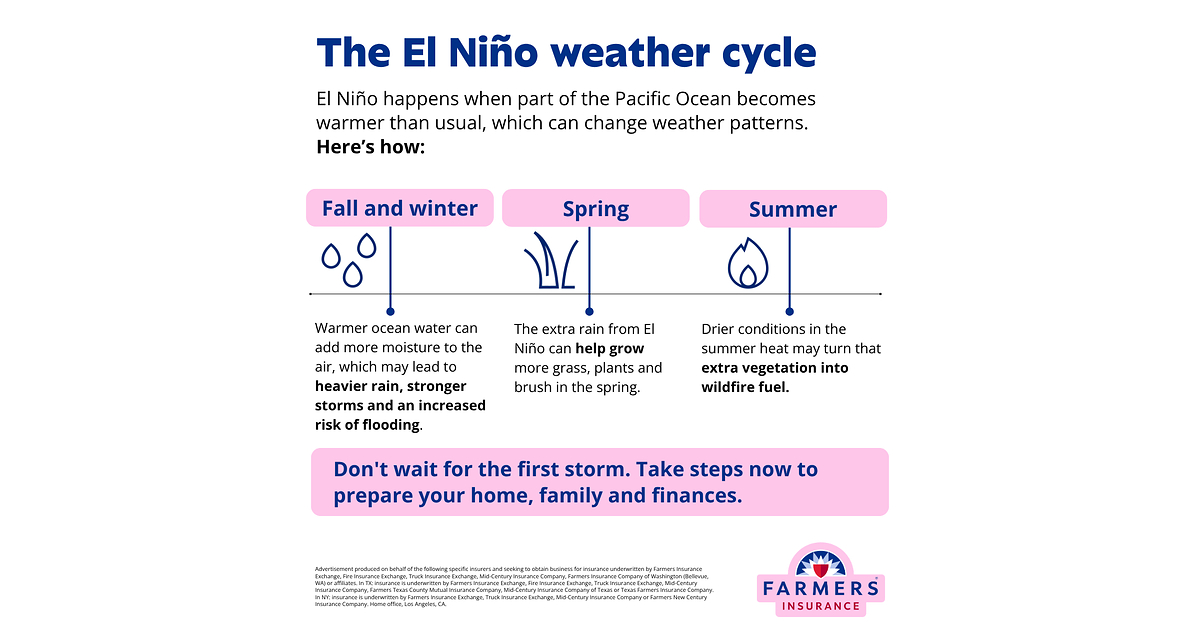
Farmers Insurance cited NOAA projections of a greater than 90% probability that El Niño becomes very strong in fall and winter 2026-27, including a 69% chance it exceeds every event measured since 1950. The insurer warned that heightened risks of flooding, severe storms and potentially wildfire-fueling vegetation growth could drive property losses, while emphasizing that standard homeowners policies typically exclude flood damage and NFIP coverage has waiting periods. The release is primarily a consumer-preparedness and insurance-marketing update, with limited direct near-term market implications.
Analysis
This is principally an underwriting-cycle signal, not a near-term earnings catalyst. Farmers is privately held within Zurich Insurance (ZURN), and its preparedness campaign should be treated as customer-retention and policy-growth marketing rather than evidence of a measurable change in loss expectations. Public U.S. personal-lines insurers with meaningful homeowners exposure—ALL and HIG—face the more immediate asymmetric risk: elevated catastrophe frequency can exhaust retained layers, while repair-cost inflation raises severity even if claim counts remain within modeled ranges.
The second-order effect is likely tighter availability and higher pricing for flood, wind, and wildfire-exposed properties. Private flood specialists and reinsurers such as RNR, ACGL, and EG could benefit over 6-18 months from greater demand for risk transfer, but only if attachment points and pricing rise faster than modeled loss costs; a large event would initially pressure earnings and capital. Building-products names such as OC, BECN, and VMC may see post-event replacement demand, although this is geographically dispersed and usually too delayed to justify buying on seasonal weather headlines.
Consensus often treats a strong El Niño as uniformly negative for insurers, overlooking portfolio re-underwriting and the ability of carriers to reprice or non-renew in regulated but increasingly constrained markets. The key market variable is not weather forecasts alone but whether 2027 reinsurance renewals show higher rates, reduced limits, or materially higher retentions. This press-release-derived signal is insufficient for a directional catastrophe trade absent exposure maps, aggregate reinsurance disclosures, and updated NOAA probability distributions.
AllMind Terminal
AI-powered research, real-time alerts, and portfolio analytics for institutional investors.
Request TrialMarket Sentiment
Overall Sentiment
mildly negative
Sentiment Score
-0.15
Key Decisions for Investors
- Maintain a 1-3 month watch on ALL relative to PGR: consider short ALL / long PGR only if catastrophe-loss guidance rises or homeowners combined-ratio expectations deteriorate while PGR's auto-loss trend remains stable. Falsifier: ALL demonstrates successful rate/coverage actions and maintains its homeowners combined ratio despite elevated weather losses.
- Add RNR and ACGL to a 6-18 month reinsurance-renewal watchlist rather than buying immediately. Initiate only if U.S. property-cat rate-on-line increases and cedent retentions rise at January/June renewals; avoid if abundant alternative capital compresses pricing despite higher modeled risk.
- Monitor ZURN for evidence that policy conversion, retention, or flood-policy penetration is improving; the campaign itself is not a catalyst. A long position requires segment disclosures showing premium growth and pricing above claims-cost inflation, not higher gross written premiums alone.
- Use any broad weather-driven selloff in OC or BECN as an event-driven screen, not a pre-event long. Enter only after verified insured-loss estimates establish a material repair cycle and local supply constraints support pricing; risk is that uninsured flood losses suppress homeowner spending and delay reconstruction.
More News
- Del Monte meets earnings view but revenue falls short
- What investors need to know about Alphabet's stock-busting earnings report
- Our next steps for Alphabet stock after earnings disappoint at nearly every turn
- Budget 2026 speech
- Wendy's shares jump 15% as Nelson Peltz's Trian offers $1.4 billion to buy burger chain
- Fortinet’s stock is taking a dive after earnings. Here’s why.