
APsystems úspešne testuje APstorage 261L UL 9540A - kľúčový míľnik v oblasti bezpečnosti
Source: PR Newswire
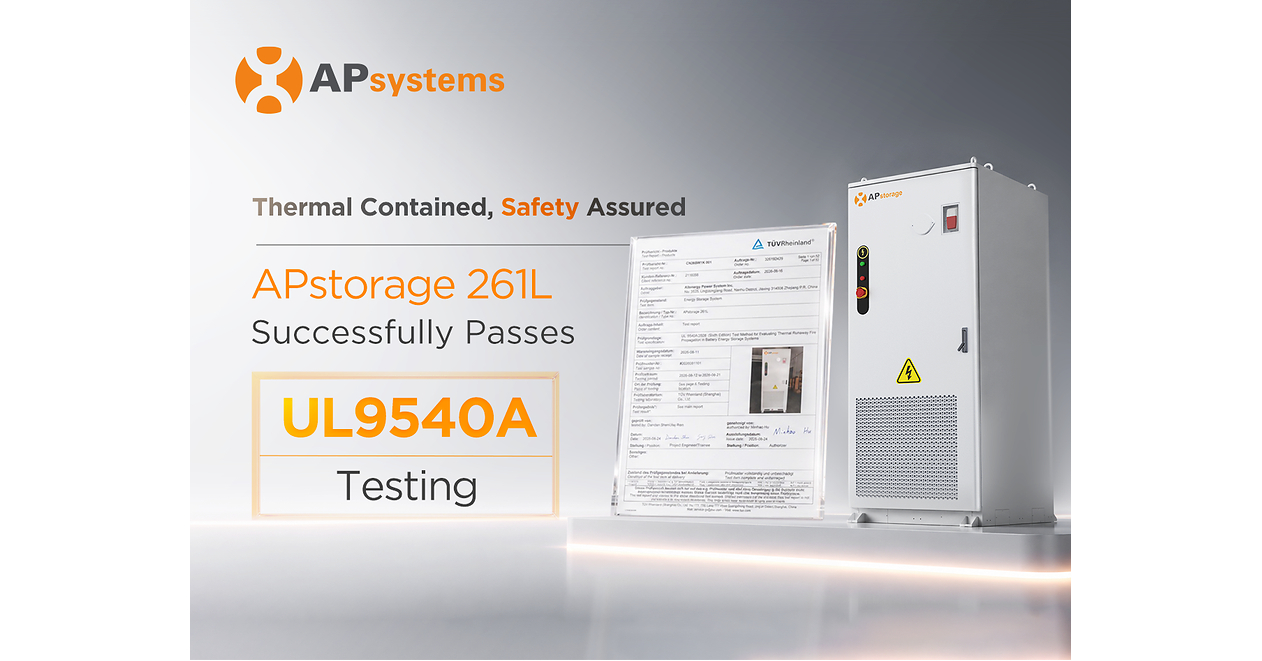
APsystems announced successful testing of its APstorage 261L liquid-cooled energy storage unit under UL 9540A, showing no thermal runaway propagation and no short circuit or explosion even at 100% SOC with fire-suppression intentionally disabled. Key results included 0 kW/m² thermal flux versus UL 9540A’s 1.3 kW/m² threshold and near-ambient impact on adjacent walls (30.6°C, only +3.1°C above ambient), supporting strong containment and structural integrity. The company is positioning the outcome as a safety milestone for European commercial and industrial deployments with plug-and-play installation and modular scalability.
Analysis
This reads more like a commercial de-risking milestone than a revenue inflection. In C&I storage, fire-safety credibility can matter more than cell cost because it lowers insurance friction, AHJ objections, and retrofitting costs; that shifts value toward vendors with bankable test data and local service networks. The likely winners are integrated European channel players and inverter/storage platforms with credible compliance documentation; the losers are low-cost entrants whose bids look cheaper on paper but fail on permitting or underwriting.
Second-order, the economics improve most for dense sites where spacing, fire suppression, and civil works are already a meaningful share of project cost. If customers believe cabinet-level containment is real, it can lift project IRR by a modest but important amount and speed conversion of stalled pipelines over the next 1-3 quarters. Public-market proxies with the most leverage are SEDG and, to a lesser extent, ENPH/CSIQ on storage attach rates; utility-scale names like FLNC benefit only if this becomes a broader safety standard, which is not yet clear.
The contrarian point is that markets often overprice certification news as demand news. Unless this leads to named deployments, insurer acceptance, or a faster permitting cycle, the fundamental impact is probably a few basis points of gross margin improvement for APsystems rather than a step-change in TAM. The thesis breaks if a competing vendor publishes equivalent or better safety data, or if any new fire incident elsewhere forces buyers back to the lowest-risk, highest-incumbency solutions.
AllMind Terminal
AI-powered research, real-time alerts, and portfolio analytics for institutional investors.
Request TrialMarket Sentiment
Overall Sentiment
mildly positive
Sentiment Score
0.35
Key Decisions for Investors
- No immediate public-equity trade: treat this as a channel-validation event, not a standalone earnings catalyst. Reassess only if APsystems or peers announce signed European C&I deployments within 1-2 quarters.
- Set a 1-2 quarter alert on SEDG Europe storage commentary. If management cites better conversion, shorter permitting, or improved insurance terms, initiate a starter long SEDG with a 6-12 month horizon; falsify on flat bookings or guide-down in Europe.
- Conditional pair trade: long SEDG / short TAN into any broad solar rally if safety-qualified storage begins to differentiate winners from commodity solar exposure. Risk/reward is attractive only if storage revenue mix, not module pricing, drives the next leg.
- Watch CSIQ and ENPH as secondary proxies for storage attach-rate data. If neither shows evidence of higher C&I adoption despite similar safety claims, the market is likely overestimating the importance of this certification.
More News
- Oil Analyst Sankey Sees ‘Very Elevated’ Market Through End of 2027
- U.S. Treasury yields ease as investors await fresh jobs data, Fed comments
- Iran ready to reopen Strait of Hormuz if US eases military pressure and lifts blockade
- McDonald's is hosting an investor day as its U.S. business struggles. Here are 4 things to expect
- Iran’s Pezeshkian meets Pakistan’s Naqvi in Tehran as tensions with US rise
- Why the Data Center Backlash Has Republicans on the Back Foot