
Micron: 6 Business Signals That Worked Last Year And What They Say Now
Source: seekingalpha.com
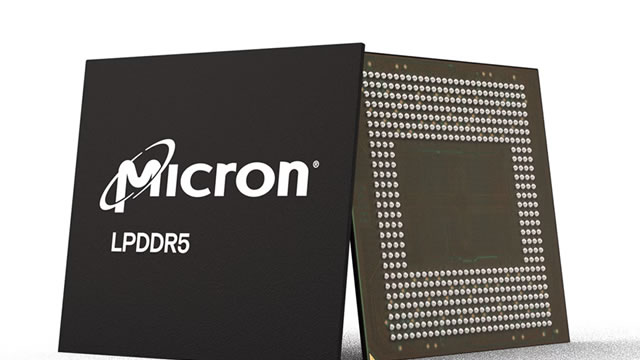
Micron reported Q4 revenue of $54.23B and non-GAAP EPS of $33.42, alongside accelerating sales, margin expansion and robust cash flow driven by AI-related memory demand. Strategic customer agreements increased to 26 from 16 and now cover more than 35% of projected revenue through 2030, materially improving long-term revenue and earnings visibility.
Analysis
The stated financial figures appear inconsistent with Micron's reported scale and should not be traded without primary-source verification; a data error would materially change both valuation and the perceived magnitude of operating leverage. The more investable signal is the increase in contracted revenue coverage: if agreements include enforceable volume and pricing commitments rather than non-binding supply allocations, MU's earnings multiple can migrate from a commodity-memory trough framework toward a higher-visibility AI infrastructure framework. The key diligence item is contract structure—take-or-pay terms, price-reset provisions, and whether commitments are concentrated in HBM versus broader DRAM/NAND output.
Near term, MU remains levered to HBM qualification and supply tightness, but the second-order risk is that customers' multi-sourcing efforts shift incremental economics to SK Hynix and Samsung rather than expanding industry profitability. Over 1-3 months, HBM pricing, advanced-packaging capacity, and hyperscaler capex commentary should matter more than headline revenue growth; any indication that HBM supply is catching demand would compress MU's premium quickly. Over 6-18 months, conventional DRAM and NAND capacity additions remain the principal downside: AI-driven HBM strength can coexist with weaker commodity-memory pricing, limiting consolidated gross-margin upside.
Consensus may be underweight the durability benefit of customer commitments but overstate their protection against a memory-cycle reversal. A premium valuation is justified only if HBM mix rises fast enough to offset normalization in legacy DRAM/NAND; evidence of contract pricing indexed to spot-memory conditions would undermine the visibility thesis. Falsify a constructive view on HBM ASP declines, a sequential gross-margin guide below expectations, delayed next-generation HBM qualification, or aggressive capacity commentary from Samsung Electronics or SK Hynix.
AllMind Terminal
AI-powered research, real-time alerts, and portfolio analytics for institutional investors.
Request TrialMarket Sentiment
Overall Sentiment
strongly positive
Sentiment Score
0.78
Ticker Sentiment
Key Decisions for Investors
- Do not initiate on the supplied figures until MU's earnings release/10-Q confirms revenue, EPS, backlog, and the legal nature of customer agreements; treat the current data discrepancy as a hard verification gate rather than a buy signal.
- If verified results show HBM-driven gross-margin expansion and contracted revenue with firm volume commitments, build a 3-6 month long MU position on post-earnings volatility, targeting 15-20% upside versus a 8-10% stop on margin-guide deterioration.
- Prefer a relative-value expression: long MU / short SOXX in equal beta over 3-6 months if MU demonstrates HBM mix gains while broader semiconductor multiples remain exposed to AI-capex normalization.
- For downside protection around the next earnings print, own MU put spreads 2-4 months out only if implied volatility remains below the prior four-quarter post-earnings move; the relevant downside catalyst is weaker gross-margin guidance, not an isolated revenue miss.
- Monitor Samsung Electronics and SK Hynix HBM qualification, wafer-capacity, and pricing disclosures. Evidence of rapid supply expansion or customer multi-sourcing should trigger profit-taking on MU longs even if near-term reported earnings remain strong.
More News
- U.S. stock futures drift higher with nonfarm payrolls in focus
- US 10-Year Yield Hits 2002 High; Micron Gives Bullish Forecast
- Investors Are Driving Government Bond Yields Higher
- One of our most recent defensive buys cleared a hurdle and its stock jumped
- You think Nvidia's $235 billion buyback is big. Just wait and see what Micron might do
- Dow futures hit three-month low as yields surge, Micron earnings offer support