
Ozelle präsentiert auf der MEDICA 2026 mit O-Cyte 1 skalierbare, KI-gestützte Hämatologie
Source: PR Newswire
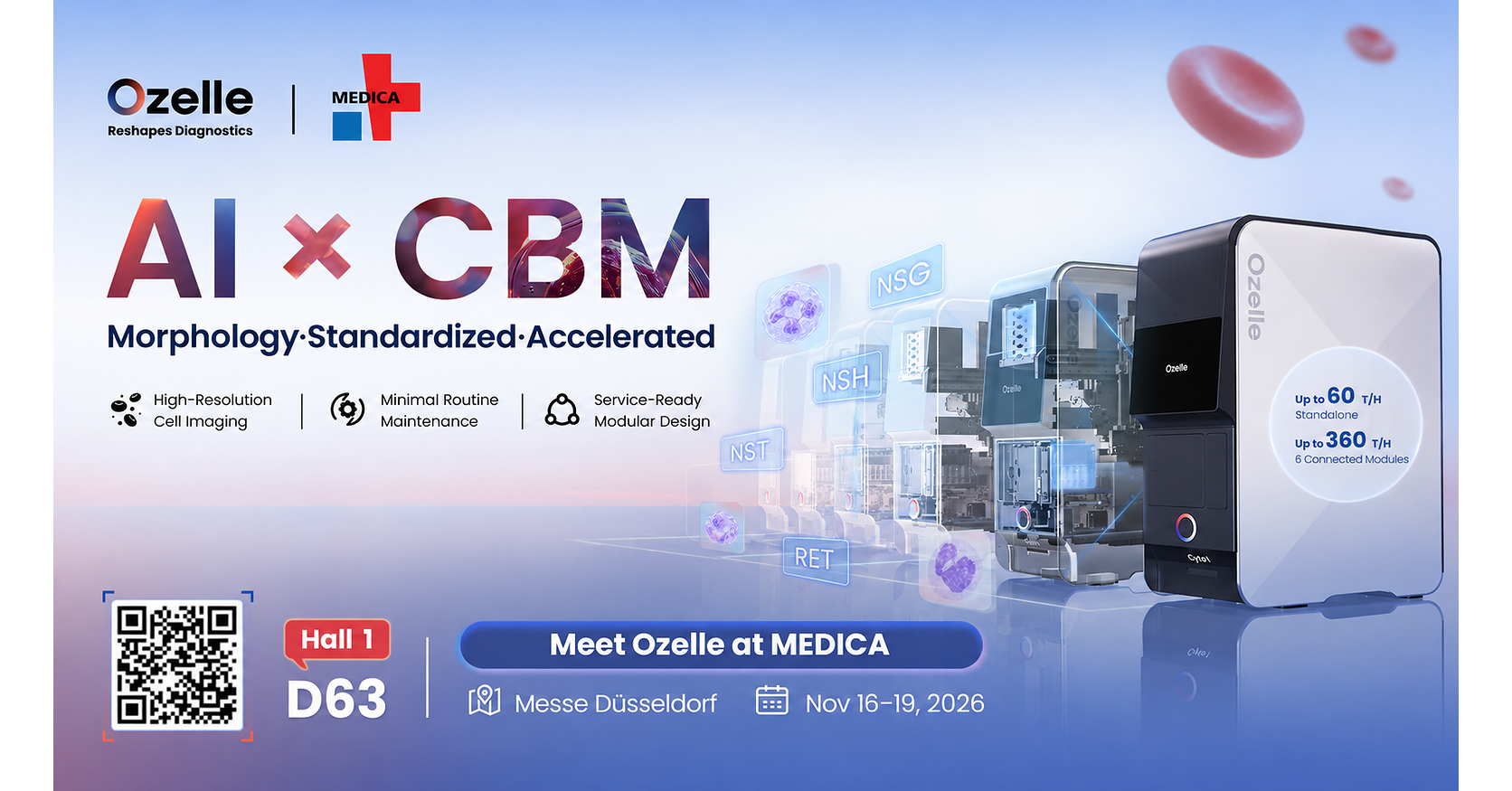
Ozelle is showcasing its O-Cyte 1 automated hematology analyzer at MEDICA 2026, combining CBC testing with a 7-part white blood cell differential, high-resolution cell imaging and AI-assisted classification. A single analyzer can process up to 60 tests per hour, while six units in cascade can handle up to 360; the design also emphasizes simplified reagent handling and routine maintenance. The announcement highlights product capabilities and a possible distribution-partner opportunity, without reporting sales or financial results.
Analysis
Ozelle’s commercial proposition is less the AI label than the potential to make cell morphology auditable within routine workflows. If independent studies show reproducibility and lower review or service burden, this could help smaller laboratories adopt digital morphology and give distributors a broader tiered offering. The counterweight is incumbent advantage: Sysmex and Danaher’s Beckman Coulter can defend through installed base, workflow integration, and validated service networks. A new ICSH standard may legitimize the category over time, but it also raises the bar for validation; image availability alone does not establish diagnostic equivalence or clinical utility.
Near term (days to 1–3 months), MEDICA is a product-visibility event, not evidence of orders or revenue conversion. The stated throughput and maintenance design are company claims; utilization, uptime, reagent economics, regulatory clearances by market, and independent clinical validation remain unverified. Over 6–18 months, the key question is whether distributors convert demonstrations into placements and recurring consumables while meeting local validation requirements. Modular consumables may simplify service but could also increase customer dependence on proprietary supplies.
No direct public-equity trade is supported: Ozelle has no supplied ticker mapping, and any read-through to diversified diagnostics incumbents is presently too small and uncertain. The contrarian risk is treating standardization as an immediate adoption catalyst; standards can first slow procurement by requiring evidence and process changes. Thesis improves with independently verified performance and disclosed placements; it weakens if regulatory or validation milestones slip, service burden is not lower in practice, or adoption fails to progress beyond demonstrations.
AllMind Terminal
AI-powered research, real-time alerts, and portfolio analytics for institutional investors.
Request TrialMarket Sentiment
Overall Sentiment
mildly positive
Sentiment Score
0.25
Key Decisions for Investors
- No trade on the MEDICA announcement alone. Treat it as a watch item rather than a near-term earnings catalyst for public diagnostics companies.
- Track Ozelle’s post-show evidence: distributor agreements that convert to installations, country-level regulatory clearances, independent comparison studies, and utilization or repeat-consumable data.
- Use Sysmex and Danaher/Beckman Coulter as competitive benchmarks, not automatic shorts. Reassess only if credible placements indicate workflow displacement or measurable pricing pressure.
- Falsification/watch triggers: delayed validation or regulatory milestones, weak distributor follow-through, or evidence that uptime, service requirements, and reagent costs do not improve laboratory economics.
More News
- What investors need to know about Alphabet's stock-busting earnings report
- Our next steps for Alphabet stock after earnings disappoint at nearly every turn
- Budget 2026 speech
- Microsoft's Big Bets on AI Start to Pay Off
- Asian shares fall as Alphabet earnings miss drags Wall St futures lower
- China’s tech darlings are losing their shine. Here’s what’s behind the sell-off