
Breakfast News: Artificial Intelligence, Real Debt
Source: fool.com
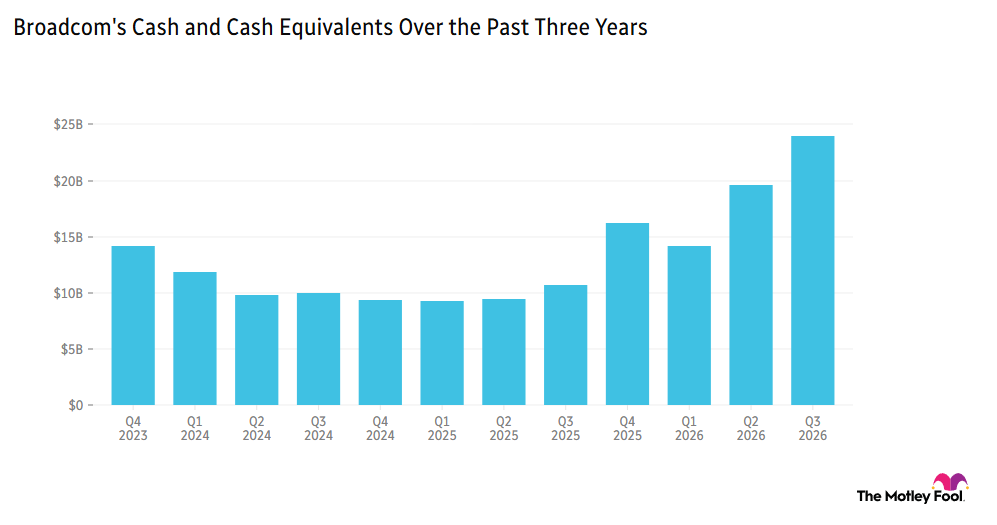
Broadcom has held early talks on more than $50 billion in financing for custom AI chips it is developing with OpenAI, after a separate $60 billion financing for Anthropic; the approach could help secure future chip orders while adding debt risk for buyers. TSMC reported third-quarter revenue up 51% to NT$1.49 trillion ($46.7 billion) and raised its 2026 growth outlook to just over 40%, while Samsung forecast third-quarter operating profit of 107.4 trillion won ($80.1 billion), nine times year-earlier levels. The article also highlights memory-supply constraints and cyclical risk, alongside a historical case for Salesforce’s valuation and its roughly 3,300% gain since a 2009 recommendation.
Analysis
The key change is that AI infrastructure demand is becoming a credit-underwriting question, not just a chip-order question. Broadcom could use financing access to deepen customer lock-in, but the value to AVGO depends on who bears default risk: lender-funded purchases without Broadcom guarantees can secure demand at limited balance-sheet cost; guarantees, take-or-pay commitments, or concentrated exposure would turn design wins into credit risk. Verify the proposed facilities’ recourse, collateral, and lender commitments before treating them as durable backlog.
Over the next 1–3 months, watch customer funding terms and whether announced capacity translates into recognized orders. Over 6–18 months, debt-funded buildout raises the risk of pulled-forward demand: if AI revenue per unit of compute disappoints, customers can defer purchases, impairing chip suppliers and capacity plans together. TSM benefits across custom and merchant silicon, but remains exposed to customer concentration, advanced-node execution, and Taiwan geopolitics. HBM tightness supports pricing near term; accelerated capacity from Micron and Samsung could reverse the balance if deployment economics weaken.
Contrarian point: strong supplier orders validate current spending, not end-user returns or the ability to service accumulated debt. Also verify Samsung’s quoted profit and revenue units against its official release before using them; the figures as presented appear internally implausible. The Salesforce valuation anecdote offers no current fundamental evidence for CRM.
AllMind Terminal
AI-powered research, real-time alerts, and portfolio analytics for institutional investors.
Request TrialMarket Sentiment
Overall Sentiment
moderately positive
Sentiment Score
0.55
Ticker Sentiment
Key Decisions for Investors
- Treat AVGO financing headlines as a diligence catalyst, not yet as incremental backlog: request confirmation of funded commitments, recourse/guarantees, and customer concentration. Reassess if Broadcom discloses material credit support or if customer orders are contingent on financing.
- Prefer TSM for diversified exposure to AI chip manufacturing over a narrow bet on any one accelerator architecture; add only on pullbacks or confirmation of advanced-node capacity and customer commitments. Falsifier: guidance or utilization weakens despite continued AI capex plans.
- Keep MU/HBM exposure sized for a cyclical reversal. Track HBM pricing, customer qualification, and announced capacity versus realized shipments over the next few quarters; cut the thesis if supply ramps ahead of absorption or pricing rolls over.
- Avoid trading the Samsung earnings claim until official figures and units are verified. More broadly, monitor AI borrowers’ funding costs and compute monetization: worsening credit terms or deferred purchases would be a warning for AVGO, NVDA, and the wider semiconductor supply chain.
More News
- Verizon stock heads for worst day since 2002 as SpaceX U.S. network plans whack telcos
- SpaceX’s Wireless Threat Rises With Spectrum Deal
- SpaceX to buy key spectrum that could help Starlink Mobile become major US cell carrier
- Why is the Chinese stock market missing the AI rally
- OpenAI's revenue scare, Delta earnings, what investors think of a Starbucks-Chipotle deal and more in Morning Squawk
- Why is T-Mobile stock tumbling today?