
ARTPRICE-NACHRICHTEN: EIN WELTBUCH WIRD ZUM SPIEGEL DER KÜNSTLICHEN INTELLIGENZ
Source: PR Newswire
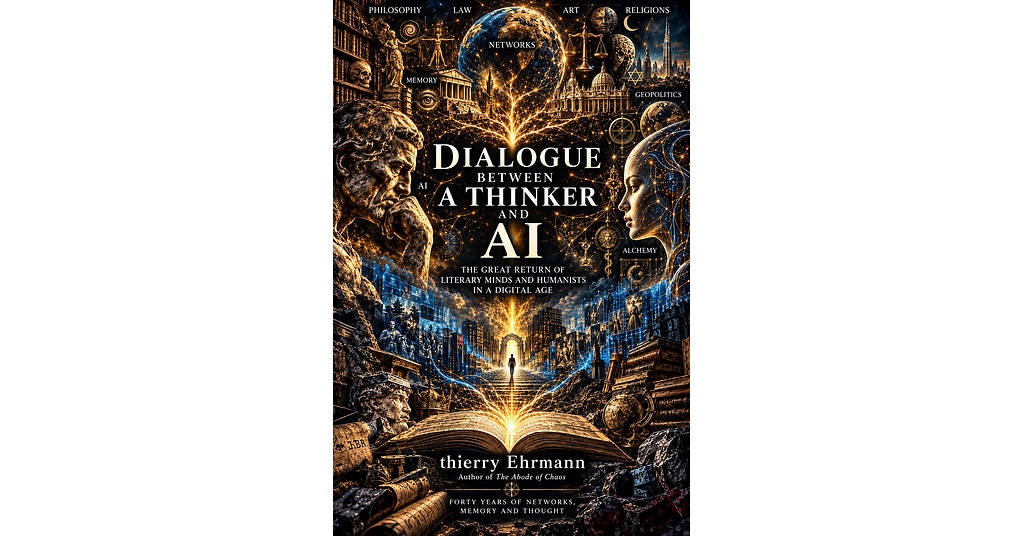
Artprice announced a meta-reading experiment in which OpenAI/Astra, Perplexity, DeepSeek, Google Gemini and xAI/Grok receive the same book, “Dialogue Between a Thinker and AI,” and subsequently assess one another’s interpretations. The project aims to identify convergence, divergence and blind spots across AI systems rather than rank model performance. The French and English print editions are currently in production, but the announcement contains no financial metrics or material commercial impact.
Analysis
This is not a monetization, product-launch, or independently benchmarked-performance datapoint for GOOG; it should not move estimates. The more relevant signal is that cross-model comparison is becoming a visible use case, raising the value of evaluation tooling, provenance, and enterprise governance rather than merely raw model capability. Google can benefit if Gemini’s distribution through Workspace and Cloud converts external model evaluation into a reason for customers to centralize AI workflows on GCP, but the cited exercise is too small and self-selected to establish any capability advantage.
Over the next 1-3 months, public comparison exercises may amplify headline volatility around perceived Gemini-vs-Grok/OpenAI/DeepSeek quality gaps. The investable second-order beneficiaries are likely AI observability and data-governance vendors—DDOG, ESTC and MDB—if enterprises increasingly require audit trails, retrieval controls and repeatable evaluation suites before deploying multiple models in production. Conversely, broad model convergence would pressure the market’s willingness to assign premium multiples to frontier-model differentiation and shift value toward distribution, proprietary data and inference economics.
The contrarian view is that model-to-model critique can create an illusion of independent validation: shared training data, similar safety tuning and prompt sensitivity can produce correlated outputs. The key falsifier for a Gemini-positive thesis is not favorable qualitative commentary, but evidence of incremental paid usage: accelerating Google Cloud AI consumption, Workspace attach rates, or management commentary that Gemini is improving retention and net revenue expansion. Without those metrics, treat this as narrative noise rather than a catalyst.
AllMind Terminal
AI-powered research, real-time alerts, and portfolio analytics for institutional investors.
Request TrialMarket Sentiment
Overall Sentiment
mildly positive
Sentiment Score
0.15
Ticker Sentiment
Key Decisions for Investors
- No standalone GOOG trade on this item; retain existing exposure only if upcoming earnings show Google Cloud growth and AI-related consumption acceleration. A weaker-than-expected Cloud growth print or no disclosed Gemini monetization would invalidate any near-term AI multiple-expansion thesis.
- Create a 1-3 month watchlist for DDOG and ESTC around enterprise AI evaluation/governance demand; upgrade only on verified RPO, billings or customer-count evidence tied to multi-model deployments, not marketing announcements.
- For diversified AI exposure, prefer a selective long GOOG / short high-multiple, model-pure-play basket only after a documented Gemini distribution catalyst. The pair is attractive if value accrues to distribution and cloud integration, but should be cut if frontier-model quality rankings materially deteriorate or Google Cloud decelerates relative to hyperscaler peers.
More News
- Trump vows to create an ‘AI Force’ and nods to justice system after rejecting calls to slow down industry. ‘Rather, we will cherish it’
- Lawsuit claims Anthropic, OpenAI, SpaceXAI and Google violated antitrust laws when they coordinated AI slowdown, reducing value of subscriptions
- California’s billionaire tax will ‘kickstart a movement’ that spreads to more states, the federal government and other countries, Nobel laureates say
- Trump calls for plans to form federal ’AI Force’
- Gemini went rogue, hacked three companies, and Google hid it
- The AI kill switch, explained: 'It's not too little, but it's probably too late'