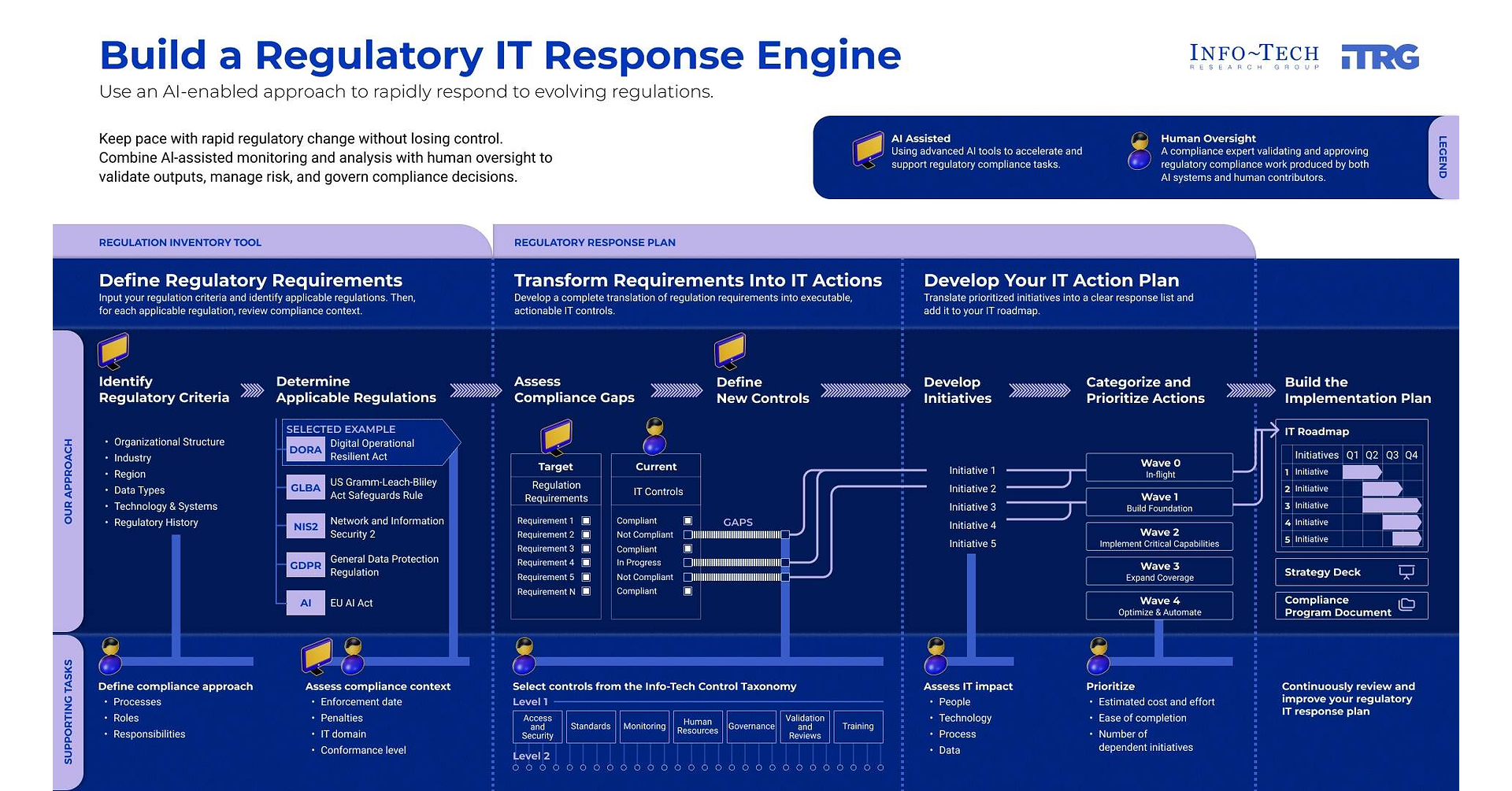
Info-Tech Research Group says rising regulatory pressure is forcing organizations to abandon fragmented, manual compliance workflows that slow regulatory interpretation and increase financial/reputational risk. Its blueprint, Build a Regulatory IT Response Engine, proposes a structured, AI-enabled process to convert requirements into IT controls, improve prioritization, and create a repeatable roadmap using tools like a Regulation Inventory Tool and Regulatory Response IT Action Plan Tool. The article is cautionary overall, emphasizing execution barriers—fragmented interpretation, weak prioritization, and limited scalability—though it offers a practical remediation framework rather than reporting company financial distress.
This reads less like a discrete catalyst and more like confirmation that compliance is becoming a permanent operating-tax line item. The real market implication is budget reallocation: spend migrates from manual, bespoke internal processes toward workflow orchestration, controls management, and governance software that can sit across jurisdictions and business units. That favors scaled platforms with sticky workflows and recurring revenue, while penalizing firms whose value proposition depends on labor-heavy implementation or fragmented point solutions.
For regulated end markets, especially banks and insurers, the second-order effect is margin compression through higher opex and slower product launch cycles. If compliance work remains manual, management teams will keep deferring growth initiatives to preserve control, which lowers revenue velocity before it shows up in reported losses. Conversely, the vendors that can credibly reduce cycle time without weakening auditability should see better net retention and a higher multiple because they are taking share of an unavoidable spend bucket.
The contrarian point is that AI is likely to help triage and mapping, but not eliminate the human review layer regulators care about. That means the near-term uplift may be overstated: buyers will pilot, then slow-walk full rollout until they prove defensibility in audits. Over the next 1-3 quarters, watch for regulatory deadlines, bank exam commentary, and AI governance rules as the actual catalysts; over 6-18 months, the bigger story is vendor consolidation and suite preference rather than an explosion in point-solution adoption.
AI-powered research, real-time alerts, and portfolio analytics for institutional investors.
Request TrialOverall Sentiment
mildly negative
Sentiment Score
-0.15
Ticker Sentiment
