
Breakfast News: Week in Review
Source: fool.com
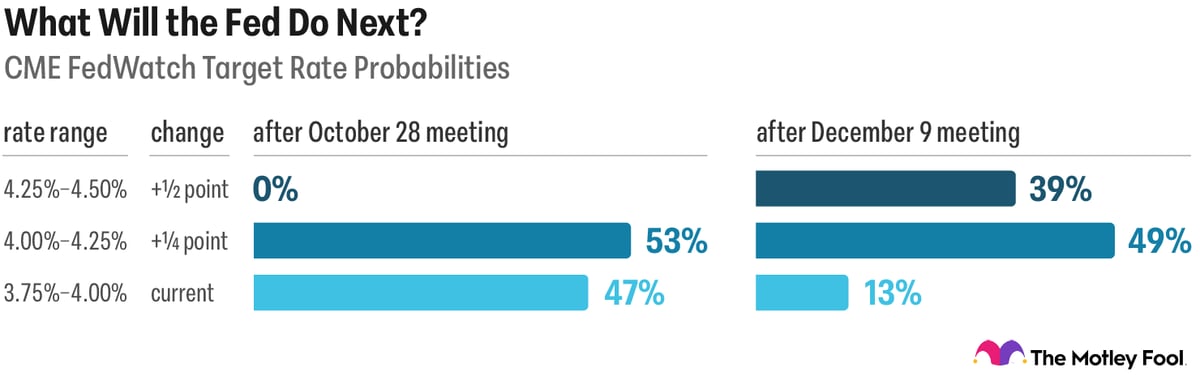
The Federal Reserve raised its benchmark rate 25bps to 3.75%-4.00%, its first hike since 2023, after a Saudi pipeline shutdown helped lift Brent crude 2.9% to $108.75/bbl and pushed the 10-year Treasury yield briefly to 5.04%. The Dow fell 631 points, or 1.2%, to 51,461.90, while Morgan Stanley shifted to forecasting two additional hikes. AI-related stocks also diverged after Anthropic and OpenAI warned against continued maximum-speed scaling: Nvidia and Broadcom each fell about 3%, Micron dropped 5.2%, while CrowdStrike rose nearly 14% to a record high. Separately, Generac surged more than 18% after disclosing a $2.4B Amazon generator order for 2027-28, tied to warrants that could expand if Amazon's purchases reach $8B.
Analysis
The rates/oil impulse is more damaging to capital-intensive AI infrastructure than to AI software, but the first-day rotation likely overstates the near-term earnings impact. NVDA, AVGO and MRVL have backlog and deployed-capacity exposure that should cushion the next one to two quarters; the more vulnerable cohort is externally financed compute capacity, where a higher terminal funding rate directly raises required GPU utilization and reduces residual-value assumptions. Over the next 6-18 months, sustained real-rate pressure should favor cash-generative hyperscalers (AMZN, GOOG) and asset-light security vendors over CRWV and marginal data-center supply-chain names.
The security bid has a real demand mechanism—autonomous-agent deployment expands machine-speed identity, endpoint and cloud-workload attack surfaces—but CRWD and NET are becoming the consensus defensive-AI expression. Their valuation support requires durable net retention and elevated bookings; any deceleration in large-enterprise IT budgets would compress multiples faster than infrastructure vendors with contracted backlog. The better relative expression is to own security against compute-capex exposure rather than chase absolute software beta.
GNRC's customer warrant structure should be viewed as customer concentration and contingent dilution, not simply validation. The order creates multi-year revenue visibility, but Amazon has captured part of the upside and can influence supplier economics as volumes scale; execution depends on generator availability, service capacity, and whether grid-flexibility initiatives reduce the need for behind-the-meter backup. GLW's equity program similarly creates a persistent technical overhang until management ties proceeds to incremental returns above its cost of capital; absent a defined capex or acquisition plan, the discount can persist for 1-3 months.
Contrarian point: a slower frontier-model cadence may shift spending from training clusters to inference, networking, power reliability and security rather than reduce aggregate AI spend. AVGO is relatively insulated if custom silicon and networking content rises per deployed workload, while MRVL's optical exposure needs actual data-center interconnect orders—not safety headlines—to validate a rebound.
AllMind Terminal
AI-powered research, real-time alerts, and portfolio analytics for institutional investors.
Request TrialMarket Sentiment
Overall Sentiment
mildly negative
Sentiment Score
-0.20
Ticker Sentiment
Key Decisions for Investors
- Initiate a 3-6 month pair: long CRWD / short CRWV, sized beta-neutral. The thesis is recurring security demand versus funding-rate-sensitive compute economics; target 15-20% relative outperformance. Exit if CRWV reports sustained positive free cash flow with utilization expansion, or if CRWD's net retention/guidance falls below expectations.
- Accumulate AVGO on further AI-led weakness rather than chase NVDA beta; use a 6-12 month horizon. Custom silicon, networking and installed-base content provide a more defensible earnings bridge if training growth moderates. Risk is a broad hyperscaler capex-guide cut; invalidate on two major customers signaling 2027 AI-capex reductions.
- Avoid initiating GNRC after the sharp move; place a buy alert 12-15% below the post-announcement level or after disclosure of margin, capacity and warrant-strike details. A position is attractive only if incremental contract economics support earnings accretion after dilution; risk/reward is unfavorable while those inputs remain undisclosed.
- Short GLW tactically versus long VZ for 1-3 months, contingent on confirmation that equity issuance continues without a specific high-return use of proceeds. The likely catalyst is ongoing ATM supply and estimate cuts from dilution/capex uncertainty; cover on a defined deployment plan, completion of issuance, or a material incremental fiber-order backlog disclosure.
More News
- Google's Gemini becomes latest AI model to break out and hack computer systems
- Stocks face a key hurdle in next week’s U.S.-China summit. Here’s what’s at stake
- Three words from Kevin Warsh have Wall Street wondering how far the Fed will go with rate hikes
- AI almost led the US military to start a war with China, report says
- Warren Buffett stepping down as chairman of Berkshire Hathaway: 'Father Time always wins'
- American, United and Southwest are all cutting ‘marginal routes’ as jet fuel prices spike