
Stevenson School Opens New Academic Centers Built for Curiosity and Discovery
Source: Newswire
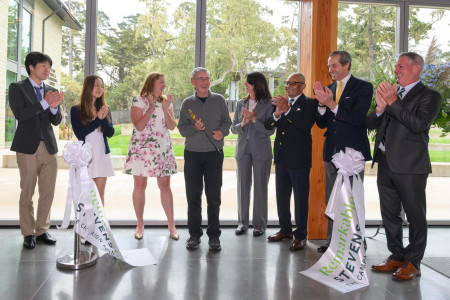
Stevenson School opened two new STEM facilities—the $45 million Day Science and Engineering Center and John Senuta Math Center—funded entirely by philanthropy, replacing the old Lindsley Science Building and nearly quadrupling STEM space. The complex introduces on-campus renewable energy (rooftop photovoltaic arrays, battery storage, and cloud-based energy management) alongside expanded labs, makerspace, and astronomy observation areas. The announcement is primarily community/education-focused with no material public-market impact expected.
Analysis
This reads as a prestige-capex event, not a public-equity catalyst. Because the spend is philanthropy-funded, the key market implication is absence of balance-sheet strain: no leverage, no operating-margin drag, and no sign of a broader capital cycle that would spill into suppliers or peers. For investors, that makes the headline mostly irrelevant to earnings models, except as a faint positive signal for the resilience of the top end of K-12 private education demand.
The more investable second-order effect is competitive positioning: high-end schools without comparable STEM facilities may feel pressure over the next 1-3 admission cycles to upgrade labs, maker spaces, and sustainability features to avoid losing tuition pricing power. But this is a slow-burn enrollment and reputation dynamic, not a same-quarter revenue driver. Any benefit to campus infrastructure names, battery storage, or building controls is too de minimis and bespoke to support a trade here.
Contrarian view: the consensus may overinterpret the renewables and “innovation” language as an ESG capex trend. In reality, this is a donor allocation decision, so the economic signal is more about wealth concentration and philanthropic appetite than about construction demand or technology adoption. The only falsifiable bullish read would be a measurable uptick in applications, yield, or tuition pricing over 6-18 months; absent that, the event is best treated as non-actionable for listed equities.
AllMind Terminal
AI-powered research, real-time alerts, and portfolio analytics for institutional investors.
Request TrialMarket Sentiment
Overall Sentiment
mildly positive
Sentiment Score
0.25
Key Decisions for Investors
- No trade in CWT or SCOO: the article does not create a verifiable earnings or multiple catalyst, and any linkage to campus water/technology systems is too indirect to underwrite a position.
- Watch list only: monitor independent-school enrollment and tuition-growth disclosures at regional premium schools over the next 1-3 admissions cycles; if a clear STEM-facility arms race emerges, reassess facility-services and education-adjacent names.
- If seeking a proxy, use a broad education-services basket rather than single-name exposure, but only after confirming that capital spending is translating into pricing power or enrollment gains rather than one-off donor optics.
- Falsifier for any positive read: if next admissions cycle shows flat or weaker applications/yield despite the new facilities, the reputational benefit is likely already reflected and the thesis should be abandoned.
More News
- Blackstone President Jon Gray Bets Big on AI Boom
- Ukraine to resume strikes on Russian refineries, shattering hopes of an 'energy ceasefire'
- What's behind the sell-off in AI neocloud stocks like CoreWeave and Nebius
- SK Hynix plunges 8% amid Asia tech rout as Fed rate hike fears, AI funding worries mount
- TSMC Earnings Beat; Anthropic Says It's Now Profitable
- Giant Taiwanese chipmaker TSMC confirms it’s in talks with Elon Musk to join ‘Terafab’ complex in Texas: ‘The AI market continues to be very strong’