
KLC met en avant les tests thermiques TTV pour l'IA/HPC et le refroidissement liquide, la conception de l'agencement puce-wafer, ainsi que des solutions de chauffage haute tension pour véhicules électriques
Source: PR Newswire
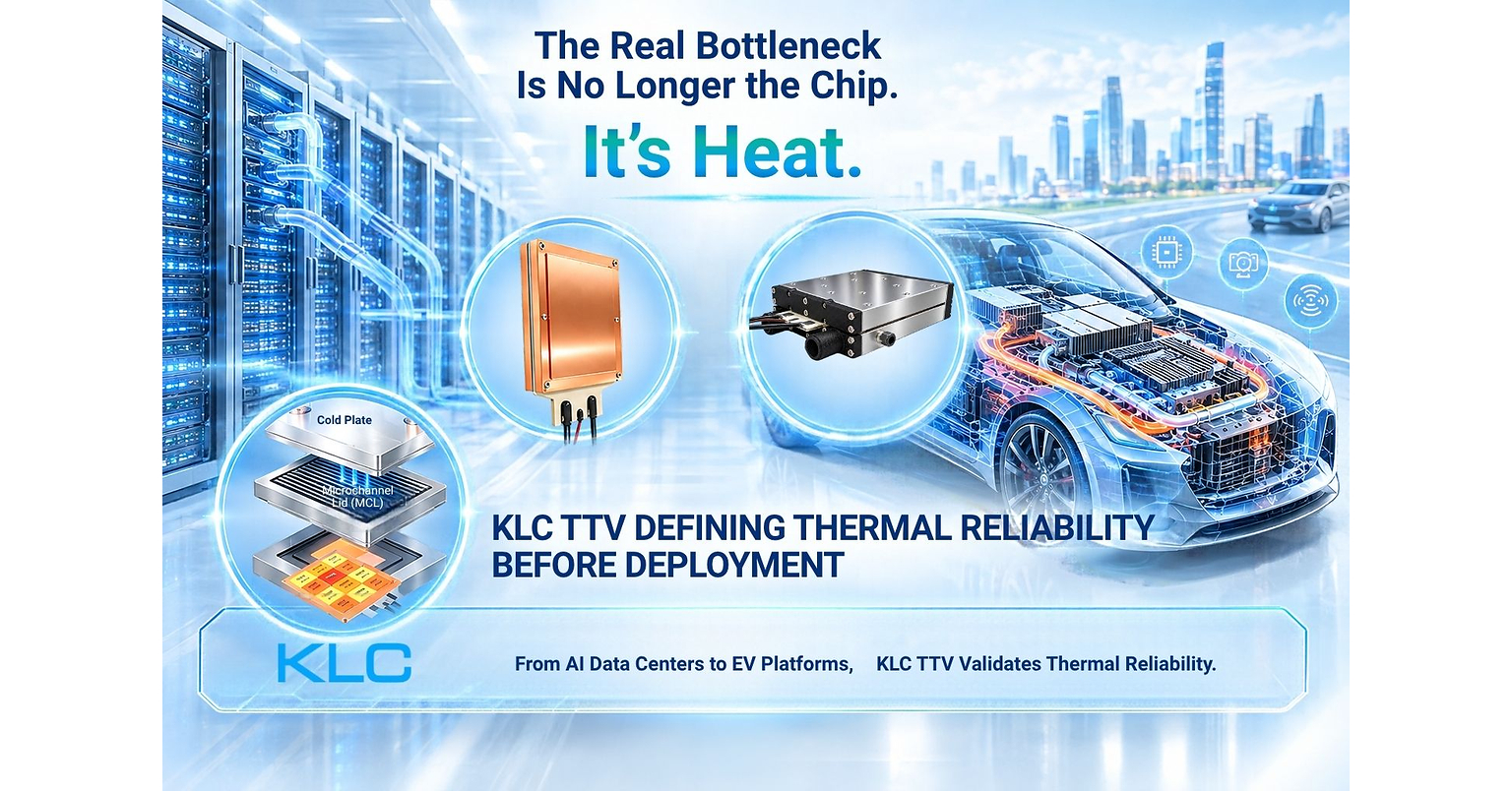
Taiwanese thermal-management manufacturer KLC highlighted thermal test vehicle (TTV) solutions for chip/wafer design and AI/HPC cooling validation, alongside high-voltage EV coolant heaters. Depending on the product series, the heaters support 12–400 VDC and output up to 12,000 W; the announcement provides no sales, contract, or financial-performance figures.
Analysis
KLC’s announcement is evidence of positioning in thermal-validation tools, not evidence yet of material AI/HPC revenue: it provides no customer wins, orders, backlog, or segment economics. The key distinction is that TTVs help engineers test cooling designs; they are not themselves data-center cooling capacity. Even if adoption grows with chip and rack power density, revenue capture could be modest relative to the spend accruing to cold-plate, liquid-cooling, and power/thermal-system suppliers such as Vertiv, Modine, nVent, and Delta Electronics. KLC’s stated EV-heater capability adds a separate, auto-cycle-sensitive exposure rather than a clean AI proxy.
Near term, this reads as promotional and is unlikely to justify repricing listed peers. Over 1–3 months, the relevant evidence is repeat orders, named design engagements, and revenue contribution from semiconductor customers—not product specifications alone. Over 6–18 months, broader liquid-cooling adoption could support a larger validation-tool market, but competitive substitution and customers’ in-house test capabilities may limit pricing power. The contrarian point: thermal bottlenecks are real, but validation demand does not automatically translate into durable supplier margins. No KLC ticker or mapped listed identity is supplied, so a direct equity trade is not actionable from this release.
AllMind Terminal
AI-powered research, real-time alerts, and portfolio analytics for institutional investors.
Request TrialMarket Sentiment
Overall Sentiment
mildly positive
Sentiment Score
0.15
Key Decisions for Investors
- Do not trade listed cooling suppliers on this announcement alone; treat it as a low-confidence signal of continued thermal-design activity, not incremental orders.
- Watch for independently verifiable KLC customer wins, repeat TTV orders, semiconductor-related revenue, and backlog disclosure. Reassess only if these establish commercial scale.
- For Vertiv, Modine, nVent, and Delta Electronics, use actual order, backlog, and margin guidance as the catalyst set; avoid assuming KLC’s product claims imply revenue gains for these peers.
- Falsify the broader validation-demand thesis if liquid-cooling deployments or related supplier orders weaken, or if customer evidence shows thermal testing remains predominantly internal.
More News
- Marvell to buy Lumentum in $115 billion deal in AI data-center bet
- Marvell, Lumentum tout historic $115B deal to create ‘category leader' in AI connectivity
- Palantir reports booming U.S. commercial revenue growth, topping government for first time
- Anthropic releases amended IPO prospectus with third-quarter financials
- Coinbase has been battered over the past month. Morgan Stanley says steer clear
- The AI boom is facing another supply crunch. This time it’s the amount of capital available to feed Silicon Valley’s endless need for cash