
Trump Versus Xi: How Their High-Stakes Summits Compare
Source: Bloomberg
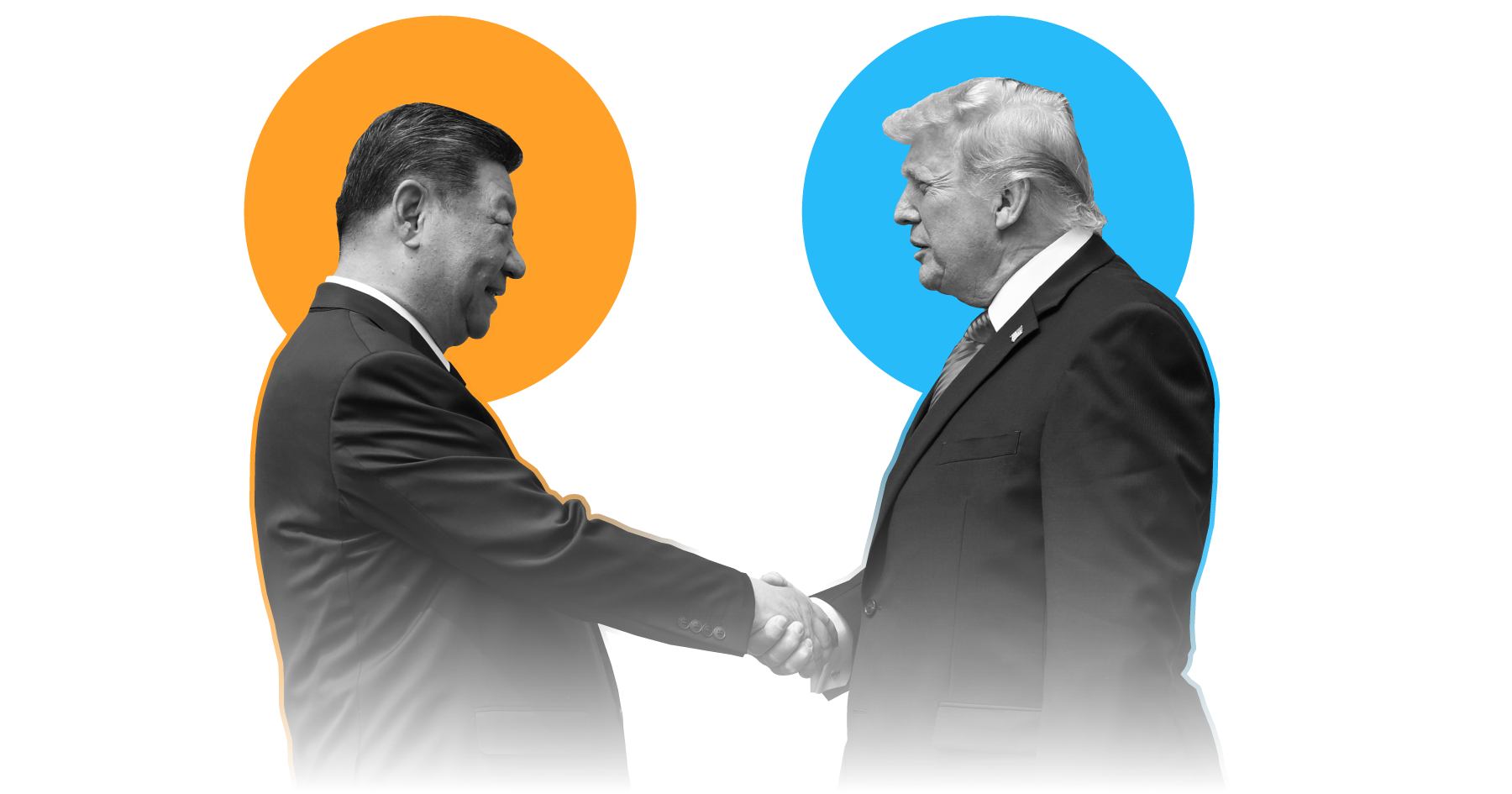
Trump hosted Xi Jinping in Washington with an unusually elaborate state welcome, including a 479-person military review, B-2 and F-22 flyover, and a dinner with Nvidia’s Jensen Huang, Apple’s Tim Cook and AMD’s Lisa Su. Despite the diplomatic display, Chinese business leaders were absent and US executives were excluded from formal talks, signaling limited prospects for new commercial agreements amid the spiraling US-China trade conflict. Semiconductor export restrictions remained salient, with Huang attending despite Nvidia’s top chips being barred from export to China.
Analysis
The investable signal is not diplomatic optics but the absence of a transaction framework: executive access without participation in formal talks suggests commercial concessions, if any, remain subordinate to national-security bargaining. That preserves a high probability of continued export-control friction for NVDA and AMD over the next 1-3 months, especially around accelerator performance thresholds, licensing rules and enforcement against transshipment. Markets should not capitalize dinner attendance into a reopening of the China AI revenue pool absent a written rule change or license approvals.
NVDA has the greatest headline sensitivity because China-derived data-center expectations remain a material narrative variable, but it also has the strongest ability to redirect constrained supply to hyperscalers elsewhere. AMD is more exposed to downside in relative terms: incremental China access would be strategically valuable for MI-series scale and software ecosystem adoption, while a sustained restriction regime cedes another cycle of installed-base advantage to NVDA and domestic Chinese alternatives. The second-order beneficiary of prolonged controls is Huawei-linked domestic substitution; BABA is not a clean beneficiary, as cheaper local compute improves cloud economics but restrictions may constrain frontier-model competitiveness.
For AAPL, the meeting marginally reduces near-term tail risk of retaliatory consumer or regulatory action, but does not alter the structural China-plus-one margin equation. The more relevant 6-18 month issue is whether détente slows supply-chain diversification: a softer political tone could defer costly redundancy spending, supporting gross margin near term, while increasing vulnerability if relations reverse. BA should not be repriced on protocol alone; an aircraft order, delivery authorization, or engine/parts agreement is required before treating China demand as recoverable backlog.
Contrarian view: the consensus may overread cordiality as de-escalation. The deliberate separation of commercial leaders from official negotiations is consistent with a managed rivalry, where symbolic stability lowers near-term incident risk but leaves technology restrictions intact. A durable risk-on rerating requires independently verifiable policy relief, not access or ceremony.
AllMind Terminal
AI-powered research, real-time alerts, and portfolio analytics for institutional investors.
Request TrialMarket Sentiment
Overall Sentiment
mixed
Sentiment Score
-0.05
Ticker Sentiment
Key Decisions for Investors
- Maintain/establish a 1-3 month relative short AMD versus long NVDA, sized market-neutral. Thesis: continued controls disproportionately limit AMD's accelerator scale opportunity while NVDA can allocate scarce supply outside China; cover if AMD reports material China licensing revenue, MI-series guidance accelerates materially, or the spread moves 12-15% in favor of NVDA.
- Do not chase NVDA on summit-related optimism. Use any policy-driven rally without a published Commerce rule change or explicit license approvals to trim tactical exposure; re-add only after verified China revenue guidance. Near-term risk/reward is asymmetric because the policy baseline remains restrictive.
- Keep AAPL as the preferred large-cap China-exposure long versus BABA over 6-18 months: AAPL has diversified manufacturing execution and less direct dependence on unrestricted frontier compute. Reassess if China-specific iPhone demand or services guidance deteriorates, or if India/Vietnam ramp costs drive gross-margin guidance below expectations.
- Put BA on a catalyst watch rather than initiate: buy only on confirmed Chinese aircraft orders or delivery-clearance language with financing and delivery timing. Without those details, the probability-weighted earnings impact is too low; a renewed China certification or delivery dispute would invalidate the trade.
More News
- Trump praises US-China friendship at state dinner with Xi Jinping
- Trump-Xi summit: Here’s what’s on the agenda, and why it matters
- Why Fervo Energy Stock Is Up Today
- The U.S. and China are quietly talking AI guardrails—even as Trump publicly rejects them
- Meta nears first new high in a year as Muse success showcases winning AI strategy
- What must happen for Boeing stock to get unstuck. The company needs, at least, to do its part