
Just Over a Year Since Inception, LumiBot Challenges Embodied AI's Data Bottleneck at IROS 2026
Source: PR Newswire
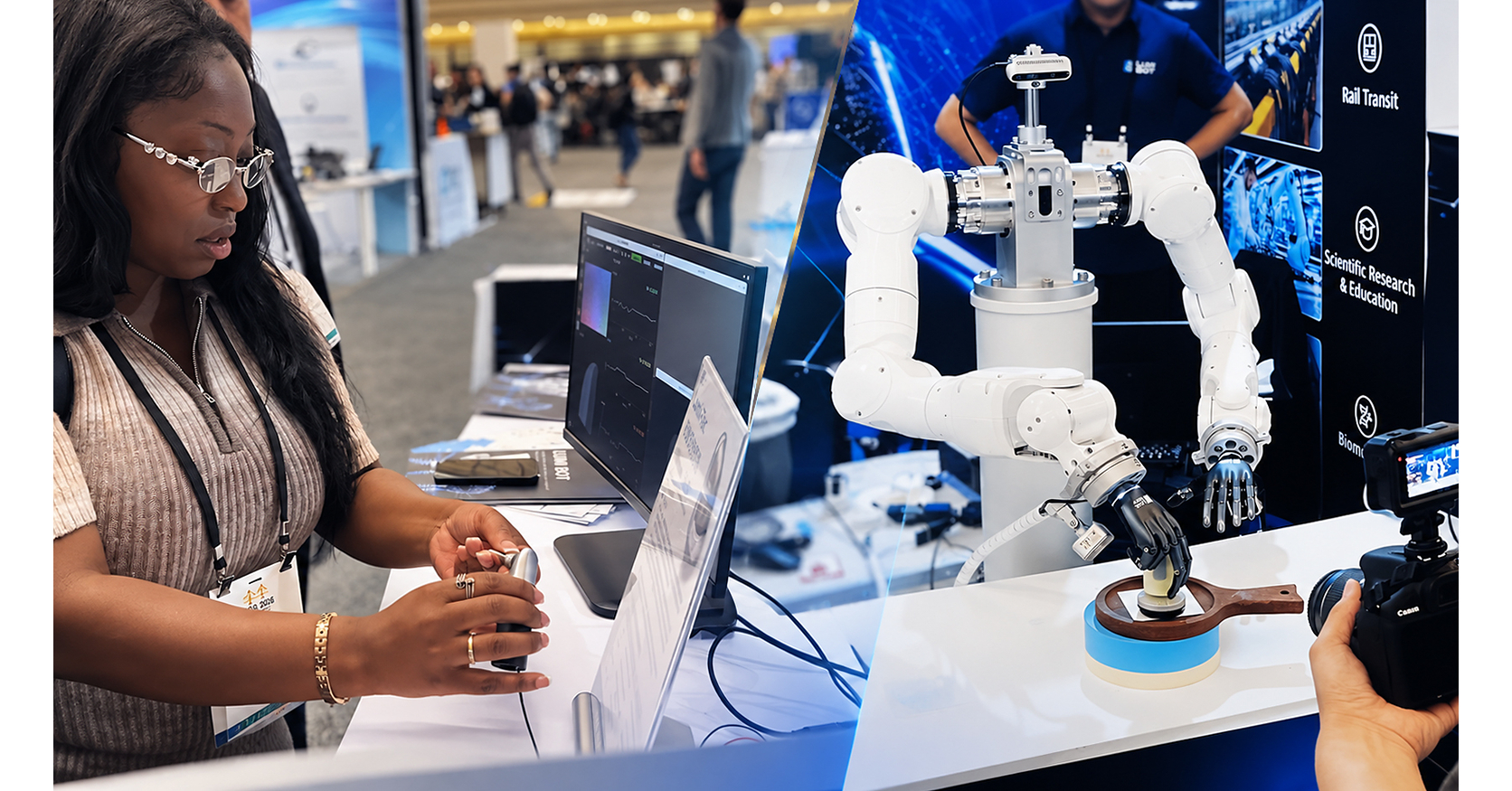
LumiBot showcased its embodied-AI hardware and manipulation-model stack at IROS 2026, targeting the scarcity of high-quality dexterous-robot data. Its upcoming active-cooled dexterous hand is designed for more than 5,000 hours of continuous no-load operation at around 50°C, while its Lumi-Tac V2 sensor offers 10-micron spatial resolution, 0.02N force-detection accuracy and 120 fps capture. The 2025-founded startup is conducting POCs with industry leaders in automotive manufacturing, 3C electronics and life sciences to validate scalable real-world deployment.
Analysis
This is not yet a public-equity catalyst, but it reinforces that embodied-AI value capture may migrate from foundation-model vendors toward the physical-data stack: end-effectors, force sensing, teleoperation, validation software, and factory integration. If reliable tactile manipulation becomes deployable, the earliest monetization should accrue to installed-base automation providers such as ABB, FANUY, and TER through higher-content robot cells, while CGNX benefits only where tactile systems complement rather than displace conventional machine vision. The critical economic variable is not demo capability; it is fully burdened cost per successful manipulation cycle versus labor, including maintenance, calibration, safety certification, and integration downtime.
Near-term, the claims should be treated as promotional until independent evidence emerges on loaded-cycle life, unit pricing, failure rates, and paid POC-to-production conversion. A fragmented proprietary hardware/data stack can create a useful data moat, but it can also constrain adoption if customers demand interoperable components and ownership of production data. The likely second-order effect is increased competitive pressure on lower-end gripper suppliers if dexterous hands move from research budgets to electronics assembly, lab automation, and automotive subassembly; however, widespread replacement of purpose-built automation remains a 6-18 month-plus question, not an immediate revenue event.
Contrarian view: investors may overvalue tactile-sensor specifications while underweighting the bottleneck of deployment engineering. Industrial customers generally pay for uptime and validated throughput, not higher-dimensional data streams; therefore, the winners may be systems integrators and established robot OEMs that can warranty a complete cell rather than component innovators. A durable re-rating of public robotics exposure requires disclosed production orders or measurable backlog conversion, not additional conference demonstrations.
AllMind Terminal
AI-powered research, real-time alerts, and portfolio analytics for institutional investors.
Request TrialMarket Sentiment
Overall Sentiment
moderately positive
Sentiment Score
0.42
Key Decisions for Investors
- No direct trade on LumiBot: it is private and the disclosed information lacks pricing, customer commitments, loaded-duty-cycle reliability, and POC conversion data. Create an alert for named production contracts in electronics, automotive, or life-sciences automation rather than extrapolating from technical demonstrations.
- Maintain a 3-6 month watchlist long ABB / FANUY / TER as liquid beneficiaries of higher robot-cell content; initiate only following evidence that customer capex is shifting from pilots to deployed manipulation cells. Favor ABB and TER where service, integration, and installed-base economics provide downside support.
- Use a relative-value framework rather than a broad AI-beta purchase: long ABB or TER versus a basket of high-multiple pure-play AI infrastructure exposure if industrial-automation orders accelerate. Falsify on sequential robotics-order weakness, declining factory-automation backlog, or a broad manufacturing-PMI downturn.
- Monitor CGNX carefully rather than assuming direct upside: tactile sensing could expand total automation sensing spend but may reduce reliance on optical inspection in contact-rich tasks. A downgrade in machine-vision guidance or evidence of bundled tactile/hand systems replacing standalone vision would support avoiding or hedging CGNX exposure.
More News
- Asian stocks dip, bonds in focus after torrid September
- Tencent leases 100,000 chips from Oracle for $7 bln- FT
- California Gov. Gavin Newsom bans AI 'robo bosses' in landmark state law, reversing his earlier veto
- RAM supply set to worsen, says Micron, as CEO celebrates ‘much higher’ prices
- Why is Kioxia stock rallying today?
- Nidec Corp shares slump after auditor declines to sign off on earnings
From AllMind Research
- Anthropic IPO Preview: Valuation, Timing, and What to Watch
- Shein After the IPO: Venue, Valuation, and What Must Be Proved
- What AI Research Tools Should a Small Hedge Fund Buy First?
- How to Build an Automated Research Process for a Fund
- Weekly Update: AI-Powered Report Editing, Investor Relations, and Enhanced Search