
Temu helps European small businesses expand internationally and create new jobs, survey shows
Source: PR Newswire
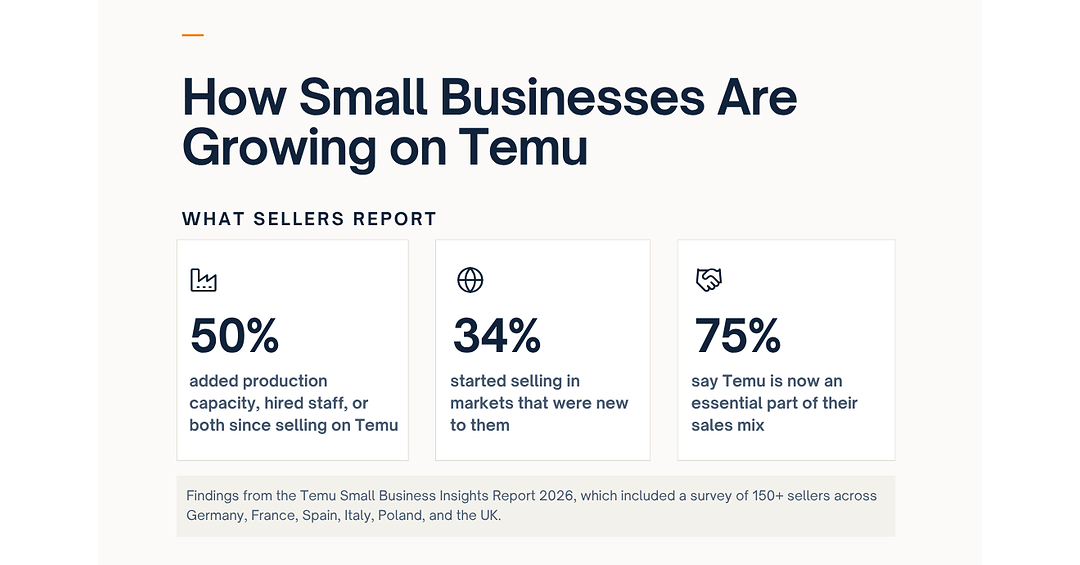
Temu’s European Small Business Insights survey of 152 sellers reports operational growth since joining: 50% increased capacity and/or hired staff, and 34% expanded into new international markets. A majority (75%) say Temu is an important or primary sales channel, with 43% citing the platform’s accessibility and 35% valuing its fair cost structure; 65% highlight dedicated seller support. Examples cited include 4,000 orders/month for a Spanish spare-parts firm and over a million orders fulfilled in the UK since early 2025, suggesting modest positive momentum for Temu’s seller ecosystem, though this is survey-based marketing rather than financial results.
Analysis
Temu is less interesting as a retailer than as a low-cost demand router for fragmented merchants. If that model holds, the structural winner is any platform that can monetize third-party inventory and merchant tooling at scale; the loser is the long tail of local retailers that still depend on paid acquisition and country-by-country launches. The second-order effect is more price transparency across Europe, which tends to compress gross margins for niche sellers even when unit volumes rise.
The immediate financial read-through is modest: a survey does not prove durable retention, monetization, or that sellers are making incremental profits after shipping, returns, and platform fees. What matters over the next 1-3 months is whether this channel meaningfully changes merchant mix and traffic economics for large marketplaces like AMZN and SHOP, versus just acting as a promotional funnel. If Temu is truly lowering CAC for smaller brands, that is bullish for shipment and payment volume but bearish for standalone DTC operators with weaker balance sheets.
The contrarian risk is that the market may underestimate how much seller growth can coexist with merchant margin pressure. A platform can be "good for jobs" while still accelerating commodity pricing and increasing regulatory scrutiny around product safety, data access, and cross-border marketplace rules. Over 6-18 months, the thesis breaks if EU enforcement tightens or if logistics/return costs rise enough to destroy the merchant economics that make the channel attractive in the first place.
AllMind Terminal
AI-powered research, real-time alerts, and portfolio analytics for institutional investors.
Request TrialMarket Sentiment
Overall Sentiment
mildly positive
Sentiment Score
0.25
Key Decisions for Investors
- No immediate outright trade; treat this as a watch item on marketplace economics rather than a standalone catalyst.
- Use AMZN and SHOP as the cleaner expressions of the theme: buy dips only if upcoming commentary confirms third-party seller growth and stable fulfillment economics; 1-3 month horizon.
- Pair trade idea: long SHOP / short XRT on evidence that merchant multichannel adoption is accelerating, with the short leg hedging weaker-priced discretionary retail exposure; target a 5-10% spread move if the theme persists.
- Avoid chasing ETSY on this headline alone; the platform benefits from discovery, but the article reinforces broader price-comparison pressure that can cap multiple expansion. Best used as a relative short versus marketplace beneficiaries if consumer spending softens.
- Set a regulatory alert on EU marketplace scrutiny: if product-safety or platform-fairness actions intensify, fade any bounce in Temu-adjacent logistics and e-commerce names immediately.
More News
- CoreWeave credit default swaps hit distress levels as investors sour on AI debt
- Treasuries Soar as Tech Slump Threatens Growth
- Penske Automotive agrees to be taken private by Penske, Mitsui
- Faraday Copper completes acquisition of BHP’s San Manuel project
- Supermicro promised a new CFO in December 2024. A $2.5 billion smuggling case and a co-founder’s arrest later, it has one
- Blackstone President Jon Gray Bets Big on AI Boom