
DaVinci Commerce Unveils Brand Agent Featuring Patent-Pending Product Context Memory For Personal AI Agents
Source: PR Newswire
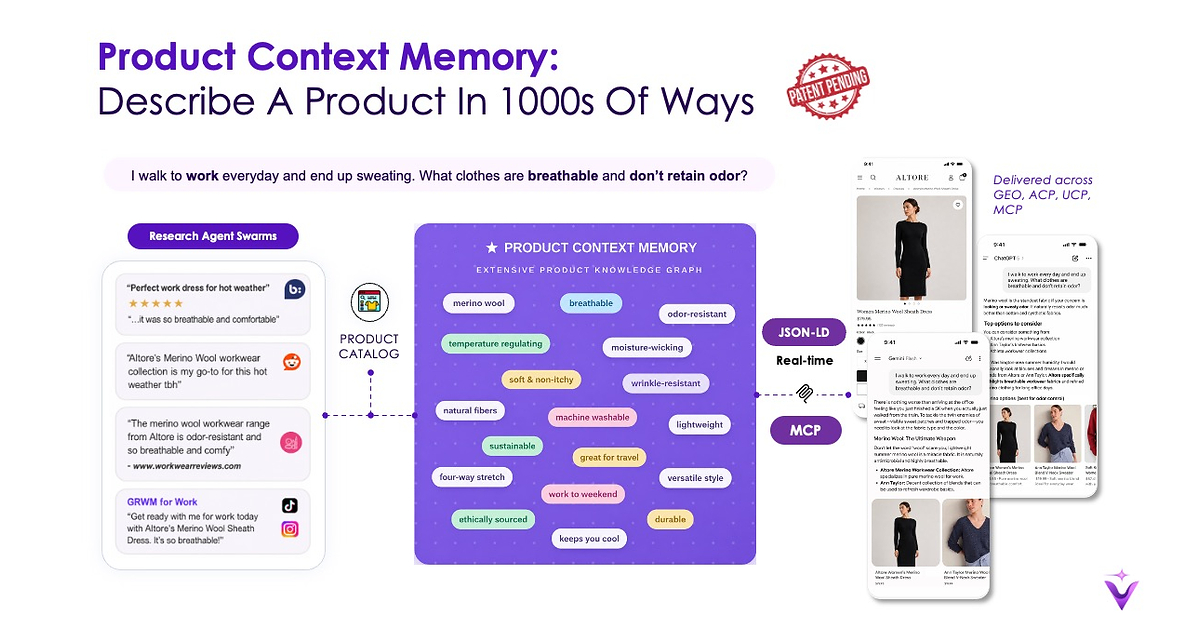
DaVinci Commerce says its expanded Agentic Commerce Experience Platform, including Brand Agent, Agentic Discoverability Engine and patent-pending Product Context Memory, is available beginning October 1, 2026. The platform is designed to enrich SKU-level product context, distribute machine-readable product information to AI shopping agents, and offer conversational brand shopping experiences; the announcement provides no financial or adoption figures.
Analysis
The investable question is not whether richer product metadata helps recommendations; it is who controls the product schema, ranking, attribution and checkout as AI shopping develops. DaVinci’s pitch could reduce brands’ dependence on retailer-specific catalog work, but it does not by itself transfer customer ownership away from Amazon or Walmart. Those platforms can accept better structured data while retaining control of ranking, sponsored placement and transaction economics—so the near-term read-through is more likely incremental tooling than platform disintermediation. Meta’s potential discovery role is similarly unproven without evidence of shopping intent converting into attributable sales.
For consumer brands such as Diageo and Nestlé, better contextual matching could improve qualified discovery, but any benefit depends on adoption by major agents and measurable conversion lift, not mentions or share-of-voice dashboards. The release supplies no customer deployment, pricing, recurring revenue, or controlled outcome data; named customer relationships and Accenture’s backing do not establish material revenue exposure for DEO, NESN or ACN.
Over 1–3 months, the catalyst is evidence of paid deployments and independently verifiable before/after conversion or retailer-page traffic. Over 6–18 months, standardized product-data protocols could commoditize enrichment while making authoritative product facts and consumer intent data more valuable. Key reversals: agent platforms decline third-party feeds, restrict access, or keep recommendations closed; alternatively, retailer adoption could validate the category. Contrarian view: the launch frames discoverability as a new infrastructure layer, but platforms may treat it as a feature and preserve their own data and monetization advantage.
AllMind Terminal
AI-powered research, real-time alerts, and portfolio analytics for institutional investors.
Request TrialMarket Sentiment
Overall Sentiment
mildly positive
Sentiment Score
0.20
Ticker Sentiment
Key Decisions for Investors
- No directional trade on this announcement alone: the vendor is not a mapped listed company, and the release lacks commercial scale or verified lift data.
- Track AMZN and WMT for signs that third-party structured product feeds are accepted without surrendering control of ranking, ads, or checkout. A meaningful change in those economics—not catalog enrichment by itself—would challenge the platform-control thesis.
- Treat DEO, NESN and ACN as watch items, not beneficiaries to buy: verify paid contracts, deployment scope, renewal rates and attributable conversion before assigning material earnings value.
- Revisit the thesis over the next 1–3 months if the company or customers publish controlled SKU-level results tied to sales or product-page traffic. Falsification would be limited retailer/agent adoption, no measurable conversion improvement, or platform restrictions that prevent distribution.
More News
- Security researcher claims to they found KVM guest-host escape flaw
- SpaceX stock climbs to highest since June, returning Musk to trillionaire status
- Security researcher claims they found KVM guest-host escape flaw
- Cocoa prices are climbing again. Here’s why this time is different
- U.S. stock futures steady after Nasdaq hits record on reduced Fed hike bets
- Wall Street rewards Microsoft's AI pivot. A longtime skeptic says it's just the beginning
From AllMind Research
- Anthropic IPO Preview: Valuation, Timing, and What to Watch
- Shein After the IPO: Venue, Valuation, and What Must Be Proved
- What AI Research Tools Should a Small Hedge Fund Buy First?
- Automating Financial Model Updates: A Source-Controlled Workflow
- Weekly Update: Live Event Center, In-App Documents, and Faster Transcripts