
Compal présente l'infrastructure « NVIDIA AI Factory » à l'OCP Global Summit 2026
Source: PR Newswire
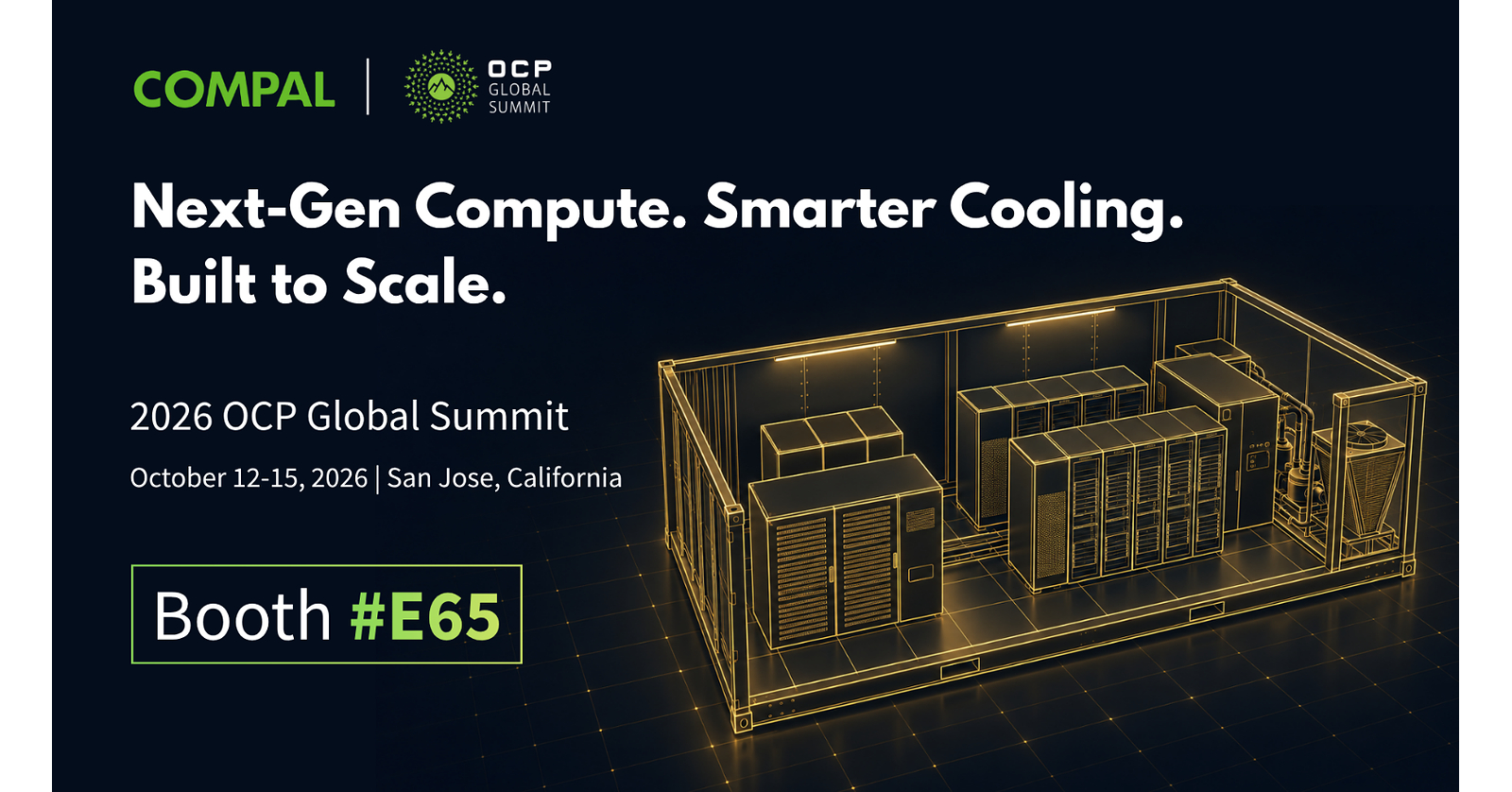
Compal will showcase its NVIDIA AI Factory infrastructure at the OCP Global Summit 2026, centered on 800V DC power architecture, megawatt-scale power delivery and advanced liquid cooling for high-density AI data centers. The company is positioning its offering as an integrated rack-to-GPU platform combining NVIDIA accelerated computing, thermal management and power infrastructure. The announcement highlights Compal's expansion beyond standalone servers into scalable AI-factory deployments, but provides no financial guidance, customer commitments or revenue figures.
Analysis
This is directionally supportive for NVDA’s platform moat, but it is not a near-term earnings catalyst: the binding constraint for frontier AI deployments is shifting from GPU availability toward power delivery, utility interconnection, and heat rejection. Suppliers able to deliver validated rack-level systems reduce deployment risk for hyperscalers, which can improve the effective utilization and attach rate of NVDA accelerators; however, Compal’s announcement alone provides no evidence of committed volume, customer qualification, or incremental revenue.
The more investable second-order exposure is electrical and thermal infrastructure. A move toward higher-voltage DC architectures raises content per megawatt for power conversion, switchgear, busway, liquid cooling and monitoring, favoring VRT, ETN, HUBB and MOD over server assemblers, whose margins remain vulnerable to ODM competition and customer concentration. Over the next 6-18 months, adoption could also pressure legacy air-cooling and lower-density data-center designs, but the transition will be gated by safety standards, utility approvals and hyperscaler reference architectures rather than component availability.
Consensus risk is that every AI-infrastructure demonstration is being capitalized as immediate demand. The relevant KPI is not OCP visibility but disclosed megawatt-scale orders, backlog conversion, and cooling/power revenue growth versus compute-system revenue. A slower utility-permitting cycle or an NVDA architecture change that reduces rack-level power intensity would defer infrastructure spend and compress premium multiples in the power-and-cooling complex before it materially affects GPU demand.
AllMind Terminal
AI-powered research, real-time alerts, and portfolio analytics for institutional investors.
Request TrialMarket Sentiment
Overall Sentiment
mildly positive
Sentiment Score
0.38
Ticker Sentiment
Key Decisions for Investors
- No incremental NVDA position solely on this release; retain core exposure only if upcoming results show sustained data-center growth and management indicates that customer deployment constraints are not pushing orders out. A material reduction in forward data-center guidance or evidence of rising uninstalled inventory falsifies the supportive read-through.
- Use 1-3 month pullbacks to build a basket long VRT / ETN / HUBB, with VRT as the highest-beta thermal-and-power exposure. Target a 15-25% upside over 6-12 months if backlog and order growth remain above expectations; exit or hedge if bookings decelerate for two consecutive quarters or valuation expansion is unsupported by backlog conversion.
- Prefer a pair trade long VRT versus short a broad server-ODM proxy only after confirming that liquid-cooling and power backlog is accelerating faster than server revenue. The thesis is higher infrastructure content per MW and less commoditized economics; key risk is hyperscaler capex deferral, which would hit both legs but could disproportionately impair VRT’s premium multiple.
- Monitor Compal (2324 TT) for customer-design-win disclosures, rack-scale shipments, and gross-margin progression before treating it as a direct AI-factory beneficiary. Until those data emerge, its infrastructure narrative is a watch item rather than a tradable catalyst.
More News
- RAM supply set to worsen, says Micron, as CEO celebrates ‘much higher’ prices
- Tencent leases 100,000 chips from Oracle for $7 bln- FT
- We're raising our Micron price target after an incredible quarter and robust guidance
- Micron beats on revenue and earnings as global memory shortage continues
- Trump’s AI lunch included every major tech company. Except Apple
- OpenAI is sued over rogue AI Hugging Face cyberattack
From AllMind Research
- Anthropic IPO Preview: Valuation, Timing, and What to Watch
- Shein After the IPO: Venue, Valuation, and What Must Be Proved
- What AI Research Tools Should a Small Hedge Fund Buy First?
- Stop Treating AI Like a Chatbot: What Are Agents, SubAgents, MCP, and Skills, and How Do They Actually Work?
- Earnings-Triggered Research Automations: A Control Guide