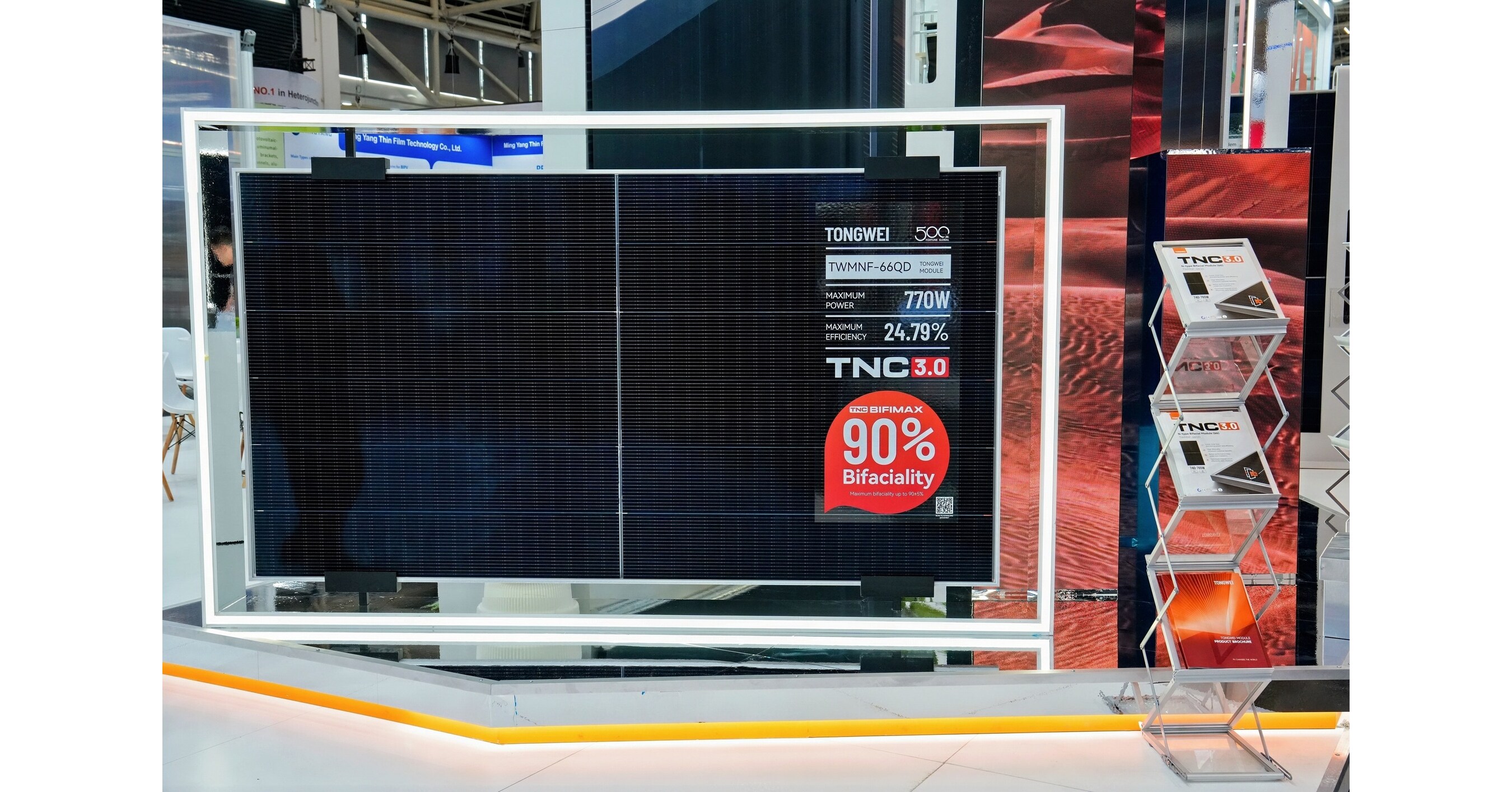
Tongwei stellte auf der Intersolar Europe 2026 das neue Premium-Solarmodul TNC 3.0 BIFIMAX vor (weltweite Premiere) mit bis zu 93,07% Bifazialitätsrate, bis zu 770 W Leistung und 24,8% Wirkungsgrad (TÜV Rheinland zertifiziert). Für eine 100-MW-Anlage in Hamburg bedeutet die höhere Bifazialität gegenüber Standardmodulen zusätzlich ca. 180.000 € pro Jahr bzw. insgesamt +81,62 Mio. kWh Lebensdauerstrom. Zudem werden extreme Wetterbedingungen durch einen niedrigen Temperaturkoeffizienten von -0,26%/°C sowie eine „Louvred Interconnection“-Technologie adressiert; Tongwei zeigte außerdem das für Privathaushalte optimierte TNC 2.0 G12R-48 (bis 480 W, 24% Wirkungsgrad) mit „All-Day“-Mehrertrag.
This is more of a competitive signaling event than an investable fundamental inflection. The incremental economic value of higher bifaciality is real, but it accrues primarily to project owners in high-albedo, utility-scale installs; for module makers it is usually competed away through pricing, especially in an oversupplied market. That means the likely winners are tracker vendors and EPCs that can package the higher yield into better project IRRs, while the losers are lower-spec module brands that lack differentiation and will be forced to match features without preserving margin.
The bigger second-order risk is that product-level innovation accelerates commoditization instead of creating moat. If every top-tier Chinese supplier can claim similar efficiency and durability within 1-2 quarters, the market shifts from "who has the best module" to "who can finance, warranty, and deliver at the lowest all-in cost," which is usually bad for gross margins and good for downstream buyers. In Europe, that shifts bargaining power toward utility developers and away from module OEMs; in the U.S., it modestly supports tracker adoption and utility-scale buildout, but only if rates and interconnection bottlenecks do not reassert themselves.
The contrarian view is that the market may overread a technical milestone as a profit catalyst. Certification and a demo install do not prove pricing power, backlog conversion, or margin expansion, and the key falsifier is any evidence that ASPs hold firm while volumes rise. Over the next 1-3 months, watch whether module makers report stable gross margins despite continuing price competition; over 6-18 months, the real value capture likely migrates to system integrators, trackers, and balance-of-system suppliers rather than to module manufacturers themselves.
AI-powered research, real-time alerts, and portfolio analytics for institutional investors.
Request TrialOverall Sentiment
mildly positive
Sentiment Score
0.35
