
Huawei запускает Fintelligent AI Solution, чтобы помочь глобальным финансовым учреждениям реализовать принцип «Владей ИИ, владей интеллектом»
Source: PR Newswire
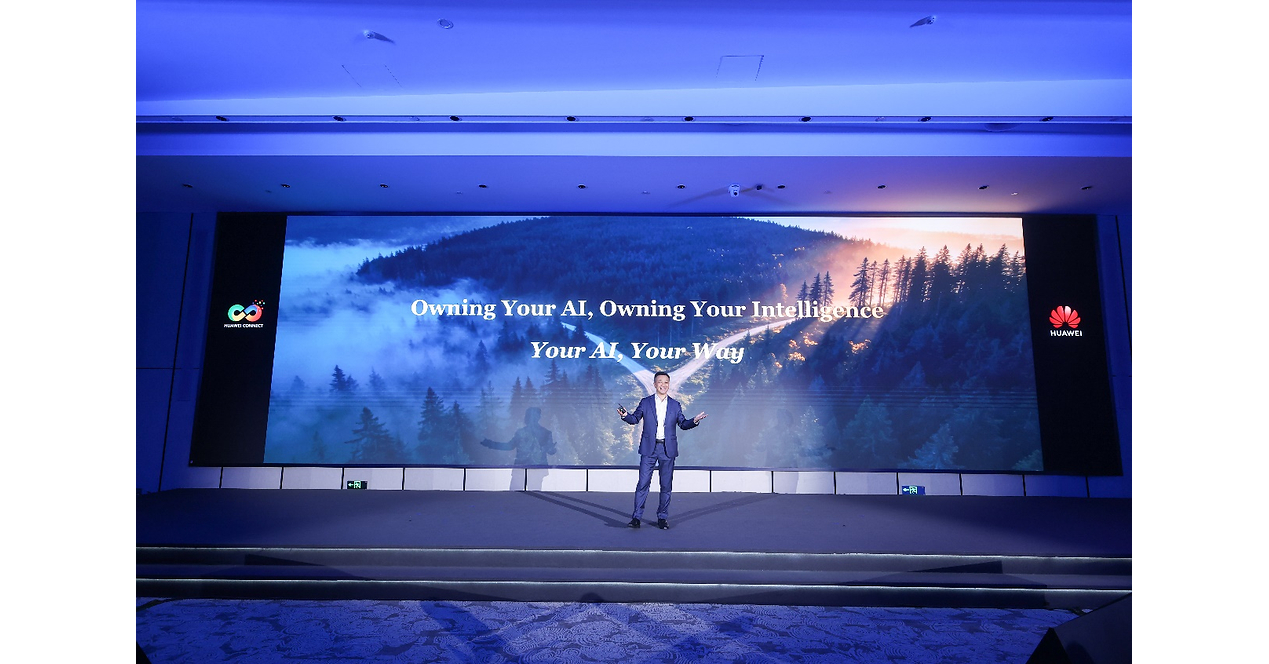
Huawei launched its global Fintelligent AI Solution at HUAWEI CONNECT 2026, targeting financial institutions' AI security, scalability and operational-resilience requirements. The offering combines agent, token and data-knowledge factories, including the open-source openJiuwen multi-agent platform, TokeNexus token-lifecycle management and Financial Agentic Data Solution. Huawei said it serves more than 7,100 financial clients across 80+ countries, including 54 of the world's 100 largest banks, positioning the launch as an enterprise-scale expansion of its financial AI ecosystem.
Analysis
This is strategically more relevant to AI infrastructure localization than to near-term bank IT spending. A credible bank-grade deployment stack would lower switching costs for institutions constrained by data-residency, sanctions, or vendor-concentration concerns, creating incremental pressure on NVIDIA's China-facing inference opportunity and on IBM/ORCL services-led AI deployments in regulated markets. The key second-order effect is that banks may standardize around sovereign, on-premise AI architectures before selecting foundation models, shifting value from model vendors toward hardware, integration, governance, and data-management layers.
The announcement itself provides no independently verifiable bookings, customer conversion, compute volumes, or pricing; therefore it is not a standalone catalyst for public equities. Over the next 1-3 months, the relevant validation points are disclosed deployments at large banks, evidence of production workloads on Huawei Ascend hardware, and whether implementation partners commit resources. Over 6-18 months, success would increase fragmentation of the financial-AI stack, reducing the durability of hyperscaler and US GPU vendor assumptions that regulated-enterprise AI workloads will remain concentrated in their ecosystems.
Consensus likely overstates the immediate threat to NVIDIA: financial institutions have long procurement cycles, stringent model-risk controls, and substantial legacy-core integration burdens. However, consensus may underprice the asymmetry in China and other sovereignty-sensitive markets, where an integrated domestic stack can win despite inferior frontier-model performance if it offers predictable supply, local support, and auditability. The tradeable signal is thus competitive and regional rather than a broad AI-demand inflection.
AllMind Terminal
AI-powered research, real-time alerts, and portfolio analytics for institutional investors.
Request TrialMarket Sentiment
Overall Sentiment
moderately positive
Sentiment Score
0.42
Key Decisions for Investors
- No directional trade solely on this launch; treat it as an alert for NVIDIA (NVDA) China/regulated-market inference exposure. Reassess if Huawei discloses multiple tier-one financial production wins or material Ascend compute commitments before the next NVDA earnings cycle.
- Maintain a 6-12 month relative-value watch: short NVDA versus long broad semiconductor exposure (SMH) only if China revenue resilience remains embedded in estimates while evidence emerges of meaningful domestic inference substitution. Falsification: NVDA reports stable or growing China-related data-center demand and Huawei fails to disclose deployable-scale financial workloads.
- For Asia technology exposure, favor diversified AI beneficiaries such as TSMC (TSM) and ASML (ASML) over a concentrated China-inference thesis; they retain broader demand drivers even if sovereign AI stacks fragment end markets. Reduce this preference if export restrictions materially impair advanced-node wafer demand or capex guidance.
- Monitor FIS, FISV, GPN, ORCL, and IBM for regulated-finance implementation commentary rather than buying on the headline. A sustained shift toward self-hosted agent platforms would pressure services and legacy-platform renewal economics only if customers cite AI-stack consolidation, lower external-software spend, or delayed modernization contracts.
More News
- Wall Street’s Nasdaq hits all-time high as AI frenzy gathers pace
- Data-Center Bet Makes ESDS One of India’s Best New Listings
- Asia stocks ride tech wave higher, oil stays subdued
- Trump Says US Team Met With Iranians at UNGA
- Morgan Stanley thinks investors should diversify into these markets
- How Kevin Warsh’s rate hike exposed a 2-speed U.S. economy, with AI and housing at the poles