
Is a Stock Market Crash Coming? What History Says a $10,000 Investment in an S&P 500 ETF Could Be Worth at the End of 2027.
Source: fool.com
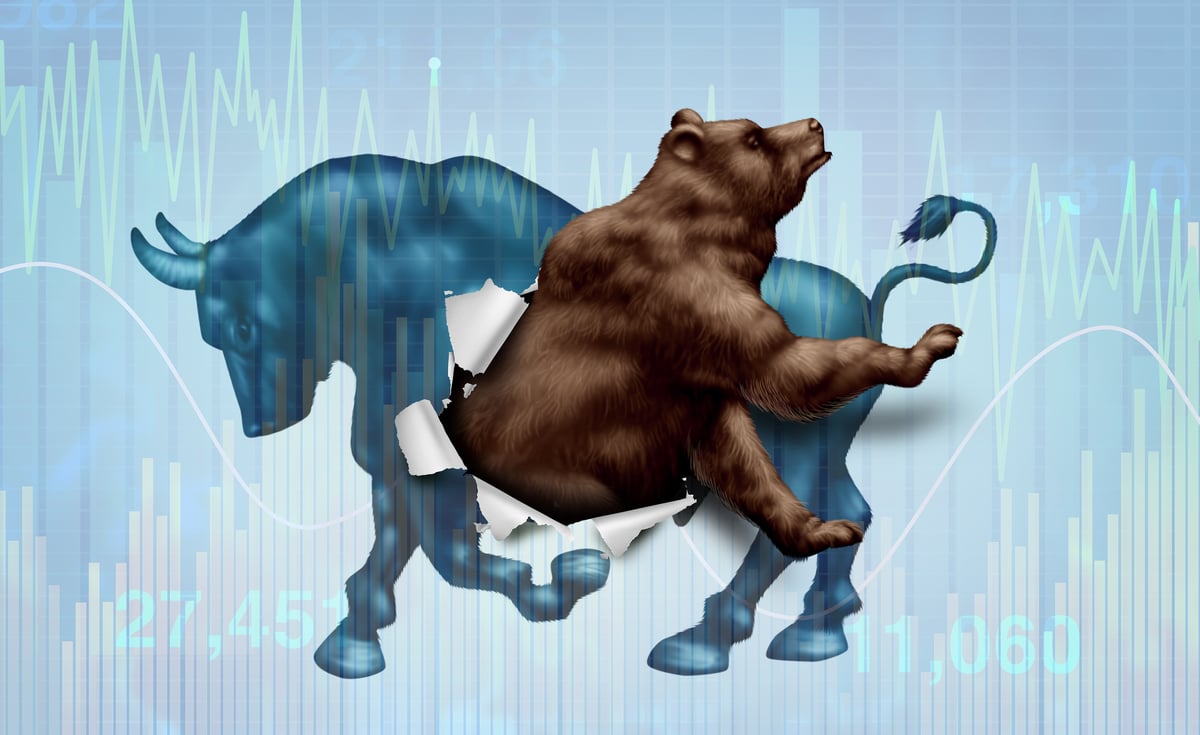
The article outlines a possible 30% bear-market loss that could reduce a $10,000 S&P 500 ETF investment to about $7,000 by year-end 2027, but also presents a historically favorable post-midterm scenario in which it could reach nearly $11,500. The S&P 500 is more concentrated in AI-linked technology stocks than during the dot-com boom, though valuations are lower: tech trades at about 19 times forward earnings versus as high as 48 times then, and the index PEG ratio is around 0.7. The author expects AI spending and the bull market to continue, while warning that slowing revenue alongside ongoing hardware refreshes could squeeze margins; the article recommends dollar-cost averaging rather than market timing.
Analysis
The key portfolio risk is not simply whether AI is “in a bubble”; it is that index-level exposure is increasingly a concentrated bet on a small set of earnings and capex assumptions. If AI revenue growth disappoints while infrastructure replacement spending persists, weaker cash returns could pressure both hyperscaler margins and the expected growth supporting their valuations. Because those firms have outsized index weights, estimate revisions could transmit quickly into broad-index returns and passive flows. Conversely, solid monetization and continued earnings delivery could keep the index supported even if valuation multiples compress.
The cited lower valuation measures are not reliable downside protection on their own: aggregate PEG depends on forecast growth, which is especially vulnerable to downward revisions when leadership is concentrated. Midterm-year seasonality is a weak timing signal, not a substitute for evidence on earnings, positioning, or valuation. Near term, watch breadth and forward estimate revisions; over 1–3 months, monitor disclosed AI capex against cloud revenue or other monetization indicators. Over 6–18 months, the hardware refresh cycle makes returns on deployed capital and depreciation policy more consequential.
The article supplies no current positioning, options pricing, or company-level capex/monetization data, so it does not support a high-conviction outright short. The named WMT, C, GE, HD, and XOM are historical index-composition examples, not evidence of company-specific catalysts.
AllMind Terminal
AI-powered research, real-time alerts, and portfolio analytics for institutional investors.
Request TrialMarket Sentiment
Overall Sentiment
mixed
Sentiment Score
0.05
Key Decisions for Investors
- Do not increase broad-index risk solely on the cited seasonal record or low PEG reading. Keep strategic exposure aligned with mandate; treat both statistics as weak timing inputs.
- Alert: if AI-leading companies report slowing monetization while capex and depreciation continue rising, consider a defined-risk 3–6 month put spread on a broad S&P 500 ETF as a hedge. Enter only after checking implied volatility and hedge cost; the thesis is falsified by stabilizing estimate revisions and improving returns on AI investment.
- Consider a modest relative-value tilt toward equal-weight S&P 500 exposure versus cap-weighted exposure if index breadth deteriorates or leadership narrows further. Reduce the tilt if earnings breadth improves and the largest constituents continue to deliver.
- Track quarterly capex, cloud-related revenue growth, and useful-life/depreciation assumptions. A widening gap between investment and monetization is the clearest catalyst for margin-risk repricing; absent that evidence, avoid treating a crash as the base case.
More News
- Citi, BCA downgrade Brazilian assets after Lula comeback
- Wall Street sees this chip stock as the big winner from the Anthropic IPO
- Walmart says AI training is boosting confidence with the technology among its 2.1 million associates
- Manhattan Associates in the spotlight: Cloud growth on trial
- Where Cramer stands on two beaten-down aerospace stocks — and the one to buy
- American Airlines hikes annual fees on rewards cards for first time since 2018