
jQuery Versions Linked to Known Security Flaws Detected On 40 Of 84 Japanese Websites Scanned
Source: Newswire
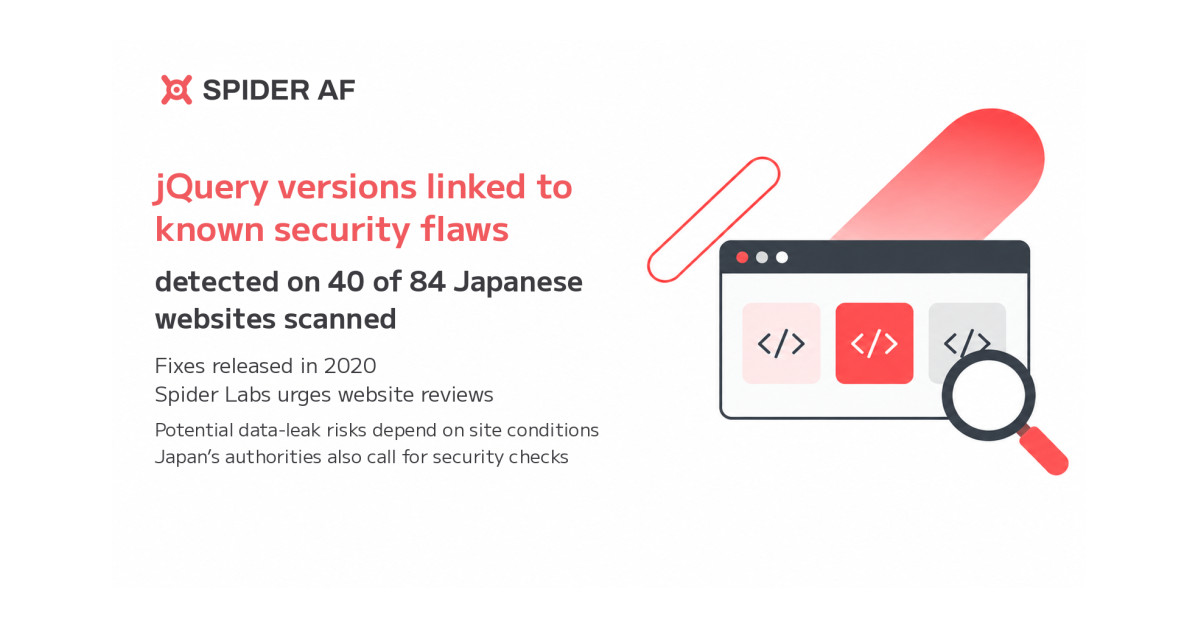
Spider Labs detected jQuery versions associated with CVE-2020-11022 and CVE-2020-11023 on 40 of 84 Japanese websites scanned (47.6%); the vulnerabilities were fixed in jQuery 3.5.0 in April 2020. Across the sample, 56 sites (66.7%) had libraries or scripts linked to known vulnerabilities, but the scan did not verify exploitability or breaches and is not an estimate of prevalence across Japan. The findings come as publicly reported cyberattack-related data-leak incidents in Japan reached 454 from January through September 2026, up 49% year over year.
Analysis
The signal is operational, not yet an earnings event. The scan is a small, commercially sourced sample—not a representative estimate—and version matching can flag software with backported fixes. It establishes neither exploitability nor a breach. Treating the 47.6% figure as evidence of broad corporate exposure would overstate the case.
The more investable mechanism is governance: organizations that outsource web maintenance may face pressure to clarify patch ownership, inventory third-party code, and test legacy pages. That can support incremental work for cybersecurity assessors and web-maintenance providers, but the jQuery fixes are years old and may be inexpensive to implement; this alone does not support a broad cybersecurity-spending upgrade. Conversely, rushed library migrations could disrupt checkout or forms, creating near-term execution risk for exposed e-commerce operators, though the article identifies no affected companies.
Over the next 1–3 months, watch for named-company disclosures, regulator follow-through, or procurement evidence—not additional vendor scans. Over 6–18 months, recurring breach scrutiny could favor providers offering continuous asset inventories and patch management over one-off scans. The contrarian point: the larger risk may be unclear post-launch responsibility, not jQuery specifically. The thesis weakens if independent testing finds fixes already backported or if there is no measurable rise in remediation budgets or incidents tied to these flaws.
AllMind Terminal
AI-powered research, real-time alerts, and portfolio analytics for institutional investors.
Request TrialMarket Sentiment
Overall Sentiment
mildly negative
Sentiment Score
-0.20
Key Decisions for Investors
- No directional equity trade on this release: the sample is small, selected through sales demonstrations or trials, and does not identify affected companies or verify exploitation.
- Put cybersecurity assessment and web-maintenance providers on a 1–3 month watchlist; seek evidence of recurring contracts and budget conversion before expressing a sector view.
- Avoid shorting Japanese e-commerce or other web-facing companies based on the scan. Reassess only if a named operator reports an incident, customer impact, or material remediation costs.
- Monitor independent validation of the findings, including backported fixes, affected-page usage, and whether regulators move from general patch guidance to enforceable requirements.
More News
- Analysts react as Binance freezes assets after $6.3 billion security breach
- Stocks slump, bonds leap as AI giants’ spending spooks investors
- Factbox-Where Binance’s $6.3 billion breach ranks in crypto’s biggest hacks and heists
- PC chip plunge wipes out a quarter of Intel’s value
- Intel plunges on a major guidance miss. What went wrong — and how to proceed
- Circle, Tether freeze funds impacted by potential Binance 'security issue'