
Performance Brokerage Services Advises on the Purchase of Mansfield Motor Group, a Three-Rooftop Nissan, Honda, and Volvo Dealership Group, in Mansfield, Ohio, from Dirk Schulter & Brett Schulter to Clement Auto Group
Source: PR Newswire
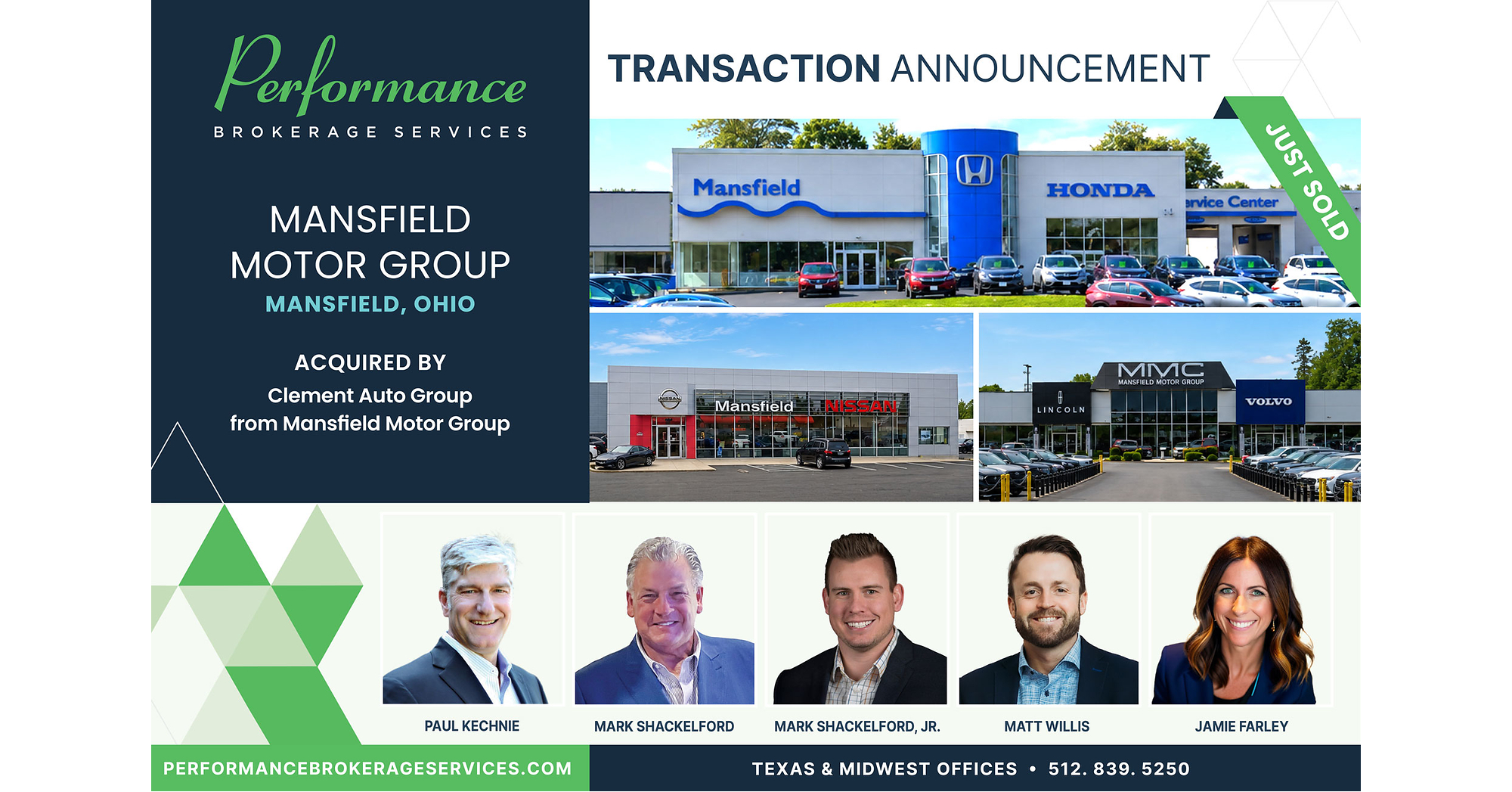
Clement Auto Group acquired Mansfield Motor Group, a three-rooftop Nissan, Honda and Volvo dealership group in Mansfield, Ohio, marking Clement's first entry into the Ohio market. The dealerships will retain their current locations and be renamed Clement Honda, Clement Nissan and Clement Volvo Cars of Mansfield. Financial terms were not disclosed; the transaction extends Clement's dealership footprint beyond its Greater St. Louis-area operations.
Analysis
This transaction is immaterial to F, HMC and VOLCAR.B earnings, but it is a modest datapoint that private dealer capital remains willing to underwrite multi-brand, secondary-market rooftops. The more relevant read-through is for U.S. franchise dealers: consolidation can improve fixed-operations utilization, inventory allocation and local advertising efficiency, supporting dealership profitability even if new-vehicle unit demand softens. Public dealer groups LAD, AN and PAG are better market proxies than the OEMs, although a single three-store acquisition does not establish a valuation trend.
For OEMs, an acquisitive, well-capitalized dealer owner may improve retail execution and service retention, but any benefit is too localized to affect reported results. Honda's generally tighter inventory and stronger residual-value positioning could make its franchise the most economically attractive rooftop in the group; Volvo's exposure is more sensitive to luxury demand and EV residual values, while Nissan remains more dependent on incentives. The second-order risk is that further dealer consolidation increases retailers' negotiating leverage over OEM stair-step programs, floorplan support and allocation practices.
Near term, there is no standalone trade signal. Over the next 1-3 months, the investable confirmation would be evidence that regional dealership transactions are clearing at stable or rising blue-sky multiples despite elevated floorplan costs; that would support a rerating case for LAD/AN/PAG. A reversal would be rising used-vehicle depreciation, higher incentive intensity, or declining dealership service absorption, each of which would impair acquisition returns and make consolidators less willing to deploy capital.
Contrarian view: dealer M&A is often interpreted as a clean demand signal, but buyers can be motivated by scarcity of franchises and expectations of expense synergies rather than an improving retail cycle. If financing costs remain restrictive, the advantage shifts toward cash-generative public consolidators and away from smaller private buyers; this is constructive for scaled listed dealers but not necessarily for OEM volumes or margins.
AllMind Terminal
AI-powered research, real-time alerts, and portfolio analytics for institutional investors.
Request TrialMarket Sentiment
Overall Sentiment
mildly positive
Sentiment Score
0.35
Ticker Sentiment
Key Decisions for Investors
- No action in F, HMC or VOLCAR.B from this event; the implied earnings impact is de minimis and the press release provides no purchase price, financing terms, throughput, or profitability data.
- Place a 1-3 month watch on long LAD or AN versus short XLY: initiate only if upcoming earnings show stable service/fixed-ops gross profit and management commentary indicates unchanged acquisition underwriting despite funding costs. Target 10-15% relative upside; exit if same-store gross profit or service absorption deteriorates materially.
- Prefer HMC over F and VOLCAR.B on a 6-12 month dealer-channel basis: stronger franchise economics and lower reliance on incentive-led volume should better protect dealer returns. Falsify on a meaningful North American incentive increase or a material decline in Honda dealer inventory turn.
- Monitor Cox/Haig-style dealership transaction multiple data and auto ABS/floorplan spreads. A widening in financing spreads or a sustained rise in used-vehicle depreciation would invalidate the consolidation-supports-public-dealers thesis and argues against new exposure.
More News
- How Pepsi fell behind in the cola wars—and then lost KFC
- Braskem creditors, shareholders near deal on $11bn debt restructuring
- Brookfield to open Qatar office as it expands Middle East operations
- The experience economy keeps defying expectations. Maybe we’ve been looking at it all wrong
- ‘We like to be first to be second’: How True Religion’s CEO is rebuilding the denim brand for Gen Z and millennials
- Trump set to announce plan by Audi to build a U.S. factory in Georgia, source says