
Global Spirulina Market to Reach USD 1612.91 Million by 2034 at 10.6% CAGR as Rising Demand for Sustainable Nutrition, Natural Colorants, and Functional Foods Accelerates Market Growth, Reports Maximize Market Research
Source: PR Newswire
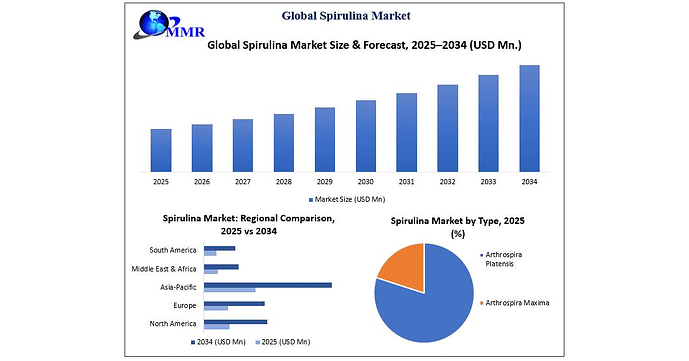
The global spirulina market is projected to grow from $651.35 million in 2025 to $1.61 billion by 2034, representing a 10.6% CAGR. Growth is driven by demand for plant-based protein, functional foods, nutraceuticals and natural phycocyanin food colorants, alongside improved cultivation and extraction technologies. High production costs, contamination risk and quality-consistency requirements remain constraints; North America leads the market while Asia-Pacific is expected to be the fastest-growing region.
Analysis
The investable implication is concentrated in premium ingredient pricing rather than broad supplement volume. Givaudan's natural-color platform can use demand for stable blue/green formulations to deepen customer stickiness and cross-sell flavors, but spirulina remains too small to alter group earnings absent disclosed contract wins. The likely pressure falls on low-cost synthetic-color suppliers and private-label pigment vendors if food manufacturers reformulate; however, natural pigments' inferior heat/light stability makes conversion cycles long and raises formulation costs, limiting near-term substitution.
HLF has modest optionality through product innovation but is unlikely to receive a material revenue benefit without evidence that algae-based SKUs improve distributor retention or North American volume trends. For Cyanotech (CYAN), the apparent read-through is more direct but liquidity, execution history, contamination risk, and customer concentration make the equity unsuitable as a core expression. The key second-order beneficiary is equipment and process-control suppliers: higher purity specifications favor scaled, traceable cultivation over commodity biomass, potentially widening the gap between branded extract producers and bulk powder suppliers over 6-18 months.
Consensus should discount the market-study forecast: its claimed growth rate is neither a demand order nor evidence of margin expansion. Natural-color adoption is constrained by regulatory approvals, formulation performance, and customers' willingness to absorb higher input costs; a consumer slowdown could shift supplement buyers toward lower-priced protein formats. Near-term catalysts are manufacturer product launches and regulatory actions on artificial dyes, while the first measurable confirmation should be 1-3 month customer commentary and 2027 ingredient-volume guidance rather than industry-market estimates.
AllMind Terminal
AI-powered research, real-time alerts, and portfolio analytics for institutional investors.
Request TrialMarket Sentiment
Overall Sentiment
mildly positive
Sentiment Score
0.38
Ticker Sentiment
Key Decisions for Investors
- No immediate standalone trade on the report; treat it as a watch item because neither HLF nor GIVN has disclosed spirulina/phycocyanin revenue exposure sufficient to move estimates.
- Maintain GIVN as the higher-quality watch-list beneficiary for 6-18 months; consider adding only after management quantifies natural-color order growth or margin-accretive formulation wins. Thesis fails if natural-color growth does not outpace the broader taste-and-wellbeing segment for two reporting periods.
- Do not use HLF as a proxy for algae demand. Reassess only if new algae-based products coincide with sustained North American volume-point growth and improved distributor retention; absent those metrics, the incremental ingredient narrative will not offset core channel risk.
- Set an event alert for US/EU artificial-dye restrictions and major beverage/confectionery reformulation contracts. A confirmed regulatory deadline plus disclosed customer conversions would support a tactical long GIVN versus a diversified food-ingredient peer basket, with a 3-6 month horizon.
More News
- Oil falls on report Asia will import highest volume of crude since start of Iran war
- OpenAI’s agent hacked Australia’s Medicare website—the latest rogue AI incident that the company didn’t know about for months
- Chinese authorities reportedly in possession of F-35 components in Hong Kong
- Meta announces new lightweight virtual reality glasses to one-up Apple’s Vision Pro
- Trump evalúa prohibir exportaciones de diésel de EE.UU.
- How Meta took the lead in the race for the post-smartphone world