
AMD: Expensive, But Growth Is Still Fast Enough To Keep The Bull Case Alive
Source: seekingalpha.com
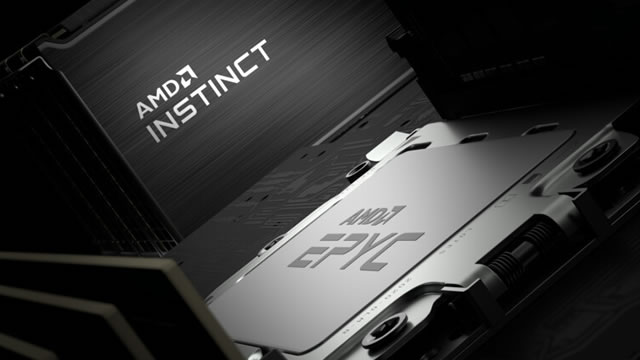
AMD is rated Buy despite a high valuation, supported by rapid AI and data-center growth and continued AI capital-spending increases from major infrastructure buyers. The analysis suggests AMD's roughly $630 share price could be supported using a 28.5x P/E reference—based on NVIDIA's trailing multiple—if AMD delivers about 45% annual revenue growth alongside a 40% metric that is not fully specified in the provided text.
Analysis
The relevant question is not whether AI spending remains robust, but whether AMD can convert design wins into durable accelerator share without sacrificing gross margin. AMD’s upside is convex to hyperscaler qualification breadth: incremental share gains in cloud inference and sovereign AI can drive revenue faster than the market expects because the installed software ecosystem is becoming less exclusive. The offset is that NVIDIA’s platform advantage allows it to defend pricing, leaving AMD potentially exposed to a lower-ASP, higher-customer-concentration path even if unit volumes grow strongly.
Near term, the stock will trade on accelerator shipment cadence, HBM availability, and the ratio of GPU revenue growth to Data Center segment margin expansion. Over 1-3 months, any evidence that MI-series deployments are moving from pilots to repeat orders should support multiple durability; conversely, a revenue beat driven by CPUs or inventory timing rather than accelerator mix would be a lower-quality catalyst. Over 6-18 months, custom ASIC adoption by hyperscalers is the more important second-order risk: it can reduce the addressable merchant-GPU pool while increasing the value of AMD's semi-custom capability, creating a more mixed outcome than a simple AMD-versus-NVIDIA share narrative.
Consensus may be underweighting the valuation asymmetry. If AMD demonstrates repeatable accelerator gross-margin accretion, earnings revisions can close the valuation gap quickly; if margins remain diluted by customer incentives, the market is unlikely to award a NVIDIA-like multiple merely for top-line AI exposure. The thesis is falsified by two consecutive quarters of accelerator growth without Data Center gross-margin progression, material backlog-to-revenue conversion delays, or evidence that cloud customers are preferentially allocating incremental spend to NVIDIA or internal ASICs.
AllMind Terminal
AI-powered research, real-time alerts, and portfolio analytics for institutional investors.
Request TrialMarket Sentiment
Overall Sentiment
mildly positive
Sentiment Score
0.30
Ticker Sentiment
Key Decisions for Investors
- Maintain a measured long AMD versus short NVDA pair only after AMD reports evidence of accelerator-led Data Center margin expansion; target a 3-6 month holding period. This isolates the share-gain thesis from broad AI-capex beta, but exit if AMD's Data Center revenue mix improves without corresponding consolidated gross-margin leverage.
- For directional exposure, prefer AMD call spreads 6-9 months out rather than outright shares while the earnings catch-up case remains unverified. Structure strikes around a 15-25% upside range from entry; the defined premium limits downside if revenue growth is achieved through lower-margin pricing or supply-constrained shipments.
- Do not chase a pre-earnings move solely on AI-capex headlines. Establish an alert for management disclosure of named cloud production deployments, accelerator revenue mix, and HBM supply coverage; these are the missing data points that determine whether estimates require upward revision.
- Hedge long AMD exposure with a small long position in SOXX puts or a short SMH overlay during hyperscaler capex-reporting windows. A broad AI infrastructure de-rating would likely compress AMD's multiple before any company-specific earnings catch-up can offset it.
More News
- Tencent leases 100,000 chips from Oracle for $7 bln- FT
- RAM supply set to worsen, says Micron, as CEO celebrates ‘much higher’ prices
- We're raising our Micron price target after an incredible quarter and robust guidance
- Micron beats on revenue and earnings as global memory shortage continues
- Trump’s AI lunch included every major tech company. Except Apple
- OpenAI is sued over rogue AI Hugging Face cyberattack
From AllMind Research
- Anthropic IPO Preview: Valuation, Timing, and What to Watch
- Shein After the IPO: Venue, Valuation, and What Must Be Proved
- What AI Research Tools Should a Small Hedge Fund Buy First?
- Can ChatGPT or Claude Replace a Research Platform?
- How the 2026 Milan-Cortina Winter Olympics Will Reshape Company Revenues and Stock Performance