
First Human Administration of Senolytic Immunotherapy to Fight Cellular Aging Announced by Immorta Bio
Source: PR Newswire
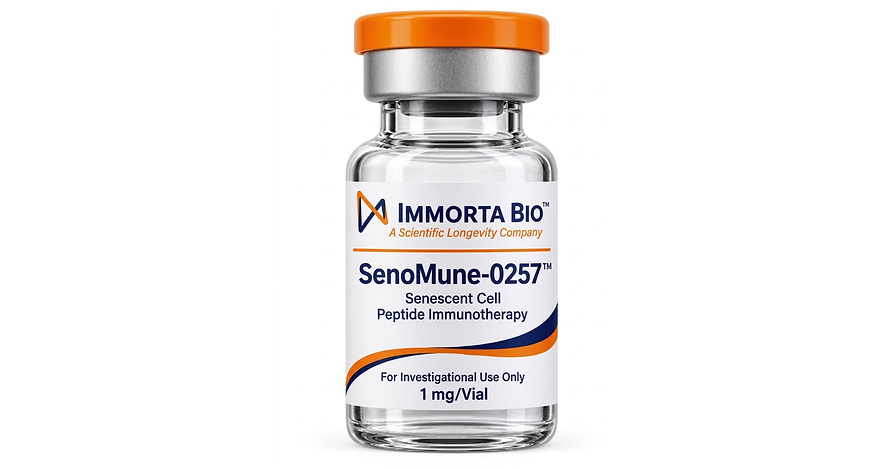
Immorta Bio announced the first human administration of investigational SenoMune-0257, a nine-amino-acid immunotherapy intended to help the immune system eliminate senescent cells. The first patient was treated on October 29, 2026, in Mexico in an independently conducted, investigator-initiated study involving patients with advanced cancer; safety and efficacy in humans have not been established. The company says the AI-assisted peptide platform could have applications beyond oncology, but no human outcomes were reported.
Analysis
The investable signal is limited: first dosing is a translational milestone, not evidence of senolytic activity, safety, or clinical benefit. Because treatment is in an investigator-initiated advanced-cancer study in Mexico, outcomes may be hard to separate from cancer progression and concurrent care; even a positive observation would not establish efficacy in the much broader aging-disease claims. The company’s platform framing should therefore not be valued as a diversified pipeline absent disease-specific trials, reproducible endpoints, and a credible development and financing plan.
For the field, a clean human pharmacodynamic signal could improve sentiment toward senolytics and draw attention to approaches pursued by other developers, including Unity Biotechnology, but it would not validate their distinct mechanisms. Conversely, immune-mediated clearance raises a class-specific question: senescent cells can also participate in tissue repair and other normal responses, so durability and consequences of broad or repeated clearance matter as much as initial target engagement.
Days: expect headline-driven attention, but no durable read-through without data. Over 1–3 months, watch for a disclosed protocol, enrollment, safety observations, and objective target-engagement measures. Over 6–18 months, the key test is whether controlled, disease-specific trials emerge and whether the company can fund them. The contrarian view is that “first in human” may be over-weighted: one administration is weak evidence, while a rigorously measured human signal would be genuinely informative. No supplied ticker or company identity makes this a direct equity trade.
AllMind Terminal
AI-powered research, real-time alerts, and portfolio analytics for institutional investors.
Request TrialMarket Sentiment
Overall Sentiment
mildly positive
Sentiment Score
0.15
Key Decisions for Investors
- No trade on the announcement alone; the supplied data identifies no investable ticker, and the release provides no clinical results or trial-level detail.
- Set an alert for the protocol and first interpretable data: verify dose, cohort size, comparator, adverse events, concurrent cancer treatments, and a prespecified senescence/target-engagement biomarker before assigning platform value.
- Treat any near-term senolytic-sector rally as a sentiment move, not a read-through to peers. Reassess only if human pharmacodynamic evidence is credible and independently reported; falsification would be absent or inconsistent target engagement, material immune toxicity, or no follow-on trial disclosure.
- For a future positive catalyst, distinguish safety/target engagement from efficacy and require replication in a defined indication before underwriting the multi-disease aging thesis.
More News
- Marvell to buy Lumentum in $115 billion deal in AI data-center bet
- Marvell, Lumentum tout historic $115B deal to create ‘category leader' in AI connectivity
- Palantir reports booming U.S. commercial revenue growth, topping government for first time
- Anthropic releases amended IPO prospectus with third-quarter financials
- The AI boom is facing another supply crunch. This time it’s the amount of capital available to feed Silicon Valley’s endless need for cash
- Anthropic to Spend $895 Billion in the Years Ahead