
Intel stock jumps 5% as SK Hynix talks put its foundry revival back in play
Source: invezz.com
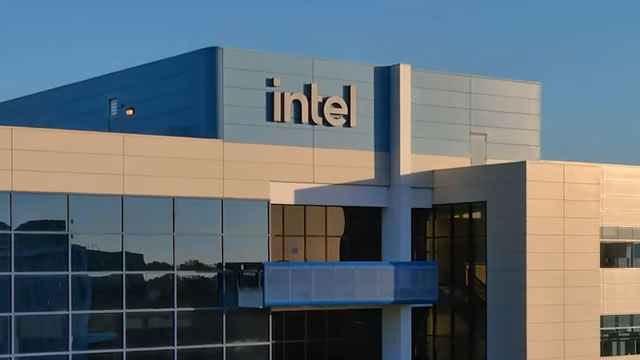
Intel shares rose 5.2% in premarket trading after Reuters reported that SK Hynix is in exploratory talks to bring memory-chip production to Intel's delayed Ohio manufacturing site. A potential deal would provide external foundry volume, directly supporting the economic viability of Intel's manufacturing turnaround. The talks remain preliminary, leaving execution and deal-certainty risks.
Analysis
The market should value this less as prospective memory revenue than as a validation event for Intel Foundry's asset-utilization problem. A credible anchor tenant can improve fixed-cost absorption at Ohio, reduce the probability of further capex deferrals or impairments, and make customer acquisition less reflexive: suppliers, packaging partners, and prospective fabless customers are more willing to commit once a site has baseline volume. The key unknown is whether the arrangement is a limited manufacturing-services commitment or a multiyear take-or-pay capacity contract; only the latter meaningfully changes Intel's medium-term FCF trajectory.
Near term, the premarket move is vulnerable because exploratory discussions have low conversion rates and memory makers remain highly sensitive to the HBM/DRAM cycle. Over 1-3 months, confirmation of a binding agreement, disclosed node/process scope, customer prepayments, or government-incentive linkage would justify incremental multiple expansion; silence or another Ohio schedule/capex revision would reverse it. The stronger 6-18 month implication is competitive: SK Hynix diversifying geographically could pressure Samsung Electronics' foundry and memory ecosystem positioning, while Intel gains a route to establish advanced packaging demand around a strategic memory customer.
Consensus may overstate the value of any announced deal if it does not transfer utilization risk to SK Hynix. Intel can generate headline foundry revenue while still earning inadequate returns if pricing is concessional, yield costs remain elevated, or the contract requires Intel to fund specialized tooling. Conversely, a customer-funded, take-or-pay structure would be more material than its initial revenue contribution because it lowers Intel's financing and execution-risk discount.
AllMind Terminal
AI-powered research, real-time alerts, and portfolio analytics for institutional investors.
Request TrialMarket Sentiment
Overall Sentiment
moderately positive
Sentiment Score
0.42
Ticker Sentiment
Key Decisions for Investors
- Do not chase the initial INTC gap. Establish a 1-3 month long only after confirmation of binding capacity, duration, and customer-funding terms; size for a 10-15% upside on a credible take-or-pay deal versus 7-10% downside if talks lapse or Ohio timing slips.
- Use a defined-risk event structure: buy INTC 3-6 month call spreads rather than outright calls, with strikes centered roughly 5-15% above spot. The thesis requires a disclosed contract or foundry milestone; close if management provides no incremental utilization evidence at the next earnings release.
- Monitor Intel's foundry segment margin, Ohio capex cadence, customer prepayments, and disclosed external wafer volume. A further capex cut without offsetting contracted demand, or foundry losses widening despite revenue growth, falsifies the utilization thesis.
- For broader semiconductor exposure, prefer a conditional pair of long INTC versus short SOXX only after a binding deal, since the catalyst is company-specific rather than a sector demand signal. Exit if SK Hynix characterizes the arrangement as non-binding evaluation or if Intel cannot disclose economics.
More News
- SK Hynix reportedly in talks with Intel to build memory chips in US
- Premarket movers: Intel jumps on SK Hynix memory-chip talks, J.B. Hunt slides
- Intel’s stock rises as investors hope memory chips can mark the next step in its turnaround
- Exclusive-SK Hynix in talks with Intel about deal to make memory chips in the US for the first time, sources say
- SK Hynix is in talks with Intel to make memory chips in the US, Reuters reports
- Why is SK hynix stock rallying today?