
MNA: Berkshire VNA Nurses and Healthcare Professionals Deliver Petition Calling for a Fair Union Contract to Strengthen Patient Access to Home Care
Source: PR Newswire
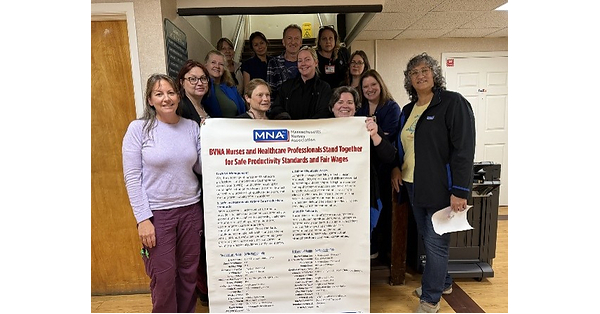
BVNA nurses and healthcare professionals, represented by the Massachusetts Nurses Association, delivered a petition seeking a fair contract, experienced-staff cost-of-living increases and achievable productivity expectations; bargaining resumes October 28. The bargaining unit has shrunk by approximately half over several years amid turnover and recruitment challenges. Management has made progress on wages for early-career staff, while clinicians say retention is also needed to support safe home care and timely hospital discharges.
Analysis
The investable signal is labor economics, not a direct earnings event: absent evidence that BVNA’s contract sets a broader wage benchmark, this is a localized read-through rather than a basis to reprice public healthcare names. If retention requires higher experienced-staff pay while productivity expectations are also constrained, providers may face a two-sided squeeze: labor cost per visit rises while the number of billable visits per clinician remains limited. Conversely, better retention could reduce vacancy and turnover friction and improve capacity; the net margin effect depends on whether reimbursement and visit volumes cover the added labor cost.
The second-order risk is hospital throughput. If home-care capacity is unavailable, discharge planning can become harder and inpatient beds may remain occupied longer; the operational consequence is meaningful locally, but this article does not establish a measurable impact on Berkshire Medical Center or any listed hospital operator. Near term (days to weeks), the October 28 bargaining meeting is the catalyst. Over 1–3 months, watch for a settlement and evidence of staffing stabilization. Over 6–18 months, the structural question is whether home-care reimbursement and referral economics support a sustainably staffed workforce.
Contrarian view: the petition’s focus on experienced clinicians highlights that recruitment incentives alone may not rebuild capacity if veteran retention and non-visit workload remain unresolved. Still, one bargaining unit’s petition is not evidence of a sector-wide wage shock. With no identified public issuer, financial terms, or independently verified staffing data, the signal is too weak for a directional equity position.
AllMind Terminal
AI-powered research, real-time alerts, and portfolio analytics for institutional investors.
Request TrialMarket Sentiment
Overall Sentiment
mildly negative
Sentiment Score
-0.15
Key Decisions for Investors
- No trade on the headline alone. Treat it as a local labor-relations watch item, not a public-equity catalyst.
- After the October 28 session, verify whether any agreement covers experienced-worker increases, productivity targets, and implementation timing; distinguish proposed terms from a ratified contract.
- Monitor staffing levels, vacancies, visit capacity, and turnover over the next 1–3 months. A settlement without measurable capacity improvement would weaken the retention thesis.
- For hospital and home-health exposure, watch for evidence that discharge delays, referral availability, or labor costs are changing across a broader market before initiating a sector position.
More News
- EQT becomes the nation’s leading natural gas ‘juggernaut’ with a $13B deal as data center, export demand surges
- Microsoft offers buyouts to nearly 30% of workforce in ongoing AI shift
- Anthropic’s risk factors include the end of humanity, a feud with the Pentagon, and CEO Dario Amodei’s reputation
- Anthropic IPO Filing Day Comes With Warning
- Microsoft offers to buy out a quarter of its workforce
- Celestica stock surges 10% after earnings beat as AI demand boosts 2027 outlook