
Bloomberg Law Survey Finds Nearly Half of Attorneys Report Worsening Well-Being
Source: PR Newswire
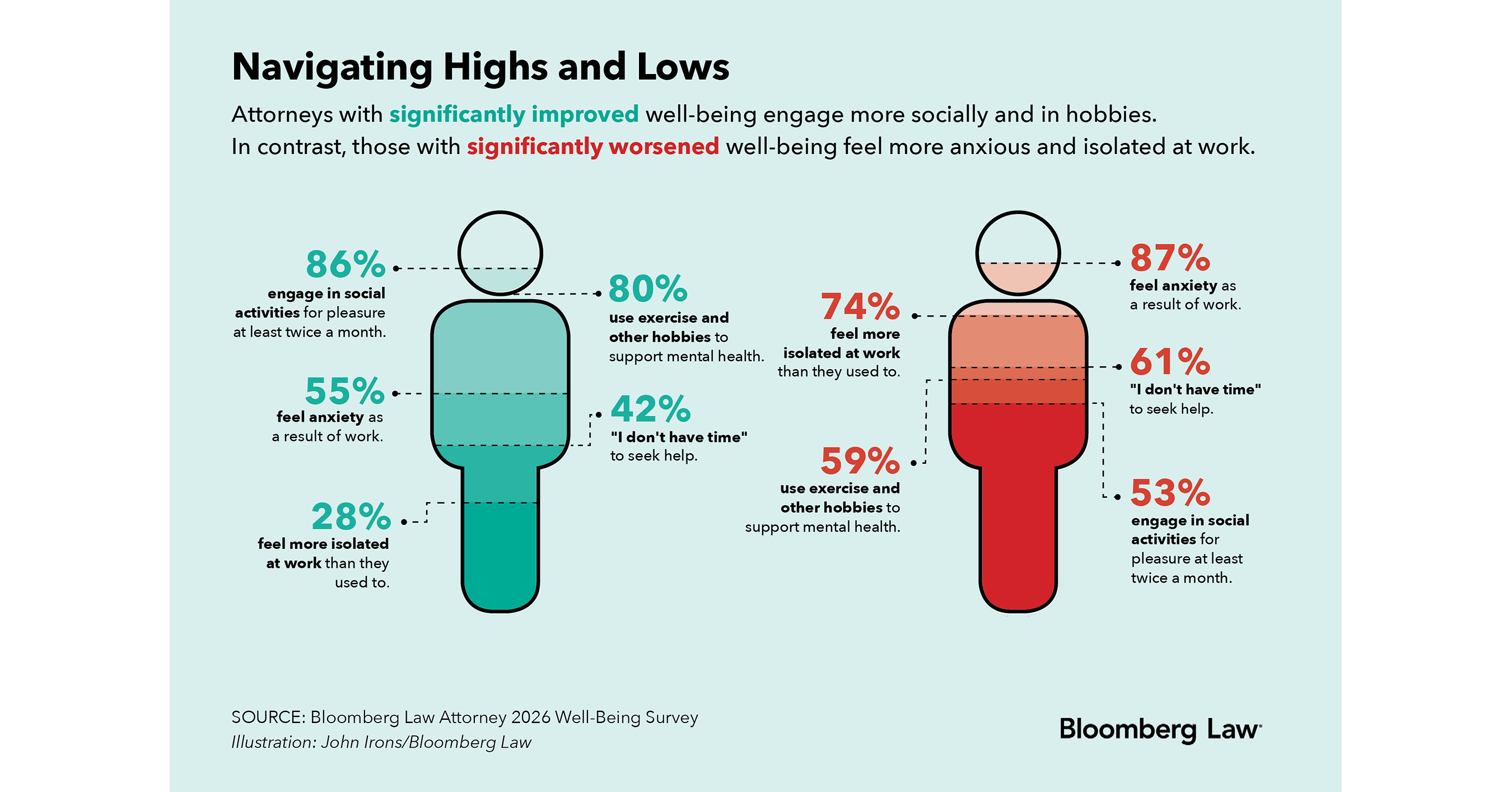
Bloomberg Law's survey of more than 1,100 legal professionals found that nearly half said their overall well-being has worsened since the start of 2025, while more than half reported work-related sleep disruption, anxiety, worsened mood, and reduced focus. Women attorneys faced disproportionate caregiving-related career effects, and half of respondents did not use available workplace well-being support. Among participants in professional or executive coaching, 75% found the programs valuable.
Analysis
This is not a standalone market-moving signal, but it reinforces a margin and execution risk that is most relevant to labor-intensive professional-services businesses. Large law firms face a trade-off between retaining senior associates through lower billable-hour expectations and preserving realization/utilization; neither outcome is attractive if client demand remains uneven. The more investable read-through is indirect: corporate legal departments under staffing pressure are likely to prioritize workflow automation and managed services over incremental outside-counsel spend.
Over the next 1-3 months, this supports the enterprise-productivity narrative for legal-tech and document-automation vendors, but the survey itself provides no evidence of incremental budgets or contract wins. Bloomberg Industry Group has an incentive to frame workplace strain as a need for better information tools, so the reported results should not be treated as proof of demand acceleration for Bloomberg Law. Watch legal-services headcount, Am Law billing-rate/realization data, and AI-related legal software bookings before assigning a revenue impact.
The underappreciated structural effect over 6-18 months is that burnout can accelerate adoption of AI-assisted research, drafting and matter-management tools, while simultaneously pressuring the traditional billable-hour model. That is potentially favorable for scaled workflow incumbents such as Thomson Reuters (TRI) and RELX (RELX), whose products can be embedded in firm workflows, but disruptive if generative-AI tools materially compress research time without equivalent price capture. The key falsifier is whether legal-tech vendors sustain organic growth and expand margins despite slower seat growth at law firms.
AllMind Terminal
AI-powered research, real-time alerts, and portfolio analytics for institutional investors.
Request TrialMarket Sentiment
Overall Sentiment
mildly negative
Sentiment Score
-0.38
Key Decisions for Investors
- No immediate directional trade from the survey; treat it as a watch item rather than a catalyst because there are no disclosed budget, renewal, or revenue data.
- Maintain a 6-18 month relative-quality bias toward TRI versus broad professional-services exposure: TRI has recurring workflow revenue and pricing power if firms substitute software for junior-associate labor. Reassess if Legal Professionals organic revenue growth falls below management's medium-term algorithm or net retention weakens.
- Monitor RELX and TRI quarterly disclosures for AI-product adoption, legal segment organic growth, and margin progression. A combination of accelerating legal-segment growth and stable margins would validate the automation thesis; higher implementation costs or price concessions would invalidate it.
- For firms with exposure to legal-process outsourcing or consulting, watch utilization and voluntary attrition over the next two quarters; rising attrition alongside declining realization would signal margin compression before it is fully reflected in reported earnings.
More News
- OpenAI’s agent hacked Australia’s Medicare website—the latest rogue AI incident that the company didn’t know about for months
- Activist Toms Capital urges Devon Energy in letter to explore alternatives, including a sale
- SEC Commissioner: We’ll Ensure Guardrails for Tokenization
- Investor Stephanie Link looks for strong brands making a comeback. This retailer fits the bill
- The Elmet Group to Invest Approximately $125 Million in Masan High-Tech Materials to Strengthen Tungsten Supply Chain
- Manchester United losses jump nearly a third to $57m despite record revenue