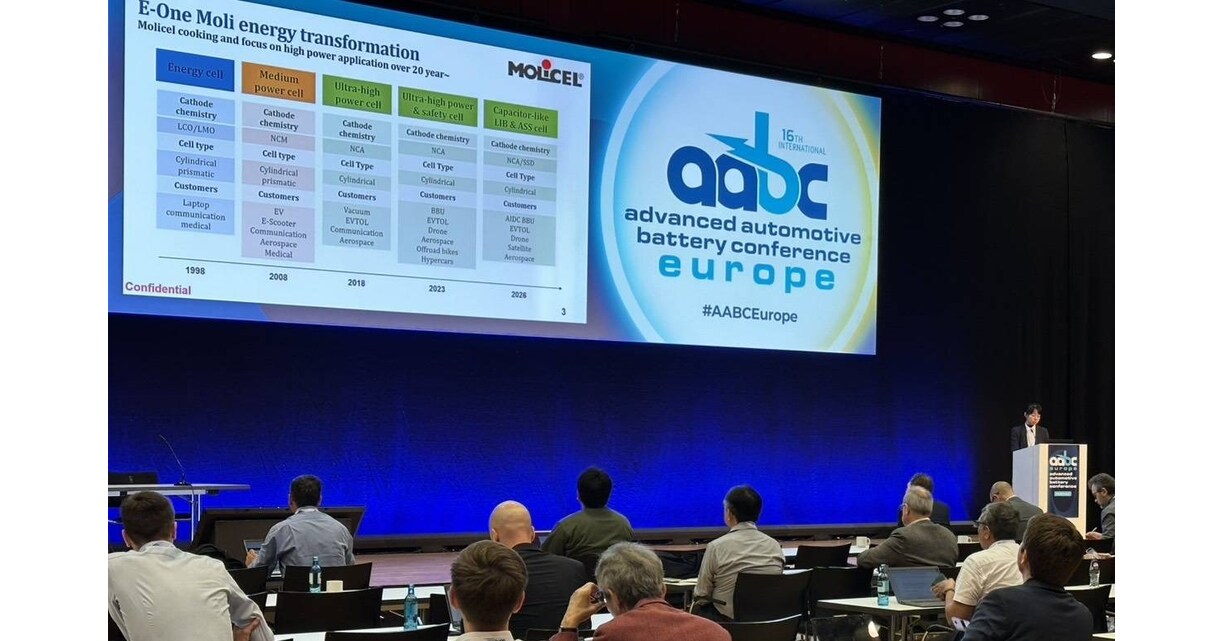
Molicel presentó la celda INR-21700-P70X con 7.000 mAh, 340 Wh/kg y descarga continua de 30C, apuntando a una sinergia entre densidad de energía y potencia tipo supercondensador. La compañía reporta seguridad al superar UL9540A con ~50% menos liberación de calor exotérmico y contención en pruebas de abuso (emite humo sin explosión catastrófica), además de durabilidad del 96% de capacidad tras 1.000.000 ciclos. El artículo enmarca la demanda como un giro hacia híbridos (EE. UU. ~20% del volumen a finales de 2025; Europa 24%; Asia-Pacífico 51,67% del valor global), con proyección del mercado global de híbridos de US$335.210M en 2026 a US$570.780M en 2034.
The commercial read-through is less about this specific cell and more about confirmation that hybrid architecture is still the cheapest path to compliance and consumer acceptance. That favors OEMs with deep hybrid lineups and vertically coordinated powertrain engineering, especially Toyota, Honda, Hyundai/Kia, and suppliers like Denso and Aisin, while it pressures pure-BEV narratives where earnings are more exposed to battery kWh growth than unit growth. Second-order, a richer hybrid mix lowers average battery content per vehicle, which is a headwind for cell makers and upstream materials if fleet electrification shifts from volume growth to content substitution.
The key risk is that this is still a technology demonstration, not a proven revenue stream. Qualification cycles in automotive are long: even if the spec is real, design-win translation is typically 12-24 months, and the near-term market impact is mostly sentiment for 1-3 months rather than fundamentals. What could reverse the trend is an acceleration back toward lower-cost BEVs via battery price deflation, subsidy changes, or a strong charging-infrastructure inflection that makes hybrid flexibility less necessary.
Contrarian view: the market may be overestimating how much incremental value a higher-spec hybrid cell creates for public equities. Better batteries do not automatically expand OEM margins if competition forces the benefit into consumer pricing or warranty terms, and hybrid adoption itself can cannibalize BEV-related capital spending. The cleaner trade is relative-value on powertrain mix, not a directional bet on the private company behind the press release.
AI-powered research, real-time alerts, and portfolio analytics for institutional investors.
Request TrialOverall Sentiment
mildly positive
Sentiment Score
0.25
