
Micron: Records Are Not Enough Anymore
Source: seekingalpha.com
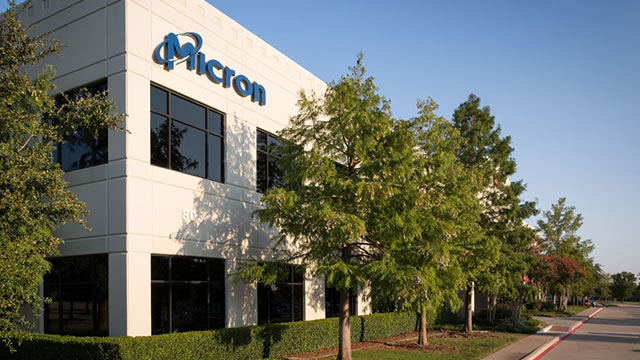
Micron remains rated Hold as its memory earnings cycle decelerates, with slowing DRAM and NAND price growth amid inventory and end-demand pressure. The company also trails SK Hynix and Samsung on capital returns, while its ability to increase distributions may remain constrained by CHIPS Act restrictions until they expire in December 2026.
Analysis
MU’s risk is less a demand collapse than a change in earnings-quality perception: once memory moves from sequential price increases to price stability, investors typically de-rate the sector before reported revenue turns negative. MU retains substantial operating leverage to incremental bit pricing, so even modestly slower DRAM/NAND contract pricing can drive disproportionate downward revisions to gross-margin and free-cash-flow expectations over the next 1-3 quarters. This creates a relative valuation problem versus SK Hynix, whose AI-memory mix and shareholder-return profile provide a more credible floor for the multiple.
The key second-order issue is capital-allocation asymmetry. A constrained buyback cadence leaves MU more exposed to the standard semiconductor-cycle pattern of capex absorbing cash precisely when investors begin demanding cash returns; that can widen the MU/SK Hynix relative-performance gap even if both companies meet near-term estimates. Suppliers with concentrated memory exposure—equipment names such as LRCX, KLAC and AMAT—could also face a delayed read-through if producers preserve utilization and capex budgets longer than pricing would otherwise justify.
Consensus may be too bearish on the duration of AI-related high-bandwidth-memory tightness, which could partially insulate MU from legacy-memory weakness over 6-18 months. The thesis is falsified if industry contract prices resume broad sequential acceleration, MU raises gross-margin or FCF guidance despite flat pricing, or HBM qualification/customer ramps materially close the profitability gap with SK Hynix. Conversely, inventory growth, weaker smartphone/PC unit data, or a cut to 2027 capex plans would confirm that price stability is masking deteriorating end demand.
AllMind Terminal
AI-powered research, real-time alerts, and portfolio analytics for institutional investors.
Request TrialMarket Sentiment
Overall Sentiment
mildly negative
Sentiment Score
-0.32
Ticker Sentiment
Key Decisions for Investors
- Initiate a 1-3 month relative-value position: long SK Hynix / short MU, sized beta-neutral. The trade monetizes expected earnings-revision and multiple divergence rather than requiring absolute memory-price declines; cover if MU delivers a material gross-margin-guide increase or if the relative spread breaks meaningfully against the entry level.
- Avoid adding outright MU exposure ahead of the next earnings cycle unless channel data show renewed broad-based DRAM and NAND contract-price increases. Use a post-results entry only if management demonstrates FCF conversion and capital-return visibility beyond a narrative-level commitment.
- For existing MU longs, buy 3-6 month downside protection or trim into strength rather than sell indiscriminately. A defined-risk put spread is preferable to naked puts because stable pricing and AI-memory mix can prevent the sharp earnings reset implied by a full bearish position.
- Monitor monthly memory spot/contract-price direction, OEM inventory commentary, and MU’s gross-margin guide as the highest-frequency falsification signals; a sustained improvement across all three warrants closing the MU underweight and reassessing long exposure.
More News
- BYD, CATL, Xiaomi executives may join Xi’s US visit, sources say
- AI trade rebound sparks flurry of unusually bullish options activity
- Exclusive-China’s CXMT eyes flash-memory push amid global shortage; firm to take on Samsung, YMTC
- Micron Turned $10,000 Into About $130,000 in 5 Years. Most of It Came in the Past 12 Months.
- UBS cuts KOSPI target by nearly 10% to reflect higher rates
- The HBM Bottleneck: 3 Tech Companies Have Locked Up 85% of the Supply of AI's Scarcest Asset