
ONEOK: Second Guidance Raise And Brazos Deal Make The Pullback Compelling
Source: seekingalpha.com
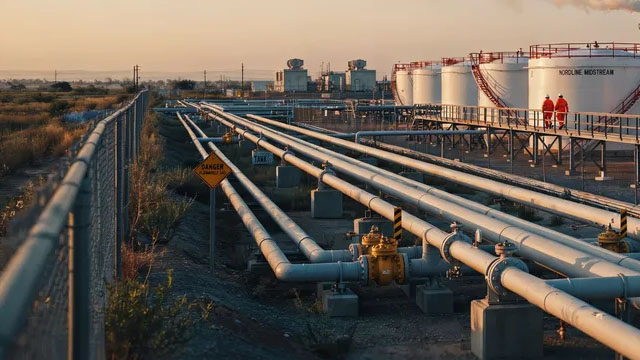
ONEOK raised 2026 full-year guidance for the second time, targeting adjusted EBITDA of $8.35B and EPS of $5.68 following strong Q2 results and its $4.425B Brazos Midstream acquisition. The acquisition is described as accretive and capital-efficient, reducing debt while preserving the share count. Despite improved fundamentals and projects nearing completion, OKE trades at a compressed 14.75x forward EPS valuation.
Analysis
OKE’s rerating case depends less on another guidance raise than on proving that acquired volumes can be integrated without diluting its historical fee-based cash-flow durability. The market is likely applying a discount for leverage, execution complexity, and exposure to more cyclical NGL/gas-basin throughput; successful early synergy capture and sustained distribution coverage could narrow the valuation gap versus TRGP and WMB over the next 1-3 quarters. A key second-order beneficiary is the broader Permian-to-Gulf Coast/NGL export chain, while KMI and WMB face modest relative pressure if OKE becomes a more credible consolidator for mid-continent and basin-adjacent infrastructure.
Near term, the risk/reward is asymmetric only if post-deal leverage trends lower faster than expected. Midstream equities can sell off despite solid operating delivery if natural-gas or NGL price weakness reduces producer drilling budgets, particularly where contract renewal rates or minimum-volume commitments are not fully insulated. The more material 6-18 month risk is that M&A-driven EBITDA growth receives no multiple credit if interest rates rise or if integration capital spending exceeds the acquisition underwriting; a widening OKE/TRGP valuation discount after the next earnings report would falsify the rerating thesis.
Consensus may be treating the multiple compression as a mechanical bargain, but the relevant question is whether free-cash-flow-per-share compounds after maintenance capital, financing costs, and distribution obligations—not adjusted EBITDA alone. If management demonstrates that the acquired asset base improves utilization of existing systems and creates incremental export or fractionation pull-through, the transaction can generate network value beyond disclosed synergies. Conversely, absent measurable commercial pull-through by year-end, OKE should remain a yield-oriented hold rather than a premium-growth midstream compounder.
AllMind Terminal
AI-powered research, real-time alerts, and portfolio analytics for institutional investors.
Request TrialMarket Sentiment
Overall Sentiment
strongly positive
Sentiment Score
0.72
Ticker Sentiment
Key Decisions for Investors
- Initiate a 3-6 month long OKE position only on evidence that net-debt-to-EBITDA is tracking below management’s post-close plan and that 2027 distributable cash flow per share is reaffirmed or raised; target a rerating toward the TRGP/WMB peer range, with downside limited by a stop if the relative valuation discount widens by more than 15% after earnings.
- Express the company-specific thesis as long OKE / short KMI in equal beta-adjusted dollars over 3-6 months. OKE offers greater upside from integration and NGL/export connectivity, while KMI is more exposed to a lower-growth, rate-sensitive valuation framework; cover if gas-directed activity accelerates materially or KMI delivers a major accretive transaction.
- Avoid adding after a guidance-driven gap higher unless Q3 disclosures quantify realized acquisition synergies, maintenance capital needs, and contract tenor. These are the missing variables needed to distinguish sustainable per-share accretion from EBITDA growth funded by balance-sheet capacity.
- For existing OKE longs, use 6-9 month downside puts or a collar around the next earnings release if sector exposure is large. The principal adverse catalyst is not a single-quarter volume miss but a higher leverage trajectory, weaker producer activity, or an integration-cost revision that delays free-cash-flow conversion.
More News
- There’s a pipeline of deals—for pipelines—that will help power the AI boom
- Dollar at 17-month high as global bond rout hits euro
- Trump says US may ask Europe to release diesel reserves
- Latin America most exposed to any US ban on diesel exports, Goldman Sachs says
- Trump launches midterms campaign blitz amid record low approval ratings
- Japanese yen firms on strong inflation, dollar muted before payrolls test
From AllMind Research
- Anthropic IPO Preview: Valuation, Timing, and What to Watch
- Shein After the IPO: Venue, Valuation, and What Must Be Proved
- What AI Research Tools Should a Small Hedge Fund Buy First?
- Can ChatGPT or Claude Replace a Research Platform?
- How the 2026 Milan-Cortina Winter Olympics Will Reshape Company Revenues and Stock Performance