
Will Citigroup's Cost-Cut Initiatives Boost Long-Term Profitability?
Source: zacks.com
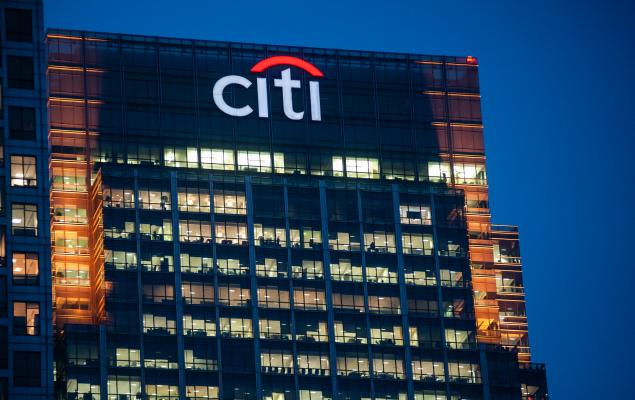
Citigroup expects restructuring, workforce reductions and technology investments to generate $2–$2.5 billion in annualized savings by 2026; it reduced headcount to 217,000 from 227,000 a year earlier and incurred more than $1 billion in severance costs in the first nine months of 2026. The company plans an incremental $5 billion investment during 2026–2028 and targets ROTCE above 11% in 2026, 11–13% in 2027–2028 and 14–15% over the medium term. Shares are up 5.5% year to date, and consensus earnings estimates for 2026 and 2027 imply growth of 43.5% and 14.5%, respectively, with both estimates revised upward over the past 30 days.
Analysis
The investment question is whether Citi converts run-rate savings into durable pre-provision earnings gains—not whether it announces a lower expense base. The key near-term read-through is the bridge between restructuring charges, recurring expenses and the efficiency ratio: annualized savings can look compelling while implementation costs and the planned technology spend defer the earnings benefit. Also, the ratio can improve through stronger revenue rather than cost execution, so track absolute noninterest expense alongside revenue and transformation charges.
Over 1–3 months, estimate revisions and guidance may support C, but much of the easy rerating case is visible in the cited low relative P/E and recent upward revisions; a cheap multiple alone does not establish a catalyst. Over 6–18 months, successful platform consolidation could create operating leverage and improve competitiveness. The counter-risk is that workforce cuts remove institutional knowledge or weaken controls during systems migration, raising remediation costs and operational risk at a regulated bank. Automation benefits are company targets, not independently verified outcomes.
WFC is a useful caution, not a clean read-through: its improving efficiency ratio alongside higher expenses shows why ratio progress alone does not prove structural savings. A broad bank-sector cost-cutting cycle could also make efficiency a lower-value differentiator if peers match it. Falsify the C thesis if recurring expenses fail to trend down against management’s path, transformation charges remain elevated, or ROTCE progress stalls; validate it with sustained expense discipline after one-off costs and no deterioration in operational-control indicators.
AllMind Terminal
AI-powered research, real-time alerts, and portfolio analytics for institutional investors.
Request TrialMarket Sentiment
Overall Sentiment
mildly positive
Sentiment Score
0.35
Ticker Sentiment
Key Decisions for Investors
- Avoid chasing C solely on the savings headline. Treat it as a conditional, medium-term rerating setup; wait for the next results and guidance to verify recurring expense reduction separately from severance and other transformation costs.
- If those KPIs confirm execution and the stock has not already rerated materially, consider a staged long C position. Size against the risk that the $5B investment program absorbs savings or delays returns; no price target is justified by the supplied information.
- Monitor quarterly noninterest expense, transformation charges, efficiency-ratio drivers, ROTCE, and technology/control incidents. A missed expense trajectory or evidence of migration-related control weakness invalidates the thesis and should trigger a reassessment.
- Do not use WFC as an automatic short hedge: its expense and revenue mix differ. Compare bank positions only after checking relative valuation, revenue trends, credit costs, and each firm’s restructuring spend.
More News
- Midterm elections could jolt stocks if Democrats sweep Congress
- Allison Transmission earnings analysis: questions answered and next catalysts
- Wells Fargo raises Hinge Health stock price target on yield strength
- Wells Fargo lowers Advanced Energy price target on valuation
- Canaccord raises Hinge Health stock price target on strong billings
- Citi expects ’continued memory undersupply’ in 2027