
Banyan Gold Confirms New Gold-Silver Discovery at Seattle Creek with 5.70 g/t Au and 544 g/t Ag over 0.5m, Nitra Project, Yukon
Source: Newswire
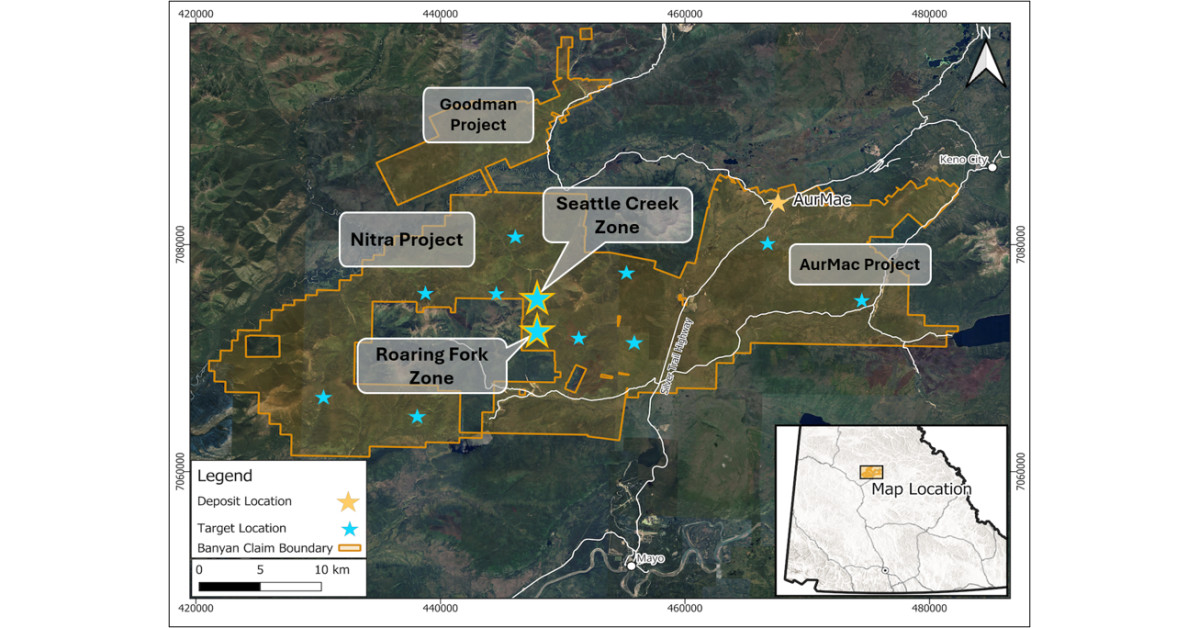
Banyan Gold confirmed a new high-grade gold-silver mineralized system at its Seattle Creek zone (Nitra project), reporting 0.5m of 5.70 g/t Au and 544 g/t Ag within a broader interval of 0.91 g/t Au and 27.01 g/t Ag over 12.1m (NT-26-006). Assays are only available for the top 95m of a 600m drillhole, with remaining results pending. Management expects follow-up drilling to define the extent/geometry, with the discovery adding a second exploration zone west of the AurMac Deposit (25km).
Analysis
The market mechanism here is not near-term cash flow but option value: every additional high-grade hit incrementally raises the probability that Banyan can convert a large land package into a district narrative, which is what small-cap explorers re-rate on. That said, visible gold and a single narrow interval are not yet a monetizable asset; the key variable is continuity across the lower hole sections and whether grades persist as widths scale. In the next 1-3 months, the stock is likely to trade more on assay cadence than geology itself, so the initial move can outrun the data.
Second-order, the real winners are not necessarily BYN holders alone but the entire financing ecosystem around a camp-scale Yukon story: drill contractors, geos, and adjacent juniors may catch sympathy if the market starts underwriting multiple satellite deposits. The main loser is implicit future dilution—the more targets they chase, the more capital intensity rises before any resource upgrade, which can cap upside unless the next holes show meaningful strike length. If the program keeps returning isolated, narrow veins, the market will quickly reclassify this as promotional exploration rather than a resource-building discovery.
Contrarian view: consensus tends to overprice early discovery headlines and underprice the probability of a good-looking but non-continuous system. The falsifier is simple: if the pending assays and step-outs do not confirm repeatable mineralized corridors over the next drill campaign, any pop should fade back toward pre-release levels. Structurally, the thesis only becomes durable if the company can translate this into a resource expansion or a partnerable deposit over 6-18 months, otherwise financing risk dominates geology.
AllMind Terminal
AI-powered research, real-time alerts, and portfolio analytics for institutional investors.
Request TrialMarket Sentiment
Overall Sentiment
mildly positive
Sentiment Score
0.35
Ticker Sentiment
Key Decisions for Investors
- Do not chase BYN/BYAGF on the headline alone; wait 1-3 months for the lower-hole assays and step-out holes to confirm continuity before adding risk. Falsifier: no repeat mineralized intervals or grades collapse outside the initial narrow zone.
- If BYN gaps up >15-20% on light volume, use strength to trim or fade it; this is a classic explorer reaction that often mean-reverts absent a resource update. Only consider a small short if borrow is available and liquidity is adequate.
- For investors who want gold-beta without single-name assay risk, prefer GDXJ over BYN until the project proves scale and financing needs are clearer. This avoids being hostage to one drillhole and one financing event.
- Watch for a financing announcement before the next assay batch; a dilutive raise at a discount would likely cap the rerate and shift the trade from discovery optionality to balance-sheet risk.
- Revisit the name only if follow-up drilling shows repeated high-grade intersections across multiple holes, which would justify a 6-18 month long thesis on district-scale optionality.
More News
- ‘The gap was not the awareness’: The company phishing trainings you loathe aren’t enough when nearly 1 in 4 security pros say their MFA is optional
- Delta Air Lines cuts 2026 forecast on fuel surge, but CEO says demand is still strong
- Is AI the new China Shock?
- Why is T-Mobile stock tumbling today?
- This exchange stock is a buy on renewed options deal, Morgan Stanley says
- India calls JD Vance's comments about immigrants 'deeply offensive'
From AllMind Research
- Anthropic IPO Preview: Valuation, Timing, and What to Watch
- Shein After the IPO: Venue, Valuation, and What Must Be Proved
- What AI Research Tools Should a Small Hedge Fund Buy First?
- Research Workflows, Report Format Selection, and Interactive Synthesis
- Can ChatGPT Analyze a 10-K? A Verification Workflow