
past.dev Introduces Frontier Memory for AI Agents: #1 on BEAM, the Largest Public Memory Benchmark
Source: PR Newswire
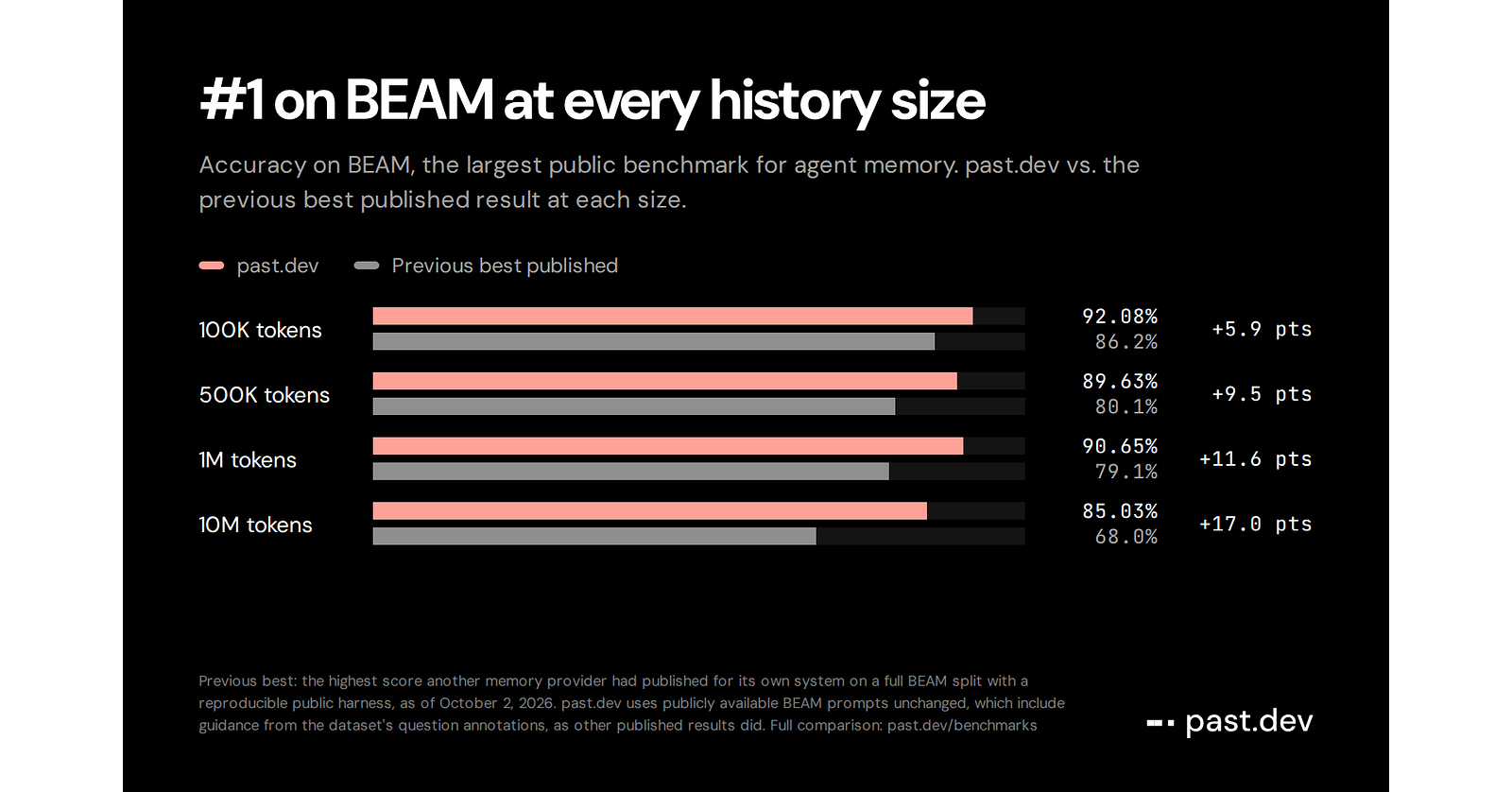
past.dev introduced its long-term memory API for AI agents and says it ranked first on the BEAM benchmark at every tested history size, scoring 85.03% at 10 million tokens versus a previous best of 68.0%. The API returns current and superseded facts with dated sources, applies access limits based on the asker’s identity, and is available today; the company says it does not train models on customer data.
Analysis
The investable signal is not the benchmark lead itself, but whether agent memory becomes a distinct enterprise software layer rather than a feature absorbed into model platforms, search, or workflow suites. If customers adopt an independent memory layer, it could redirect some spend from repeated long-context inference and generic retrieval toward state management, permissions, and auditability. That may benefit enterprise AI platforms and cloud providers indirectly through higher agent usage, while raising feature-competition risk for retrieval and vector-database vendors. These are conditional effects, not evidence of customer displacement.
Near term, the release is unlikely to support a material public-equity re-rating: past.dev is private and the announcement provides no independently verified deployment, revenue, pricing, retention, or unit-cost data. The benchmark is a useful technical signal, but production value depends on reliable updates, access control, latency, and cost across messy enterprise data. SOC 2 and ISO credentials do not by themselves establish that deployments avoid privacy or security failures.
Over 1–3 months, watch for reproducible third-party benchmark results, named customer adoption, and integration depth with platforms such as Microsoft, Salesforce, and ServiceNow. Over 6–18 months, the key risk is commoditization: model and enterprise-software incumbents could bundle adequate memory, compressing standalone pricing. Conversely, verified workflow-level adoption would suggest memory is complementary infrastructure, not merely a retrieval feature. No direct trade is warranted on this announcement alone.
AllMind Terminal
AI-powered research, real-time alerts, and portfolio analytics for institutional investors.
Request TrialMarket Sentiment
Overall Sentiment
moderately positive
Sentiment Score
0.55
Key Decisions for Investors
- No immediate position: past.dev is private, and the release supplies no commercial metrics that justify trading public proxies.
- Add enterprise agent infrastructure to the watchlist; require independently reproducible performance plus evidence of paid production use, retention, and acceptable serving costs before taking exposure.
- Monitor Microsoft, Salesforce, and ServiceNow for agent-product adoption and monetization evidence; treat any benefit from standalone memory as conditional, not attributable from this announcement.
- Falsify the durable-infrastructure thesis if major platforms bundle comparable state and permission handling, or if third-party tests fail to reproduce the benchmark advantage; upgrade the thesis only on customer evidence and sustained workflow usage.
More News
- US stock market hits all-time high as investors bet big on AI
- Singapore's Temasek warns of the ‘biggest risk’ facing markets right now
- A 32% beat, a +6% jump: the IT solutions name our models picked in July
- Nvidia Is on the Verge of a $6 Trillion Market Value
- What Marvell's rosy long-term guidance means for our AI chip stocks
- U.S. stock futures steady after tech rally lifts S&P 500, Nasdaq to records