
Keys® Launches in ChatGPT, Turning "I'm Locked Out" Into a Locksmith Request
Source: PR Newswire
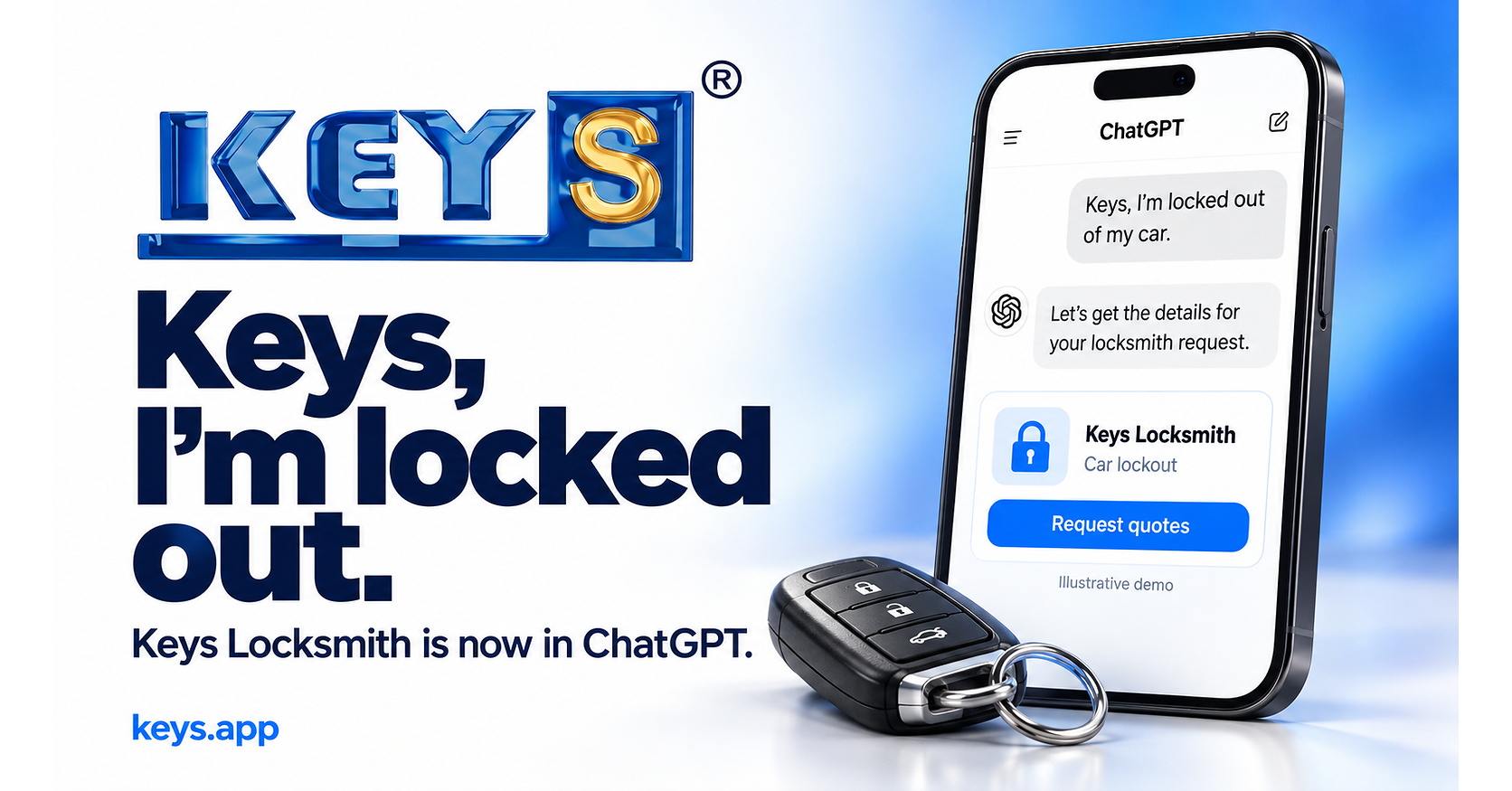
Keys Inc. launched Keys Locksmith in ChatGPT using the Model Context Protocol, allowing customers to describe locksmith needs, request quotes from participating nearby providers, and select a locksmith and authorize payment through a secure Keys page. Keys demonstrated the integration at the 46th Annual Yankee Security Convention, held October 20–24, 2026; service availability depends on location, requested service and provider participation.
Analysis
The economic question is whether this becomes a low-cost, incremental source of completed jobs—not whether conversational service requests attract attention. The handoff to Keys’ own page for provider selection and payment leaves Keys in control of conversion, but also means ChatGPT is currently an acquisition surface, not an end-to-end transaction layer. If requests convert, arrive with useful job details, and are geographically dense enough for providers to respond, Keys could improve provider value and retention. If not, locksmiths may see another quote channel that adds price competition without enough incremental work.
The competitive read-through is conditional: Google local search, Yelp, Angi and Thumbtack could face pressure if customers shift high-intent service discovery into AI conversations, while locksmiths may gain reach but compete more directly on price and arrival time. The announcement provides no adoption, conversion, job-volume or provider-retention data; claims about reduced friction are not yet evidence of lower acquisition costs or better unit economics. OpenAI may gain utility and engagement, but no direct commercial benefit is established here.
Near term, this is a product-validation event, not a sector earnings catalyst. Over 1–3 months, watch for independently verifiable request volume, quote-to-booking conversion, repeat usage and provider coverage by market. Over 6–18 months, the larger risk to incumbent discovery channels depends on whether AI assistants can reliably match local supply and earn consumer trust. Poor coverage, slow or inaccurate quotes, disputes, or weak repeat use would reverse the thesis. With no company identities or tickers supplied and no financial impact disclosed, there is no grounded public-equity trade today.
AllMind Terminal
AI-powered research, real-time alerts, and portfolio analytics for institutional investors.
Request TrialMarket Sentiment
Overall Sentiment
mildly positive
Sentiment Score
0.30
Key Decisions for Investors
- No immediate position: treat the announcement as an unverified distribution experiment rather than evidence of material revenue or competitive displacement.
- Set a 1–3 month diligence alert for disclosed or independently observed completed-job volume, conversion from quote request to booking, provider participation/retention, and performance across multiple geographies; without those data, do not underwrite improved unit economics.
- Watch Google local search, Yelp, Angi and Thumbtack as conditional competitive read-throughs, not automatic shorts. A trade would require evidence of sustained consumer migration and measurable lead or booking deterioration at an exposed incumbent.
- Reassess the longer-term thesis if the workflow expands beyond locksmithing and demonstrates reliable matching, repeat usage and adequate local provider density; falsify it if coverage gaps, poor quote response, cancellations or disputes prevent repeat bookings.
More News
- From Wall Street to Silicon Valley, Anthropic IPO poised to have massive 'trickle-down effect'
- A shock in Brazil sends stocks plunging, while neoclouds take another hit
- EQT becomes the nation’s leading natural gas ‘juggernaut’ with a $13B deal as data center, export demand surges
- Microsoft offers buyouts to nearly 30% of workforce in ongoing AI shift
- Anthropic’s risk factors include the end of humanity, a feud with the Pentagon, and CEO Dario Amodei’s reputation
- Elon Musk warns more than 200 AI cloud companies face ‘guppy-level death’ as the AI boom runs into a debt crisis