
Iternal Technologies Launches Ultrabench, the Free AI Benchmark Aggregator Ranking Every Major AI Model on Intelligence, Price and Hardware Fit
Source: PR Newswire
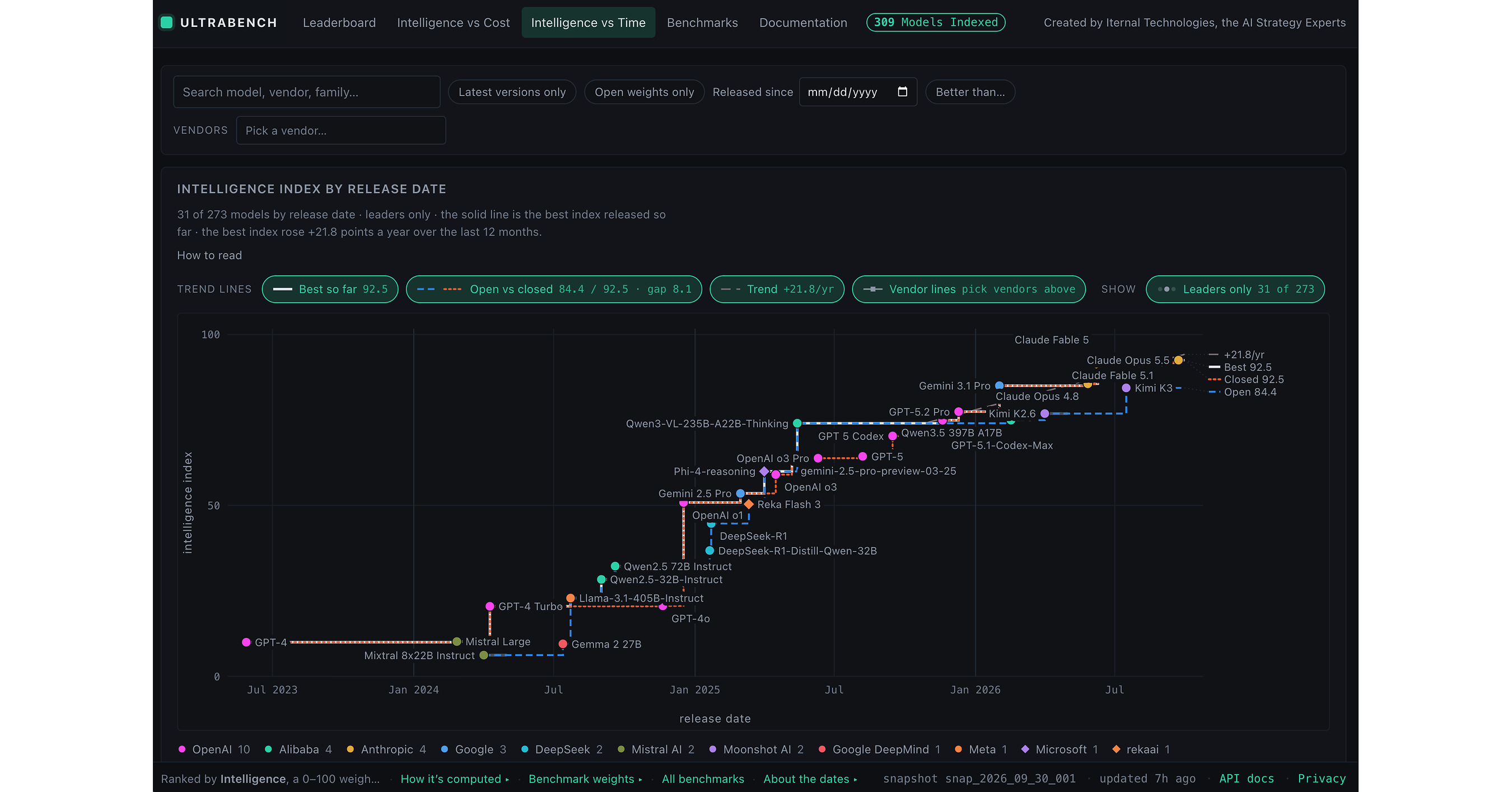
Iternal Technologies launched Ultrabench, a free AI-model benchmark aggregator tracking 309 LLMs across 530 benchmarks, up from 199 models at its August debut. The platform combines a 0-to-100 intelligence index with token pricing, hardware-memory requirements and source-linked scores from more than 40 data sources. In its Sept. 30 snapshot, Anthropic's Claude Opus 5.5 led with a 92.5 intelligence score, while Moonshot AI's Kimi K3 was the top open-weights model at 84.4.
Analysis
A transparent model-comparison layer marginally shifts bargaining power from frontier-model vendors toward enterprise buyers and application developers. As model quality converges above the threshold needed for common coding, support, and document workflows, procurement will increasingly optimize for latency, token economics, data residency, and deployment flexibility rather than absolute benchmark leadership. This is structurally supportive of open-weight ecosystems led by META and, indirectly, cloud providers with broad model catalogs such as AMZN, GOOGL, and MSFT; it is less favorable for vendors whose valuation depends on sustaining premium proprietary API pricing.
The second-order effect is accelerated inference workload fragmentation. Better routing across models can increase total token consumption while lowering blended cost per task, benefiting hyperscaler cloud utilization and GPU/accelerated-compute demand, but reducing the probability that one model provider captures winner-take-most economics. NVDA remains the cleanest near-term beneficiary because heterogeneous model deployment still favors its mature software stack; however, smaller and quantized models improve the addressable market for lower-cost inference hardware, creating a longer-duration read-through for AMD and custom silicon programs at GOOGL, AMZN, and META.
This is a weak standalone trading catalyst: the source is a self-promotional release and benchmark aggregates can be gamed, stale, or poorly correlated with production reliability. The investable signal is only validated if enterprise API price dispersion narrows over the next 1-3 months and cloud management commentary shows rising multi-model routing or open-model deployments. The contrarian risk is that regulated enterprises continue to pay for proprietary-model indemnification, security controls, and uptime guarantees, preserving premium pricing despite apparent benchmark parity.
AllMind Terminal
AI-powered research, real-time alerts, and portfolio analytics for institutional investors.
Request TrialMarket Sentiment
Overall Sentiment
mildly positive
Sentiment Score
0.35
Key Decisions for Investors
- No immediate directional trade on the release; treat as a 1-3 month monitoring catalyst rather than a company-specific event.
- Favor a 6-18 month pair of long META versus MSFT in AI model-layer exposure: META benefits if open weights become the default cost-control option, while MSFT has relatively greater exposure to premium proprietary-model monetization. Reassess if Azure growth reaccelerates while META reports materially higher AI infrastructure expense without incremental engagement or ad-ranking monetization.
- Maintain NVDA as the near-term inference-compute expression, but begin monitoring AMD for a 6-12 month catch-up trade if disclosed enterprise deployments show greater INT4/INT8 inference adoption. The thesis is falsified if enterprise workloads remain concentrated in large proprietary models requiring highest-end accelerators.
- Watch quarterly commentary from AMZN, GOOGL, and MSFT for model-routing usage, Bedrock/Vertex/Azure AI consumption, and inference-margin trends. Rising AI usage with falling revenue per token would favor cloud platforms with broad distribution but caution against extrapolating model-vendor pricing power.
More News
- US job growth expected to slow in September; unemployment rate likely steady
- SoftBank completes final phase of $30 billion investment in OpenAI
- Trump launches midterms campaign blitz amid record low approval ratings
- Amazon seeks to offload $8 billion of Nvidia chips to investors, FT reports
- Amazon seeks to offload $8 bln of Nvidia chips to investors- FT
- Fed’s Cook sees AI buildup as top inflation risk for 2027