
Bank of America Study: Early December Could Overtake Black Friday as the Peak Holiday Shopping Window This Year
Source: PR Newswire
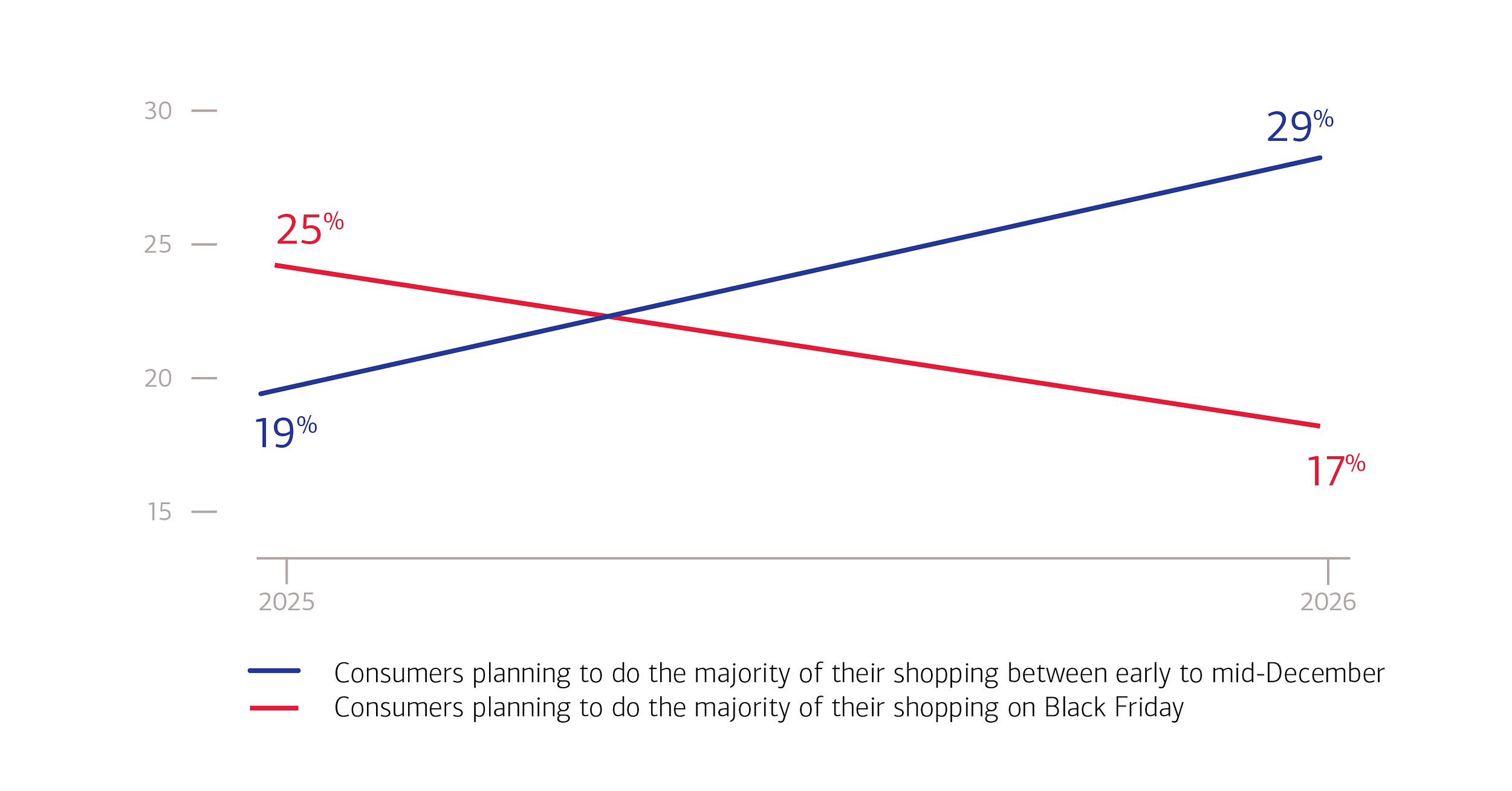
Bank of America's survey of 2,062 U.S. adults found 29% plan to do most holiday shopping in early to mid-December, up from 19% in 2025, while the share focusing on Black Friday fell to 17% from 25%. Spending plans are restrained: 48% expect to spend about the same as last year, 39% expect to spend less and 12% plan to spend more; Bank of America separately reported holiday spending was increasing at a solid rate through September. Consumers also reported less planned use of AI tools and social-media shopping, while credit cards became the preferred payment method for 49%, up from 32% in 2025.
Analysis
The investable signal is a timing and mix risk, not clear evidence of a holiday-spending collapse. If purchases shift into December, retailers may face weaker Black Friday conversion and more concentrated late-season fulfillment, raising the risk of markdowns for merchants that misread early demand or carry the wrong inventory. Conversely, retailers with flexible replenishment and value positioning could capture delayed purchases. The survey’s cautious intentions sit against Bank of America’s cited transaction data showing spending growth through September; neither self-reported plans nor one bank’s customer data settles the holiday outcome. Watch actual November–December card volumes, retailer inventory commentary, and promotional intensity.
BAC’s higher reported credit-card preference is directionally supportive of purchase volume, but is not evidence of incremental BAC revenue: the survey gives no spend amount, card issuer share, revolving balance, or credit quality. Greater card usage could also raise post-holiday delinquency exposure if households finance purchases rather than pay in full. The pullback in social shopping and AI use is not yet a thesis on platform earnings; stated intent does not establish transaction conversion.
Near term, delayed shopping can widen retailer performance dispersion and make early sales reads misleading. Over 1–3 months, the key catalyst is whether December demand arrives without margin-destructive promotions. Over 6–18 months, persistent budget discipline would favor value-oriented operators over discretionary merchants reliant on full-price demand. Contrarian point: weaker sentiment may overstate weakness if shoppers are merely changing when they buy; the thesis fails if December sales disappoint alongside elevated inventories, or if broad promotions show demand is being bought at the expense of margins.
AllMind Terminal
AI-powered research, real-time alerts, and portfolio analytics for institutional investors.
Request TrialMarket Sentiment
Overall Sentiment
mixed
Sentiment Score
-0.10
Ticker Sentiment
Key Decisions for Investors
- Avoid treating the survey as a broad consumer-demand short. Keep broad retail exposure neutral pending November transaction data and retailer inventory updates.
- Use any Black Friday weakness as a relative-value watch, not an automatic sell signal: favor value-oriented retailers over more discretionary, full-price-dependent peers only if December demand and inventory data confirm the divergence.
- Treat BAC as a watch rather than a holiday-spending trade. Reassess if card purchase volumes strengthen, while monitoring revolving balances and delinquency trends for the offsetting credit-quality risk.
- Set a falsification trigger: if December sales remain soft while retailer inventories rise and promotional intensity increases, reduce discretionary-retail exposure; if sales shift later without margin deterioration, the delayed-demand thesis is supported.
More News
- Stop sharing your passwords with AI agents, Bank of America warns customers
- Warren urges DOJ criminal probe of Bank of America over anti-money-laundering violations
- Kimberly-Clark completes $4.9 billion senior notes offering to support Kenvue deal
- Analysts react as Binance freezes assets after $6.3 billion security breach
- Stocks slump, bonds leap as AI giants’ spending spooks investors
- DoorDash offers $17 billion for Instacart: ‘the largest companies are only eating more and more of the pie’