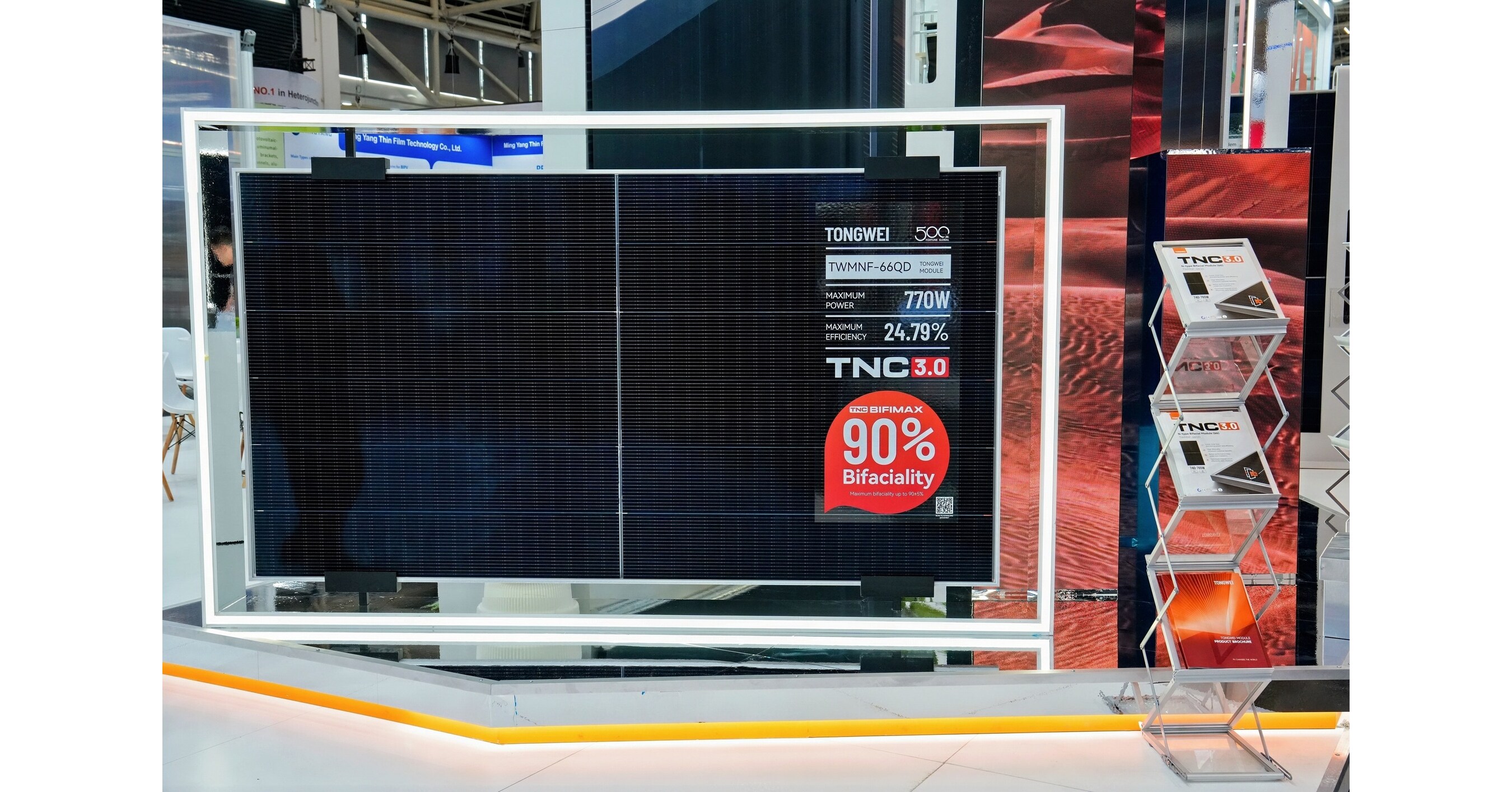
Tongwei a lancé au salon Intersolar Europe 2026 son module bifacial TNC 3.0 BIFIMAX, certifié TÜV Rheinland, avec une bifacialité record jusqu’à 93,07 %, une puissance jusqu’à 770 W et un rendement de conversion jusqu’à 24,8 %. L’article indique qu’une centrale de 100 MW à Hambourg pourrait générer ~180 000 € de recettes supplémentaires par an vs des modules standard, soit +81,62 GWh sur la durée de vie. Tongwei a aussi présenté le module résidentiel TNC 2.0 G12R-48 (480 W, rendement 24 %, <2 m²) visant à étendre la production jusqu’au crépuscule et à mieux résister aux conditions météorologiques extrêmes via des technologies d’interconnexion renforcées.
This reads less like an immediate P&L event and more like a competitive signaling shot in a structurally oversupplied solar market. When module makers move the spec curve higher, the economic value usually migrates downstream to developers and installers unless the vendor has enough pricing power to hold ASPs; that argues for margin compression across commoditized module peers rather than a broad-based uplift. The most exposed losers are lower-tier Chinese manufacturers and polysilicon/wafer suppliers, because higher efficiency and higher bifacial output reduce silicon intensity per watt and can deepen the deflationary spiral in the upstream chain.
The first-order beneficiary is any utility-scale or rooftop operator that can translate better yield into higher project IRRs, especially in land-constrained or high-albedo markets in Europe. But the timing matters: the real impact is 1-3 quarters out, once distributors, EPCs, and financiers decide whether the product is truly bankable and whether warranty/degradation data match the lab claims. In the next few days, the news can still move sentiment, but it is unlikely to change earnings estimates without evidence of shipment traction or ASP resilience.
Contrarian view: the market may be overestimating how much a trade-show launch changes economics in a brutally competitive industry. If Tongwei’s efficiency lead is replicated or priced away, the headline advantage becomes a share-shift story, not a margin expansion story. Falsifiers are simple: if solar module ASPs stabilize despite higher specs, or if polysilicon prices stop falling because supply discipline arrives, the bearish upstream thesis weakens quickly.
AI-powered research, real-time alerts, and portfolio analytics for institutional investors.
Request TrialOverall Sentiment
strongly positive
Sentiment Score
0.55
