
ConocoPhillips: A Crude Awakening Is Coming (Rating Downgrade)
Source: seekingalpha.com
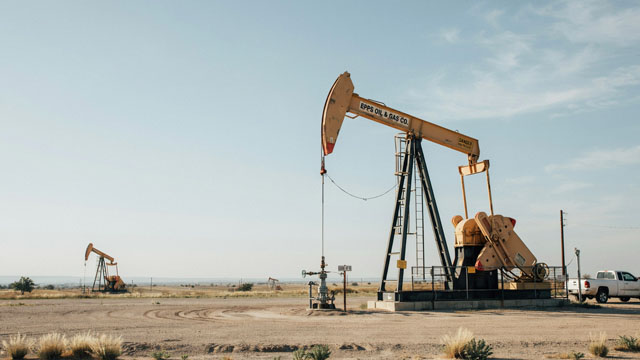
ConocoPhillips has 66% of proved reserves in liquids, leaving it heavily exposed to crude prices with limited natural gas upside. New CEO Andy O'Brien signaled no strategic shift, while the company targets $7B in free cash flow by 2029—roughly double 2025 levels—contingent on sustained high crude prices.
Analysis
The key exposure is not the FCF target itself, but its sensitivity to crude: absent a strategic change, that target should be treated as a commodity-price scenario rather than a dependable operational milestone. This leaves COP more exposed to oil-driven estimate revisions than producers with more diversified earnings streams. A sustained oil rally could therefore make COP outperform, while a weaker crude tape may pressure both cash-flow expectations and the multiple investors assign to them. The CEO transition adds little near-term catalyst value if capital allocation remains unchanged.
Over the next 1–3 months, crude prices and any updated production, spending, or shareholder-return guidance matter more than the long-dated target. Over 6–18 months, the question is whether execution and portfolio mix can reduce dependence on high oil prices; the supplied information does not establish that they will. The contrarian risk to a cautious view is that the market may already discount the commodity dependence, leaving COP with meaningful upside if crude holds firm. Conversely, a fall in oil prices would test whether the stated cash-flow ambition is resilient or simply recedes with the price deck. No valuation or market-expectation data are provided, so conviction on outright direction should remain limited.
AllMind Terminal
AI-powered research, real-time alerts, and portfolio analytics for institutional investors.
Request TrialMarket Sentiment
Overall Sentiment
mildly negative
Sentiment Score
-0.18
Ticker Sentiment
Key Decisions for Investors
- Keep COP exposure sized as a high-crude-beta position, not as a stand-alone long-duration FCF-growth thesis. Avoid adding solely on the 2029 target without checking the assumed oil-price deck and sensitivity.
- For a relative-value expression, consider underweighting COP against more diversified energy producers when the objective is to reduce crude sensitivity; verify peer mix, valuation, and current positioning before sizing a pair.
- Use the next guidance update and crude-price direction as the 1–3 month decision points. A reduction in spending or shareholder-return commitments alongside weaker crude would strengthen the cautious case; maintained commitments and resilient cash generation despite lower prices would weaken it.
- Falsification/watch item: sustained crude strength accompanied by upward revisions to production, cash flow, or capital returns would challenge the underweight thesis. The key missing data are management's commodity-price assumptions, sensitivity to crude, and the market's existing expectations.
More News
- Trump says renewed Iran strikes ‘highly unlikely’ if talks progress but warns he could still strike
- The Pentagon is reportedly ramping up economic warfare and espionage. Nvidia CEO Jensen Huang’s affair with a suspected Chinese spy shows why
- How a Frenchman’s book on ‘Democracy in America’ nearly 200 years ago explains the midterms, from data centers to Texas
- China AI bust threatens Xi’s ’Wall Street East’ ambitions
- Nvidia Probes Huang Affair Amid Spying Controversy
- Berkshire Hathaway speeds up stock buybacks, though profit falls