
MINISFORUM S5: 5-Bay All-Flash Agent NAS for Intelligence, High-Speed Storage, Quiet Operation and Low Power Consumption
Source: PR Newswire
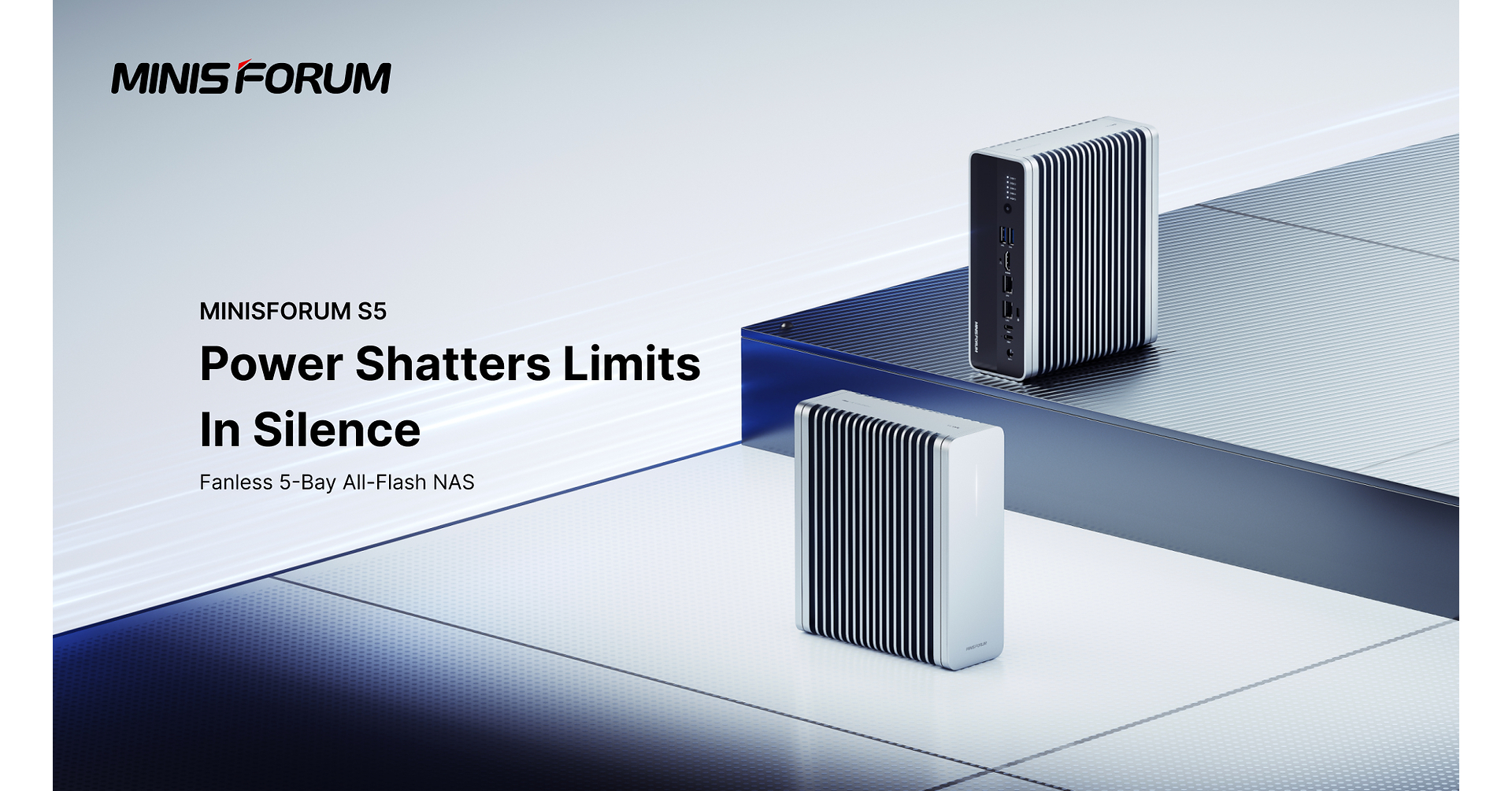
MINISFORUM announced the S5, a fanless five-bay all-flash Agent NAS supporting up to 40 TB of NVMe storage, with one 10GbE port and a built-in NPU rated at 15 TOPS (INT8). The company says it delivers up to 6x faster sequential and 100x faster random read speeds than traditional HDDs; its laboratory test reported approximately 15W of CPU power under combined stress at 25°C. The S5 is available for $599 (12GB/0TB) or $3,759 (12GB/20TB), each discounted 20% from the stated original price; the 20TB configuration is estimated to ship in early November.
Analysis
For Intel, this is product-validation evidence, not a meaningful near-term earnings catalyst: one niche NAS launch does not establish processor volume, pricing power, or broader design-win momentum. The more relevant signal is that vendors are packaging local task execution with cloud AI, but the stated 15-TOPS NPU points to lightweight orchestration rather than a substitute for cloud inference. That limits the inference that this product validates a large new on-device compute market.
The potential competitive pressure falls on conventional NAS propositions from Synology and QNAP if small creative teams value quiet, low-latency shared storage and automation enough to accept all-flash capacity economics. But adoption depends on real-world total-system power, sustained thermals, SSD cost and endurance, software reliability, and cloud-service dependence—not vendor lab claims. All-flash demand could benefit NAND suppliers at the margin, but this single launch provides no basis to estimate shipments or supplier revenue.
Time horizon: the immediate PR-driven effect on INTC should be negligible. Over 1–3 months, independent reviews, shipping cadence, and evidence of repeat design wins are the useful signals. Over 6–18 months, a broader shift toward edge-cloud appliance bundles could support incremental client silicon demand, but only if it scales beyond hobbyist and small-studio niches. Contrarian point: the product’s AI label may overstate the compute opportunity; the customer value may chiefly be quiet, fast storage, with agent features not yet proven to drive purchase decisions.
AllMind Terminal
AI-powered research, real-time alerts, and portfolio analytics for institutional investors.
Request TrialMarket Sentiment
Overall Sentiment
mildly positive
Sentiment Score
0.15
Ticker Sentiment
Key Decisions for Investors
- No trade in INTC on this announcement alone. Treat it as low-signal product news, not evidence of a material earnings revision or a change in Intel’s competitive position.
- Set a 1–3 month diligence watch: verify actual ship dates, independent whole-system power and thermal tests, software/agent functionality, and evidence of sales or repeat customer demand. Company-stated component power is not a substitute for measured system consumption.
- Revisit the Intel read-through only if Minisforum or other vendors disclose multiple edge-AI design wins with meaningful unit volumes, or if Intel links such wins to a measurable client-processor revenue or mix contribution.
- Falsification of the edge-appliance thesis: weak availability, poor sustained performance, limited software integrations, or customers choosing conventional NAS systems because SSD capacity cost and cloud dependence outweigh quiet operation and faster access.
More News
- We're downgrading this retail stock after a big comeback. Plus, AI names slide again
- Why is VanEck Semiconductor ETF sliding today?
- I watched Nvidia's Jensen Huang work the room in London. He brought big checks — and a blunt message
- Tesla's Roadster reveal, Apple and Meta team up, Nike's India push and more in Morning Squawk
- Why is BE Semiconductor Industries stock sliding today?
- Benchmarked: Nvidia's RTX Spark notebook delivers serious local AI compute, at a price