
CSI's 2.3 MWh Mobile BESS Earns TÜV Certification to Applicable UL 9540 Requirements
Source: PR Newswire
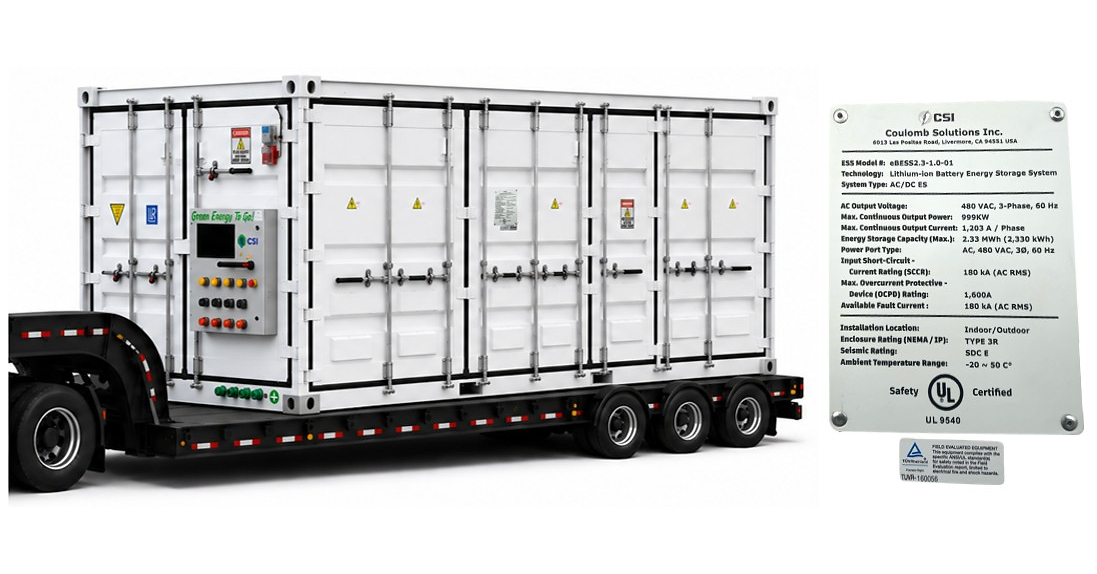
Coulomb Solutions' 2.3 MWh mobile battery energy storage system, featuring an integrated 1 MW, 480VAC power-conversion system, received TÜV certification for applicable UL 9540:2023 safety requirements. The certification supports commercialization of the transportable system for commercial EV charging, data centers, construction sites, grid support and temporary-power uses where permanent grid capacity is constrained. CSI also plans full UL testing for a next-generation model with optional bidirectional megawatt charging capability.
Analysis
This is a commercialization de-risking event rather than a demand signal. Safety validation can reduce permitting, insurer, and site-host friction for mobile storage, but CSI is private and the release provides no backlog, pricing, utilization, warranty reserve, or unit-economics data; there is no basis to infer a near-term revenue inflection. The key bottleneck remains interconnection and customer willingness to pay a premium versus diesel generation, utility upgrades, or stationary storage.
The broader read-through is modestly favorable for mobile-power ecosystems: certified temporary capacity expands the addressable market for megawatt-scale fleet charging and data-center bridging, where grid delays carry high opportunity costs. Public beneficiaries are more likely component and incumbent storage vendors with established distribution—Fluence (FLNC), Tesla (TSLA), Generac (GNRC), and Wärtsilä (WRT1V.HE)—but CSI's product does not materially alter their revenue outlook absent evidence that mobile deployments become a repeatable procurement category. Mobile systems may also substitute for diesel rental demand at the margin, creating a long-duration headwind to Aggreko-type temporary-power economics, though the effect is presently immaterial for listed U.S. rental proxies.
Over 1-3 months, the relevant catalyst is whether insurers, AHJs, and large fleet customers explicitly accept this certification as sufficient for rapid deployment; state and local fire-code interpretations can still delay installations despite product-level testing. Over 6-18 months, demand could accelerate if data-center and commercial-fleet grid queues remain extended, but economics deteriorate if LFP pricing rises, battery degradation under frequent transport is worse than modeled, or utilities shorten upgrade timelines. The contrarian view is that certification may be necessary but not differentiating: established BESS suppliers already compete on bankability, service coverage, financing, and performance guarantees—not merely compliance.
AllMind Terminal
AI-powered research, real-time alerts, and portfolio analytics for institutional investors.
Request TrialMarket Sentiment
Overall Sentiment
moderately positive
Sentiment Score
0.42
Key Decisions for Investors
- No standalone trade from this release: CSI is not publicly traded and the disclosed information lacks orders, ASPs, gross margin, and deployment utilization. Add an alert for disclosed multi-unit contracts or named fleet/data-center customers; those would be the first evidence of investable demand.
- Maintain FLNC on a 1-3 month watchlist rather than buying on this news. A broader shift toward certified distributed storage could improve pipeline conversion, but initiate only if bookings/backlog conversion and gross-margin guidance improve; falsify on further project cancellations, working-capital deterioration, or guidance cuts.
- For a 6-18 month grid-constraint thesis, prefer a diversified long in TSLA over a pure mobile-BESS extrapolation: Megapack scale, software attachment, and financing capacity provide superior optionality if temporary and stationary storage demand converge. Risk-manage against weaker storage deployment commentary or sustained battery-price inflation.
- Monitor GNRC for a potential relative-value long versus diesel-exposed temporary-power/rental proxies if megawatt-scale mobile storage adoption produces verified fleet orders. Do not establish the pair until recurring deployments demonstrate substitution rather than one-off event and construction use.
More News
- How the US midterm elections reflected resistance to data centres
- Elon Musk once said the Cybertruck would be Tesla’s ‘best product ever.’ Now he’s winding down production
- AI Party isn't Ending Because Of The Blue Wave Says Ives
- The AI ‘credit card’ is getting costlier as CoreWeave bond yield tops 16%
- OpenAI to press ahead with data-center expansion despite midterm sweep, CFO tells CNBC
- SoftBank, ABB consider China carve-out to rescue $5.4bn robotics deal