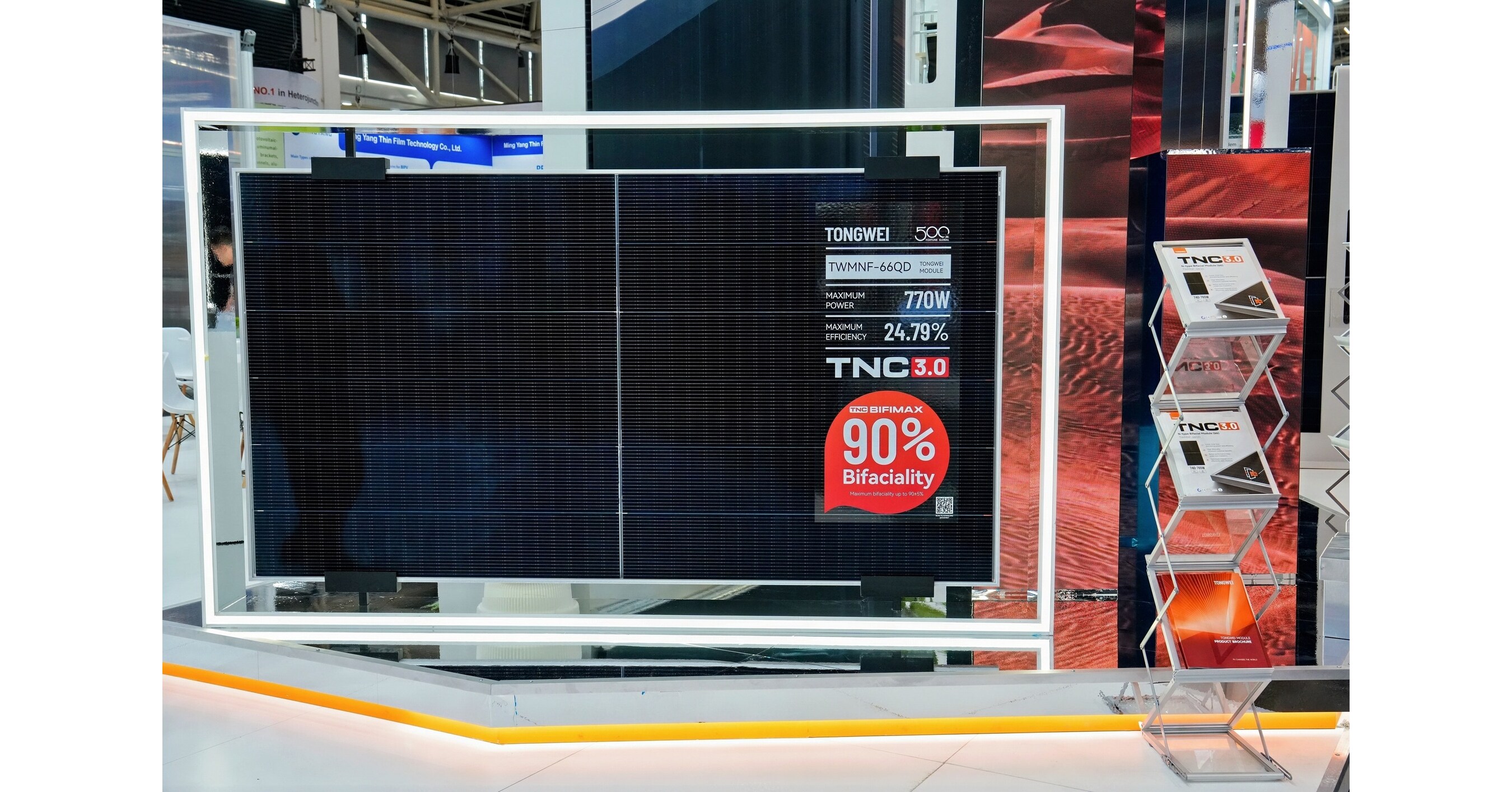
Tongwei anunció en Intersolar Europe 2026 el lanzamiento global del módulo TNC 3.0 BIFIMAX con bifacialidad récord de hasta 93,07%, potencia de salida hasta 770 W y eficiencia de conversión hasta 24,8% (certificado por TÜV Rheinland). En un sitio solar de 100 MW en Hamburgo, esta configuración se estima en +180.000 euros de ingresos anuales y +81,62 millones de kWh adicionales de electricidad limpia durante la vida útil versus módulos estándar. También presentó el residencial TNC 2.0 G12R-48 (hasta 480 W, eficiencia 24%, <2 m²), apuntando a mayor generación en baja luz y mejor resistencia a microfisuras.
The market read-through is less about one new panel and more about a higher auction anchor for utility-scale solar. When a leader pushes a materially better spec, developers use it to renegotiate pricing, which typically expands installed-base economics for project owners but compresses gross margin for every mid-tier module vendor downstream. The near-term beneficiary set is therefore likely project developers and IPPs with locked-in offtake, while weaker Chinese and ex-China module makers face another round of ASP pressure.
Second-order effects matter more than the launch itself. Higher module output per square meter lowers land and balance-of-system intensity for constrained sites, but it also reduces revenue per MW for trackers, racking, wiring, and EPC labor if the industry standardizes on fewer modules per project. In the 1-3 month window, the key catalyst is whether spot module prices and order books soften; if they do not, this is mostly marketing. Over 6-18 months, sustained bifacial efficiency gains should favor the lowest-cost, most bankable suppliers and deepen the moat around names with financing credibility.
The contrarian view is that the headline spec is overfit to ideal utility conditions and may not translate cleanly to rooftop economics, where aesthetics, permitting, and installer throughput matter more than a few points of bifaciality. If policy support weakens or rates stay elevated, the demand elasticity from slightly better module economics may be insufficient to offset financing drag. The thesis is falsified if module ASPs hold firm, or if project pipelines do not inflect despite the better hardware.
AI-powered research, real-time alerts, and portfolio analytics for institutional investors.
Request TrialOverall Sentiment
mildly positive
Sentiment Score
0.25
Ticker Sentiment
