
Motional Open-Sources Dataset to Help Autonomous Vehicles Master Human-Like Reasoning
Source: PR Newswire
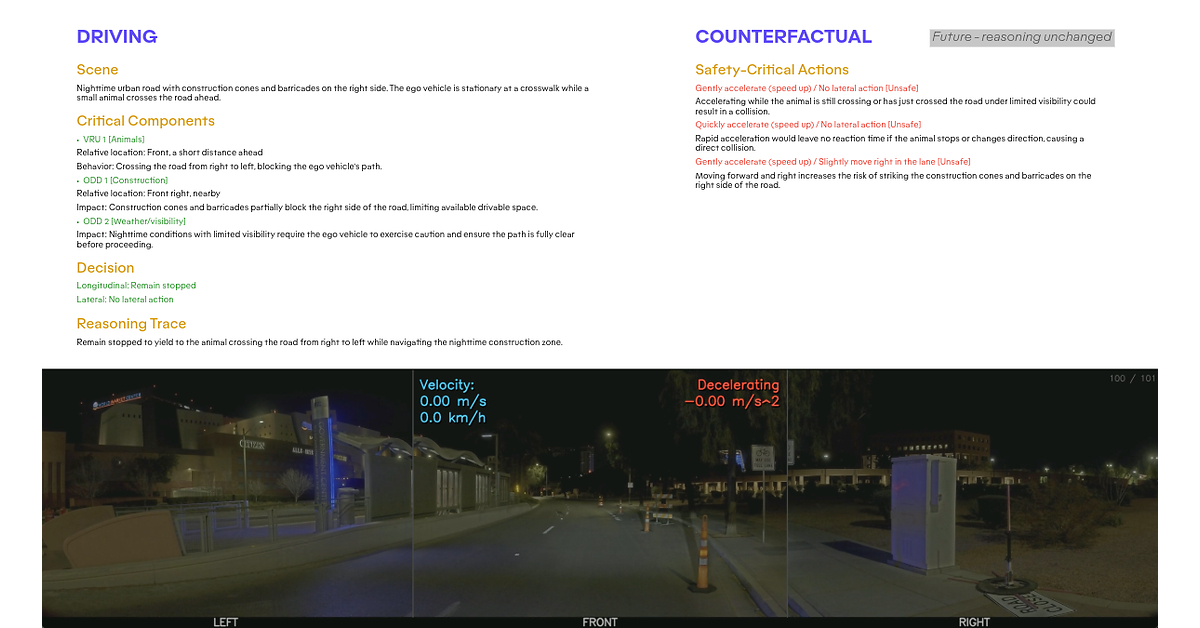
Motional launched nuReasoning, an open autonomous-vehicle dataset containing 20,000 long-tail driving scenarios, more than 105 hours of edge-case footage, and 247,000 human-verified reasoning annotations. The dataset is intended to improve vision-language-action models' ability to reason through safety-critical situations, while a related ECCV challenge will test planning and reasoning on 1,000 private scenarios. A prior miniset was downloaded more than 50,000 times, signaling research demand, though the announcement is primarily a technology and ecosystem development rather than a near-term financial catalyst.
Analysis
This is strategically constructive for the AV ecosystem but immaterial to UBER’s near-term earnings. Open reasoning benchmarks reduce the cost and time required to train edge-case planning models, which should narrow the performance gap between well-capitalized fleet operators and smaller developers; the second-order effect is erosion of proprietary-data scarcity as a durable moat. The commercial value will accrue only if benchmark performance translates into lower remote-assistance rates, faster safety-case approvals, and reduced vehicle utilization downtime.
For UBER, the relevant transmission channel is partner economics rather than software ownership: a more capable Motional fleet could expand autonomous supply on the platform and improve contribution margins by reducing driver-incentive exposure in constrained markets. Conversely, Uber’s negotiating leverage could weaken if AV partners prove they can scale cheaply and retain more trip economics. The next 1-3 month catalyst is whether the December benchmark results produce credible third-party evidence that reasoning-based models outperform conventional planning stacks; absent that, this remains a research-community signal rather than a deployment catalyst.
The contrarian view is that explainability may lengthen, not shorten, commercialization timelines. Explicit reasoning outputs create a larger audit trail for regulators and plaintiffs, and safety gains in curated long-tail tests may not generalize to mixed urban operating domains. A meaningful bullish read-through requires evidence of driverless operating expansion, falling safety-operator/remote-support costs, or improved partner unit economics over the next 6-18 months—not dataset downloads or challenge rankings.
AllMind Terminal
AI-powered research, real-time alerts, and portfolio analytics for institutional investors.
Request TrialMarket Sentiment
Overall Sentiment
moderately positive
Sentiment Score
0.48
Ticker Sentiment
Key Decisions for Investors
- No standalone UBER trade on this release. Maintain existing exposure only; the stated impact is too indirect to alter near-term bookings, EBITDA, or valuation assumptions.
- Set an event alert around December benchmark results and subsequent Motional operating updates. Upgrade the UBER AV-supply thesis only if results are followed by a defined driverless-service expansion and disclosed evidence of lower intervention or support intensity within 3-6 months.
- For AV thematic exposure, prefer a watchlist pair rather than immediate execution: long Hyundai Motor (005380 KS; Motional parent) versus short a broad auto proxy only after verified autonomous deployment milestones. Thesis fails if regulatory approval slips or fleet utilization/support costs do not improve despite model progress.
- Monitor UBER’s AV-partner take-rate disclosures and autonomous trip availability in Las Vegas. A rising autonomous-trip mix without margin accretion would be a warning that suppliers, rather than UBER shareholders, are capturing the incremental economics.
More News
- Meta shares are down 9% this week. Here's why Mike Khouw is buying now
- Wayve, Stellantis and Nvidia team up with France on self-driving cars
- China’s Baidu tests robotaxi on London streets
- Maplebear Inc stock hits all-time high of 54.78 USD
- Instacart explores potential sale, holds talks with Uber and DoorDash: report
- Instacart in talks for sale, The Information reports