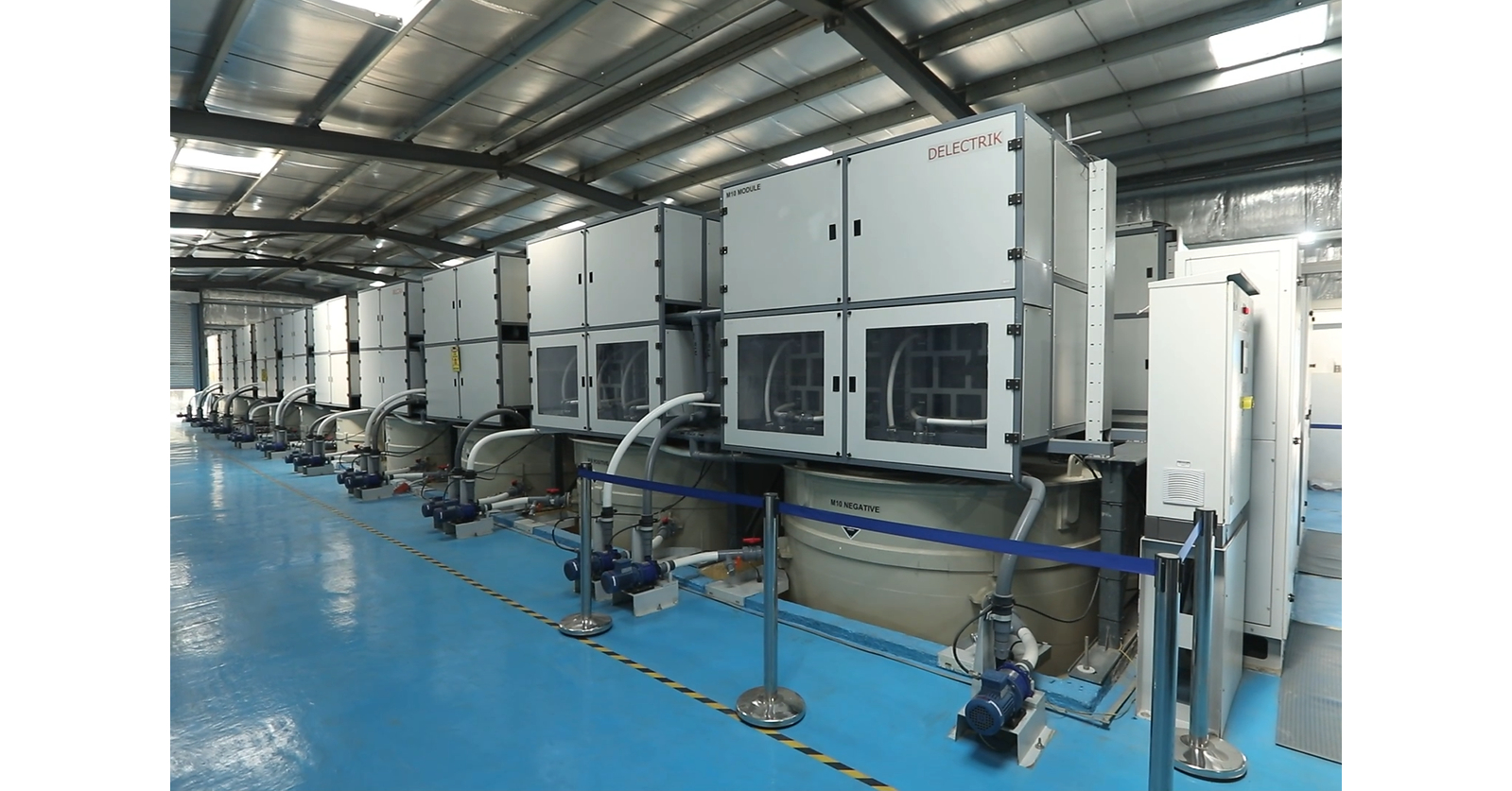
Delectrik Systems will build India’s first utility-scale vanadium redox flow battery project with 100 MWh capacity, awarded by NTPC Renewable Energy (NTPC’s 100% subsidiary). The system is targeted for commissioning in 2027 at NTPC’s Khavda solar park, which is planned to scale to 30 GW by 2029, following a prior successful 3 MWh deployment with NTPC in Greater Noida in 2025. Delectrik aims for at least 1 GWh of flow-battery order backlog over the next 12 months and frames the deal as India’s first lithium-free (no lithium) large-scale BESS project.
This is less an earnings event than a procurement signal: India is beginning to test whether long-duration storage can be bought as a bankable grid asset rather than a science project. The near-term market impact should be small, but the strategic implication is larger for whoever can repeatedly deliver dispatchable capacity at scale; that favors integrated utilities and EPCs with balance-sheet strength over pure-play renewable developers that still sell mostly kWh, not firm power.
The second-order winner is not necessarily the battery chemistry itself, but the utility customer that can use it to monetize curtailment reduction, peak arbitrage, and grid-stability value. If these projects scale, the competitive pressure shifts toward technologies that can prove 8+ hour economics and local supply resilience; that is a headwind for lithium-ion suppliers in the long-duration segment and a tailwind for domestic industrialization around vanadium processing, power electronics, and EPC execution. The biggest gating item is raw-material economics: if vanadium prices or financing costs rise, the supposed cost advantage can evaporate quickly.
Contrarian view: the market may over-read a first-of-kind order as proof of a new procurement standard. What matters is whether the buyer follows with repeat awards, disclosed tariffs, and utilization rates that justify the capex versus simply satisfying a policy headline. Over the next 1-3 months, the real catalyst is not this installation itself but the next tender; over 6-18 months, the thesis lives or dies on whether long-duration storage becomes embedded in NTPC's renewable buildout and whether data-center/C&I customers adopt it as a diesel-displacement tool.
AI-powered research, real-time alerts, and portfolio analytics for institutional investors.
Request TrialOverall Sentiment
mildly positive
Sentiment Score
0.35
