
Trump-Xi Summit Delivers Most on Pageantry, Not Substance
Source: Bloomberg
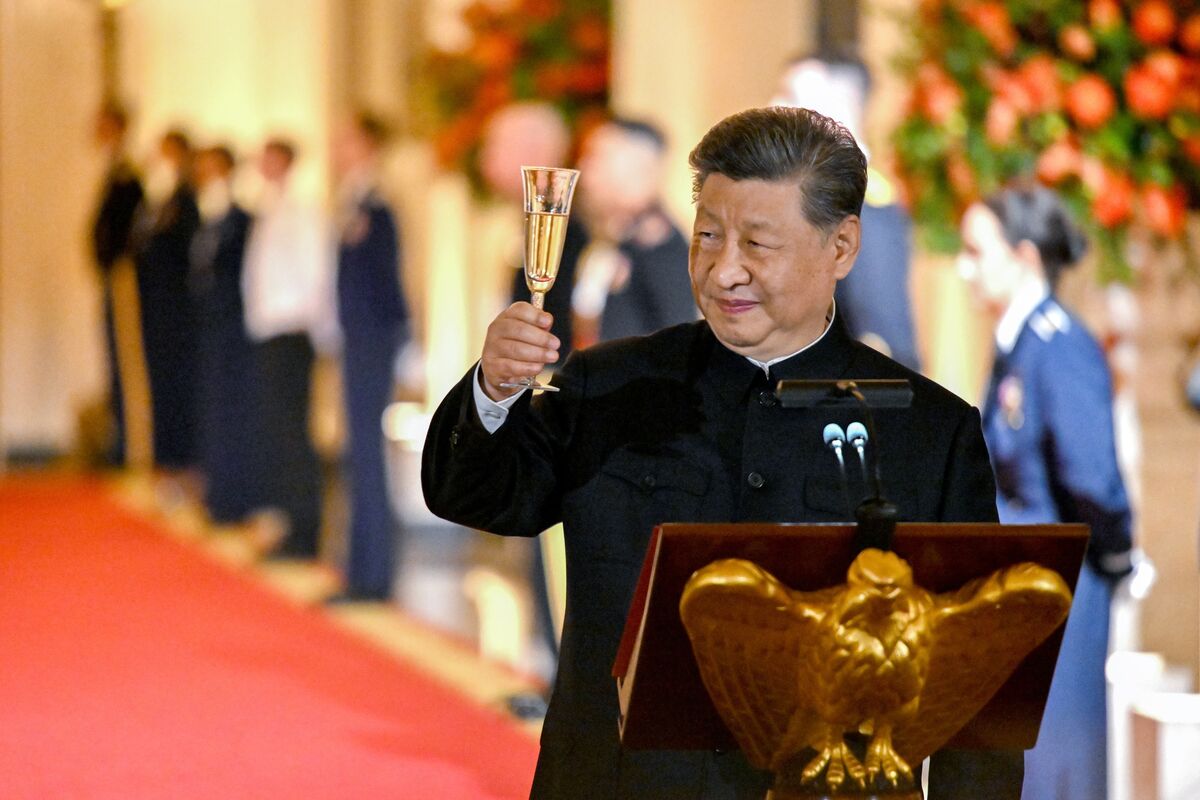
The US and China extended their trade truce by two months, announced as President Xi Jinping arrived for his Washington summit with President Trump. The summit has otherwise produced pageantry and broad platitudes rather than substantive new agreements, leaving trade-policy uncertainty beyond the extension unresolved.
Analysis
The near-term market effect is a reduction in the probability of an immediate tariff escalation, not a reopening of the US-China trade corridor. That distinction matters: retailers and hardware assemblers can defer contingency pricing and inventory actions over the next 1-3 months, but they are unlikely to reverse multi-year sourcing diversification without a durable agreement. The most tradable beneficiaries are therefore high-China-content US consumer discretionary and electronics names with operating leverage to avoided cost inflation, rather than broad China equities.
The second-order loser is the “friend-shoring” capital-expenditure narrative in Mexico and Southeast Asia, but only at the margin. Factory relocations, supplier qualification and logistics redesign are largely irreversible once funded; a short extension does not alter 6-18 month capacity plans for firms such as HON, JABIL and major EMS suppliers. Conversely, the absence of concrete rules on export controls, investment restrictions, semiconductors and enforcement leaves a meaningful policy-risk discount on SOXX and KWEB that headline-driven rallies may not fully close.
Consensus may overread the absence of escalation as a policy reset. The two-month horizon creates a discrete repricing event around expiry, while corporate earnings guidance is unlikely to improve materially until companies can quantify tariff schedules and licensing restrictions. The cleaner expression is to own near-term relief beneficiaries selectively while retaining cheap protection against a renewed tariff threat; avoid chasing broad Chinese beta unless credit, FX and capital-flow data confirm a genuine improvement in China risk appetite.
AllMind Terminal
AI-powered research, real-time alerts, and portfolio analytics for institutional investors.
Request TrialMarket Sentiment
Overall Sentiment
neutral
Sentiment Score
0.05
Key Decisions for Investors
- Use a 1-3 month tactical long basket in BBY, TGT and RH versus short XRT: these names have greater sensitivity to China-linked merchandise costs and consumer-discretionary beta than the diversified retail ETF. Keep sizing modest; exit if management commentary indicates sourcing disruption persists or if tariff implementation details fail to improve.
- Maintain a structural long HON / short KWEB pair over 6-12 months rather than treating the truce as a reversal of supply-chain reconfiguration. HON retains exposure to reshoring, aerospace and automation investment, while KWEB remains vulnerable to policy, capital-flow and regulatory risk; reassess if a binding agreement addresses technology restrictions and investment access.
- For existing SOXX or KWEB longs, buy 2-3 month put spreads timed beyond the truce expiry rather than sell volatility into a binary policy date. The hedge is justified if implied volatility remains below prior trade-policy event peaks; invalidate the hedge thesis if formal tariff and export-control terms materially reduce the next escalation risk.
- Do not initiate a broad FXI or MCHI long solely on summit optics. Upgrade only if USD/CNH strengthens sustainably, China credit impulse improves, and the agreement produces verifiable sector-specific concessions; absent those signals, any rally is more likely multiple expansion than earnings revision.
More News
- Iran says it awaits US response on seven-day roadmap to end war
- Boom or bust? The case for and against panicking about 5% yields
- US, Iran Explore Phased Hormuz Deal
- Houthi attack on Mecca, Medina would cross ‘red line’, Pakistan PM tells UN
- What would a US diesel export ban mean for global fuel prices?
- The Tiny Magnet Maker That Attracted $1.6 Billion From Lutnick