
United States Antimony Corporation Provides Third Quarter Update on Antimony Shipments to the DoW
Source: Newswire
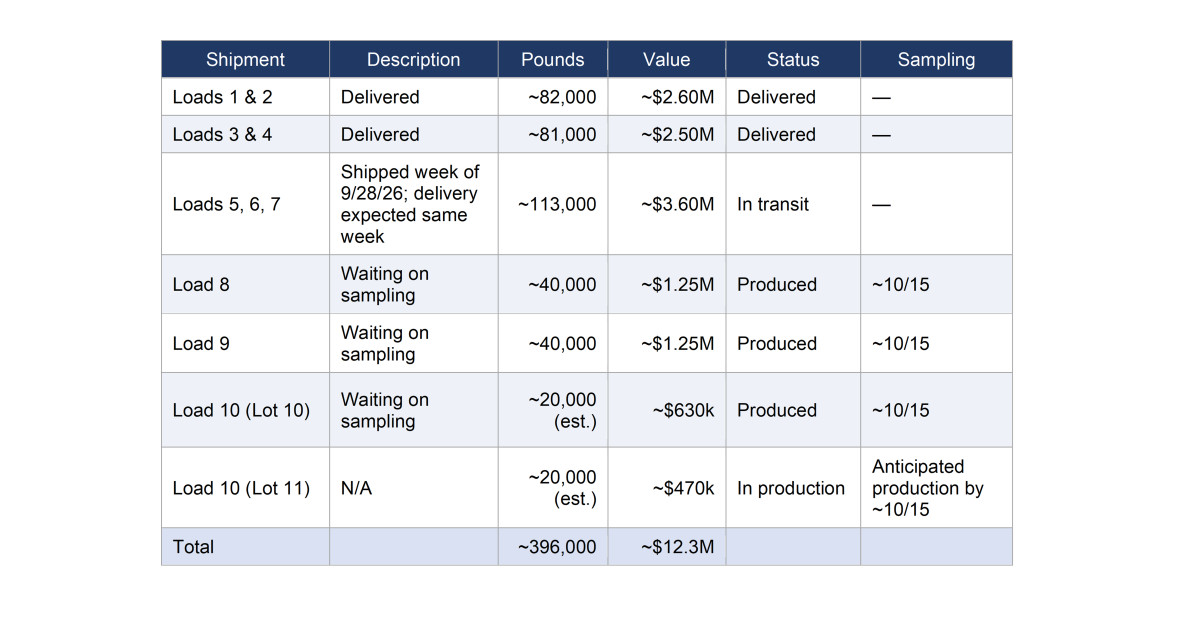
United States Antimony reported third-quarter deliveries of MIL-SPEC antimony ingots to the Defense Logistics Agency under its $245 million sole-source supply contract. Higher-purity (~99%) Bolivian antimony flake has arrived at its Thompson Falls smelter, improving furnace efficiency, while more than 400,000 pounds of Stibnite Hill, Montana antimony feedstock is stockpiled for processing. The company expects expanded processing capacity and lower-cost domestic material to support increased DLA deliveries and improved finished-product margins.
Analysis
The investable question is not whether UAMY can process more material, but whether it can convert a sole-source award into repeatable cash generation before working-capital demands and feedstock dependence absorb the benefit. Higher-purity imported feed should lift recoveries and lower unit energy/processing costs immediately, while domestic stockpile processing could improve gross margin over the next 1-3 quarters. Neither the shipment volume, realized price, contract backlog, cash collection terms, nor incremental capex was disclosed; absent these, the release does not support a reliable earnings revision.
The supply-chain moat is strategically valuable but narrower than the equity narrative implies: the company remains exposed to foreign upstream material even as it expands domestic sourcing. A disruption in Bolivian logistics, assay/quality rejection, or delayed federal procurement acceptance would create disproportionate downside because a small producer has limited inventory and balance-sheet capacity to buffer a missed delivery. Conversely, verified sequential delivery growth and disclosed margin capture could force a rerating from speculative critical-minerals optionality toward contracted-defense revenue.
Near term, UAMY is vulnerable to a sell-the-news reaction if the market had anticipated deliveries and the next filing fails to quantify revenue conversion. Over 6-18 months, domestic feedstock reduces geopolitical and input-cost risk, but permitting, mine-development execution, and metallurgical recovery are likely more important to valuation than further promotional contract updates. The contrarian view is that the scarcity premium may already capitalize much of the defense narrative; the catalyst required for further upside is audited economics rather than strategic language.
AllMind Terminal
AI-powered research, real-time alerts, and portfolio analytics for institutional investors.
Request TrialMarket Sentiment
Overall Sentiment
moderately positive
Sentiment Score
0.48
Ticker Sentiment
Key Decisions for Investors
- Do not chase UAMY on this release. Establish only a small tactical long after the next 10-Q if it discloses DLA revenue recognition, receivables, gross-margin expansion, and positive operating-cash-flow evidence; target a 3-6 month holding period with a 15-20% risk limit given micro-cap liquidity and execution risk.
- Use a catalyst watch: add to UAMY only if management quantifies delivered pounds and remaining contract value, while gross margin improves sequentially without a material increase in inventory or accounts receivable. Failure of any two metrics is thesis-invalidating and argues for exit.
- For defense-critical-minerals exposure without single-asset processing risk, prefer a basket approach—long MP and/or LAC alongside a limited UAMY position—rather than treating UAMY as a core defense allocation. This diversifies procurement-policy upside while reducing dependence on one feedstock route.
- Avoid shorting UAMY outright ahead of contract-performance disclosures: sole-source procurement and critical-minerals policy can create sharp upside gaps. A bearish view should instead be expressed by withholding exposure or, where liquid options exist, using defined-risk puts after a news-driven spike.
More News
- UK Prime Minister Burnham says Iran 'played a part' in British air base incident
- South Korea’s exports hit record high on AI boom
- RAM supply set to worsen, says Micron, as CEO celebrates ‘much higher’ prices
- Tencent leases 100,000 chips from Oracle for $7 bln- FT
- Greer urges G20 to back Trump tariff agenda, takes aim at China
- Asia stocks rise on chipmaker gains, soft U.S. inflation; Nikkei outperforms
From AllMind Research
- Anthropic IPO Preview: Valuation, Timing, and What to Watch
- Shein After the IPO: Venue, Valuation, and What Must Be Proved
- What AI Research Tools Should a Small Hedge Fund Buy First?
- Weekly Update: AI-Powered Report Editing, Investor Relations, and Enhanced Search
- Automating Financial Model Updates: A Source-Controlled Workflow