
Global Battery Electrolyte Market to Reach USD 50.98 Bn. by 2034 as EV Expansion, Grid-Scale Energy Storage and Next-Generation Battery Technologies Accelerate Demand Maximize Market Research Reports
Source: PR Newswire
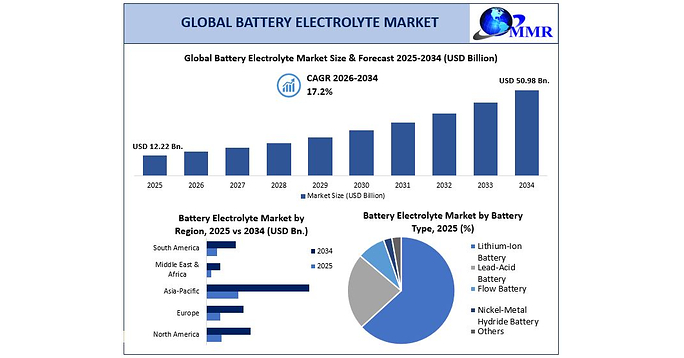
The global battery electrolyte market is projected to grow from $12.22 billion in 2025 to $50.98 billion by 2034, a 17.2% CAGR, driven by EV production, grid-scale storage, and next-generation battery technologies. Global EV battery deployment reached 1.2 TWh in 2025, up nearly 30% year over year, while battery-storage additions totaled 108 GW, with about 80% deployed at utility scale. Solid-state, sulfide, high-voltage, and fast-charging electrolyte formulations are emerging growth areas, although volatile lithium-salt, solvent, and additive costs remain a key margin and supply risk.
Analysis
This is not a near-term earnings catalyst: a third-party market forecast does not establish incremental orders, pricing, or capacity utilization for listed suppliers. The investable implication is narrower—electrolyte localization raises qualification barriers and customer stickiness, favoring scaled specialty-chemical incumbents with regional plants and battery-grade quality systems over commodity solvent suppliers. BASF (BAS.DE), Solvay (SOLB.BR), Arkema (AKE.PA), and Umicore (UMI.BR) have optionality, but electrolyte exposure is too diluted to warrant a directional trade absent disclosed contract wins or segment-margin guidance.
The more material second-order issue is chemistry mix. Stationary storage’s shift toward LFP lowers the value of high-nickel performance additives relative to EV-focused formulations, while sodium-ion and alternative chemistries could constrain lithium-salt intensity per kWh over the 6-18 month horizon. For Solid Power (SLDP), solid-electrolyte commercialization remains a binary scale-up and customer-validation story; broad electrolyte-market growth should not be capitalized into SLDP revenue until qualification milestones translate into funded production commitments. Consensus may overvalue headline market CAGR while underestimating electrolyte price deflation, Chinese supplier overcapacity, and the long qualification cycle required to displace incumbent liquid-electrolyte systems.
Over the next 1-3 months, watch battery-material contract announcements, utilization at North American/European battery plants, and lithium-salt spreads rather than aggregate deployment forecasts. A sustained widening in regional battery-grade salt premiums would support localized suppliers’ pricing power; narrowing spreads alongside weak gigafactory ramps would signal excess capacity and margin pressure. The structural thesis is falsified if OEMs delay solid-state programs, stationary-storage demand migrates materially away from lithium-ion, or specialty suppliers fail to demonstrate pass-through of lithium-salt and solvent volatility.
AllMind Terminal
AI-powered research, real-time alerts, and portfolio analytics for institutional investors.
Request TrialMarket Sentiment
Overall Sentiment
moderately positive
Sentiment Score
0.42
Ticker Sentiment
Key Decisions for Investors
- No new outright position on this release; treat it as a low-impact thematic data point. Require disclosed electrolyte capacity utilization, multi-year customer offtake, or segment guidance revision before underwriting earnings upside in BAS.DE, SOLB.BR, AKE.PA, or UMI.BR.
- Maintain SLDP as a small, catalyst-driven watch position only; consider a long only ahead of independently verified automotive qualification or funded factory commitments within 6-12 months. Exit on a further commercialization-delay disclosure, cash runway deterioration, or evidence that sulfide electrolyte yields cannot scale; binary downside remains materially larger than the signal in this report.
- For 3-6 months, prefer a relative-value basket long BAS.DE/SOLB.BR versus short HUN if European and North American battery localization produces specialty-material pricing resilience. Size modestly: BASF and Solvay have broader portfolio offsets, while Huntsman is more exposed to cyclical industrial demand; close if battery-material margins do not improve at the next two reporting cycles.
- Set an alert on battery-grade lithium-salt regional price spreads and announced North American cell-plant commissioning dates. A narrowing spread plus delayed commissioning is a negative read-through for localized electrolyte investment and argues against adding exposure to European specialty-material names.
More News
- Germany's RAG Foundation could sell entire Evonik stake
- Moderna has been on a tear since mid-August. Citi now sees it plunging 60%
- Why is Moderna stock down 4% today?
- Merck reports positive phase 2 trial results for HS treatment
- South Korea’s exports hit record high on AI boom
- In photos: China's Xi hardens Taiwan warning as country celebrates week-long National Day holiday