
LULU Falls 14.1% in a Month: Can New Growth Levers Help Investors?
Source: zacks.com
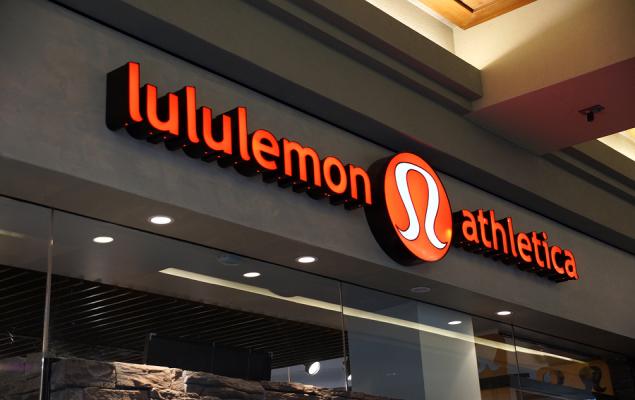
Lululemon's shares fell 14.1% over the past month after fiscal Q2 2026 revenue declined 4% year over year to $2.4 billion and comparable sales fell 9%; Americas revenue and comps dropped 8% and 12%, respectively. The company now expects fiscal 2026 revenue of $10.35-$10.50 billion, down 5-7%, with EPS of $9.48-$9.73 as lower traffic, weak conversion and product misalignment pressure demand. Gross margin rose to 60.5% only because $134.5 million of tariff refunds added 560bps; excluding this benefit, higher tariffs, markdowns and fixed-cost deleverage remained material headwinds, while operating income fell 13% to $453.7 million.
Analysis
The investable issue is not simply weak demand but the collapse in operating leverage: a lower-volume store base, elevated marketing and faster product chasing can turn even a modest sales miss into disproportionate EPS downside. The tariff-related benefit obscures the underlying margin run rate; absent a sustained improvement in full-price sell-through, consensus FY27 earnings likely still embeds too generous a gross-margin recovery. Inventory units being lower reduces liquidation risk, but also means a successful product pivot could create stock-outs and expedite costs rather than immediate margin accretion.
NKE is the relative beneficiary at the margin: LULU's women’s apparel disruption lowers a competitor’s need to discount aggressively in premium activewear, while NKE's scale gives it more freedom to fund brand reinvestment. adidas (ADS) remains a less direct read-through because footwear-led lifestyle demand is the larger driver, but broad athleticwear promotional intensity should remain a sector headwind. The more consequential second-order signal is China: simultaneous brand-sentiment weakness in North America and China challenges the prior thesis that international expansion can diversify a mature domestic base.
The consensus may be too anchored to the low earnings multiple as a floor. A premium apparel brand with negative traffic and an unproven assortment reset can de-rate further if the market reclassifies it from a structural compounder to a fashion-sensitive retailer; the relevant comparison becomes specialty retail rather than its own historical multiple. Conversely, a clean 6-8 week sequence of improving web traffic, new-style sell-through and lower promotional penetration would create a sharp short-covering rally because the balance sheet limits solvency risk and positioning is likely already defensive.
Near-term catalysts are holiday product launch cadence and third-party traffic/search data over the next 1-3 months; the decisive proof point is whether management can stabilize Americas comps without buying demand through markdowns. Falsify the bearish thesis on two consecutive monthly improvements in U.S. traffic/conversion and evidence that gross-margin pressure excluding non-recurring tariff items is contained below roughly 100 bps. A further FY26 EPS guide cut, elevated clearance mix, or China comp deterioration would support another leg down over 3-6 months.
AllMind Terminal
AI-powered research, real-time alerts, and portfolio analytics for institutional investors.
Request TrialMarket Sentiment
Overall Sentiment
strongly negative
Sentiment Score
-0.62
Ticker Sentiment
Key Decisions for Investors
- Maintain an underweight/short LULU into the next earnings and holiday update, preferably expressed as long NKE / short LULU dollar-neutral over a 3-6 month horizon. The pair isolates product-execution and operating-leverage risk; cover the LULU leg if U.S. channel checks show two consecutive months of traffic improvement and reduced promotions.
- Do not buy LULU solely on the forward P/E discount. Establish a recovery watch rather than a position until weekly web traffic, Google Trends, app engagement, and full-price sell-through demonstrate that new silhouettes are incrementally additive rather than cannibalizing core bottoms.
- For defined downside exposure, evaluate LULU put spreads dated just beyond the next earnings release only if implied volatility is below its post-earnings move history; missing data are current IV, skew, and consensus FY27 EPS. Target a 2:1 payoff versus premium, not an outright put purchase after volatility reprices.
- Reduce broad premium-apparel exposure through XRT selectively if promotional data deteriorate into holiday: LULU’s response through higher chase volume raises the probability that suppliers and peers face a more promotional order environment, though this is a secondary—not primary—sector signal.