
Nanoramic Launches Neocarbonix® Slurry Precursor (NXSP™) Standard Product Catalog to Deliver Immediate Cost and Performance Gains for Battery Manufacturers
Source: PR Newswire
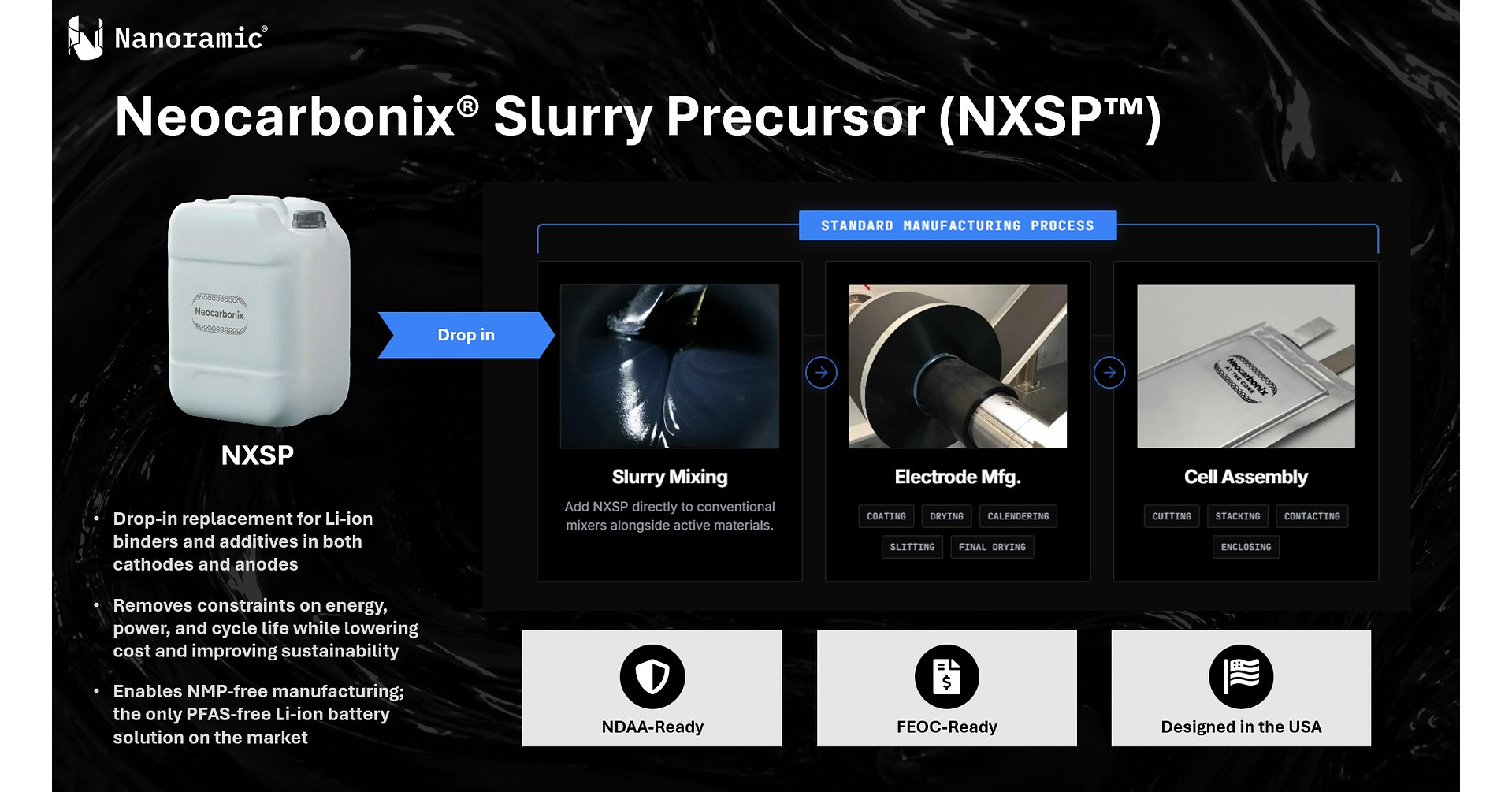
Nanoramic launched a standard catalog of Neocarbonix Slurry Precursor (NXSP) products, a drop-in composite binder intended to lower lithium-ion battery cost per kWh while improving energy density, power density and electrode performance. NXSP is compatible with major cathode chemistries, silicon anodes, sodium-ion and solid-state battery technologies, without requiring changes to existing wet-coating production lines. The company said product standardization and mass-production capacity added earlier in 2026 position it to address broadening demand across EVs, stationary storage and consumer-electronics applications.
Analysis
This is not yet a tradable public-equity catalyst: Nanoramic is private, and the release contains no independently verifiable customer qualification, unit-volume, pricing, yield, or cell-level cycle-life data. The relevant mechanism is nevertheless important: a binder that enables higher electrode loading can reduce inactive-material and coating costs while raising cell-level energy density, but qualification on automotive lines typically takes 12-24 months. Near-term market impact should therefore be limited unless a named cell maker discloses production adoption or independently published performance data.
If validated, the technology pressures incumbent fluoropolymer binder suppliers, particularly Arkema (AKE.PA), Kureha (4023 JP), and Solvay (SOLB BB), more through mix and pricing than aggregate volume: higher-loading electrodes may require less binder per kWh even if battery output grows. The larger second-order beneficiary would be silicon-anode commercialization, where mechanical stability—not theoretical capacity—remains the bottleneck; this is directionally supportive of Amprius (AMPX) and private silicon-anode peers, although AMPX's nanowire architecture is not a direct proxy for a conventional silicon-composite binder.
The contrarian view is that “drop-in” processing claims can obscure material risks at commercial scale: slurry rheology, drying speed, electrode cracking, fast-charge degradation, and recycling compatibility can each erase laboratory cost savings. A meaningful read-through requires disclosed cell-level data showing comparable or improved cycle life at high silicon loading, plus evidence that coating throughput and scrap rates do not deteriorate. Failure to secure a named Tier-1 battery customer or production qualification within 12-18 months would argue that the addressable market remains developmental rather than disruptive.
AllMind Terminal
AI-powered research, real-time alerts, and portfolio analytics for institutional investors.
Request TrialMarket Sentiment
Overall Sentiment
moderately positive
Sentiment Score
0.42
Key Decisions for Investors
- No immediate directional position based solely on this release; treat it as a technology-validation watch item rather than a catalyst for public battery equities.
- Monitor AKE.PA, 4023 JP, and SOLB BB for binder-volume commentary, battery-material pricing pressure, or customer transitions over the next 2-4 quarters. Consider a relative short only after disclosed qualification by a major cell producer; absent that evidence, incumbent replacement risk is too speculative.
- Place AMPX on a 6-18 month thematic watchlist rather than buying on this announcement. Upgrade only if independent data demonstrate durable high-silicon cycling at commercially relevant loading and a named OEM or cell-maker adoption; the thesis is falsified by continued customer delays, cash-burn acceleration, or no production contract.
- For broad battery exposure, avoid extrapolating this claim into long LIT or individual cell manufacturers until adoption is confirmed. The potential benefit accrues unevenly and may initially be captured by the materials supplier rather than battery makers, whose gains could be competed away into lower cell pricing.
More News
- South Korea’s exports hit record high on AI boom
- RAM supply set to worsen, says Micron, as CEO celebrates ‘much higher’ prices
- Tencent leases 100,000 chips from Oracle for $7 bln- FT
- Asia stocks rise on chipmaker gains, soft U.S. inflation; Nikkei outperforms
- Why is Nidec stock plunging today?
- Nidec Corp shares slump after auditor declines to sign off on earnings