
AI’s Grip on Financial Markets Was Never Clearer on the Way Down
Source: Bloomberg
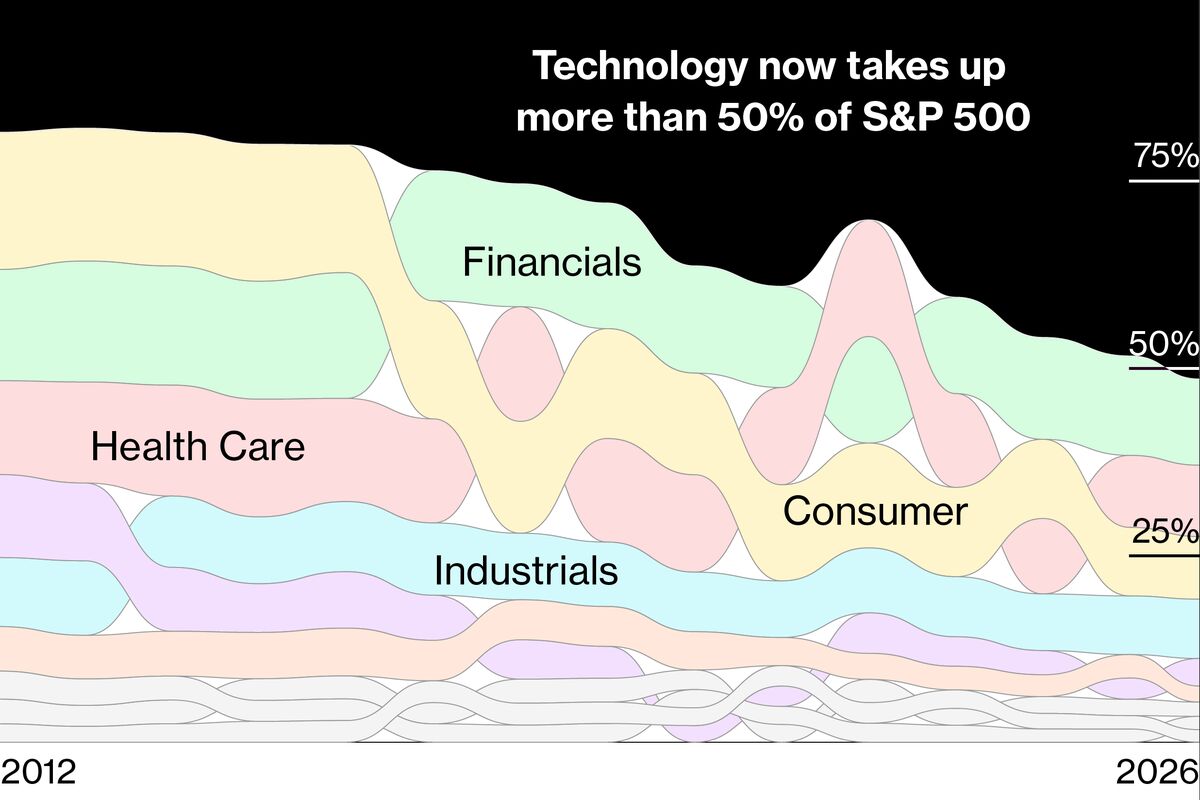
A sudden selloff on Thursday erased $2.3 trillion in stock-market value, exposing the downside risk created by Big Tech’s outsized market weight and pervasive AI investment. The article frames the concentration as a broad-market vulnerability, with routs potentially affecting investors well beyond the technology sector.
Analysis
The key risk is not simply a decline in a handful of AI-linked stocks; it is that index concentration can turn a thematic repricing into a broad portfolio and liquidity event. Cap-weighted benchmarks and passive products transmit losses to investors with little direct AI exposure, while volatility controls and de-risking can amplify selling across otherwise unrelated holdings. That creates a potential relative-value opportunity in breadth, but the article alone does not establish whether AI expectations, earnings, or positioning caused the move.
Over days, avoid chasing an index short after a sharp selloff: crowded hedges can reverse quickly. Over 1–3 months, monitor equal-weight versus cap-weight performance, market breadth, and earnings revisions for the largest AI beneficiaries. Over 6–18 months, the structural question is whether AI spending produces returns sufficient to support the capital intensity; a weaker return-on-investment narrative could pressure both AI leaders and suppliers, while customers may benefit if compute costs fall.
Contrarian angle: concentration is a genuine transmission channel, but a single drawdown does not prove the AI investment cycle is broken. The thesis weakens if breadth improves while large-cap technology earnings expectations hold; it strengthens if leadership narrows further alongside downward revisions. No company-specific conclusion is supportable from the supplied information.
AllMind Terminal
AI-powered research, real-time alerts, and portfolio analytics for institutional investors.
Request TrialMarket Sentiment
Overall Sentiment
moderately negative
Sentiment Score
-0.55
Key Decisions for Investors
- Use a conditional relative-value watch, not an outright bearish call: consider long RSP (S&P 500 equal-weight ETF) versus short SPY (cap-weight S&P 500 ETF) if breadth continues to deteriorate and the relative-performance spread confirms weakness. Define risk at the pair level; exit if cap-weight leadership resumes and breadth stabilizes.
- Do not add broad index shorts solely on this report. Reassess after the next earnings and guidance cycle for major AI-exposed constituents; require evidence of weaker spending returns or estimate cuts before expressing a 1–3 month bearish view.
- Track QQQ versus RSP, advance-decline breadth, and volatility-control or fund-flow indicators over coming sessions. A renewed narrowing of leadership with worsening breadth is an alert for further de-risking; broad participation and stable earnings revisions would falsify the concentration-unwind thesis.
- For a 6–18 month allocation decision, distinguish AI infrastructure suppliers from businesses adopting AI: verify spending plans, realized productivity gains, and returns on invested capital before treating the entire technology complex as one trade.
More News
- Tech stock rout, driven by US AI fears, continues in Asian trading
- Asian Markets Tally Losses From Worsening Global Rout
- Magnificent 7 loses $1 trillion. The most eye-popping stats from Thursday's tech stock plunge
- Wall Street’s best post-midterm rally in 44 years lasted just one day—then $3 trillion vanished as chip stocks plunged over AI fears
- How Wall Street's postelection rally got obliterated — and what's next
- ‘The nail that sticks out gets hammered first’: Elon Musk’s net worth falls $113 billion from Tesla and SpaceX drops